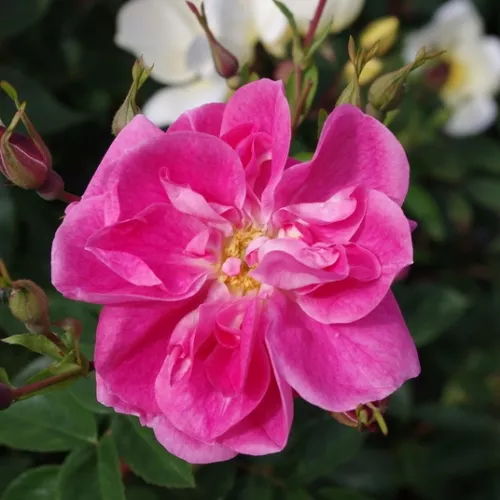
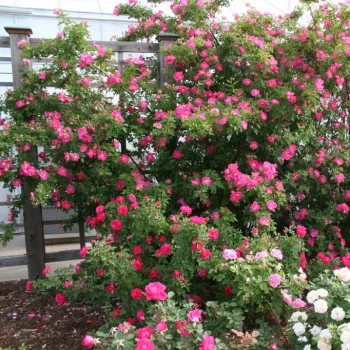
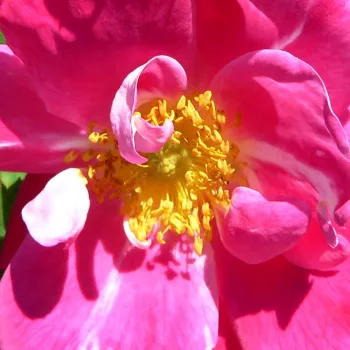
Vibrant deep pink with a purplish tinge, slightly lighter at the base of the petals. - climber, climbing rose - very weak, barely perceptible scented rose - delicate, rose-like character
– Abundant deep pink clusters all summer.
– Vigorous climber for fences and pergolas.
– Glossy dark foliage creates lush coverage.
– Proven hardy to –37 °C, reliable in cold.
– Recognised Earth-Kind North rose performer.
– Special feature: Forms decorative tomato‑orange hips in autumn.
Familiar garden experience – Long-term garden plan
pharmaROSA® ORIGINAL 2-litre own-root potted rose
18,70 £
Unfortunately, we are currently unable to ship to the United Kingdom; we only deliver to countries within the European Union. For more information, please contact us!
5(7110)
WILLIAM BAFFIN – deep pink climbing-rambler rose - Svejda
This vigorous own-root climber brings reliable colour and structure to family gardens with minimal fuss, forming a dense wall of glossy foliage and deep pink blooms that cope well with exposed British sites and coastal weather conditions. Its semi-double clusters flower generously in early summer, followed by a plentiful second flush that keeps arches, fences and pergolas in bloom when many shrubs are fading, while good self-cleaning helps the plant stay neat without constant deadheading. As an own-root rose it builds a naturally balanced framework over time, offering long-lived, regenerative stability without the worry of graft incompatibility, and it settles well into heavier soils when planted with basic attention to drainage. In year one it concentrates on root formation, in year two you see strong new canes and shaping potential, and by year three the full display of height, flower and foliage impact is usually achieved. Its H7 hardiness rating and proven Canadian background provide reassuring winter resilience, while Earth-Kind recognition and ARS awards confirm dependable performance in ordinary gardens. Medium maintenance needs and suitability for partial shade make it a practical choice for busy households who still want a lush, romantic screen of roses around the home.
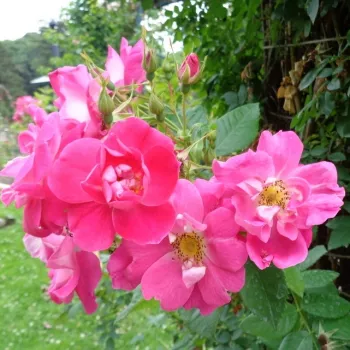
William Baffin climbing rose in full bloom.
William Baffin flowers shown in different opening phases.
Close-up of the very light, rose-like fragrance of William Baffin.
Usage options
Target area
Reasoning
Front-garden focal pergola
Use it to cover a modest pergola or arch near the front door where you want height, impact and a welcoming flower show without intricate pruning knowledge; its vigorous climbing habit and generous clusters quickly create a strong vertical accent, ideal for a beginner.
Flowering house wall or fence
Trained along wires or trellis, it forms a dense curtain of glossy dark foliage and deep pink blooms that soften brick, timber or render, while good self-cleaning reduces the time you spend tidying spent flowers, suiting the needs of a time-pressed homeowner.
Long-term boundary screen
Planted at the recommended spacing along a boundary, it develops into a substantial, long-lived line of growth with reliable flowering, giving privacy and structure year after year as its own-root system regenerates naturally, appealing to the long-range plans of a thoughtful planner.
Mixed cottage-style border backdrop
Behind perennials and smaller shrubs, its medium-sized, repeatedly flowering clusters add romantic deep pink notes that blend well with cottage favourites, while its remontant second flush keeps colour going into late summer, suiting an aesthetically minded garden enthusiast.
Partially shaded side return
Along a side path or north-east facing fence, it will still flower reliably in partial shade, giving life to trickier aspects where many roses underperform, so you can achieve a cohesive look even in awkward spaces as a practical urban gardener.
Exposed or coastal position
Its robust hybrid kordesii background, dense foliage and proven hardiness help it cope with cooler winds and unsettled seasons, supporting dependable growth even in breezier British plots where a durable framework is valued by a coastal-region owner.
Large container by terrace (40–60 L)
When grown in a substantial 40–60 litre container with sturdy support, it offers climbing height and colour on patios or roof terraces, while medium maintenance needs mean that basic watering and feeding routines are usually enough for a satisfying result for a busy city-dweller.
Low-intervention family seating area
A single plant trained over a bench or garden seat delivers shade, colour and a sense of enclosure, and thanks to its awards for robust garden performance it provides reassurance that, with simple pruning and watering, it will reward an informal family user.
Styling ideas
Cottage-arch – Train it over a simple wooden arch and underplant with Campanula glomerata and catmint for a soft, traditional cottage entrance – ideal for lovers of classic British front gardens.
Rosy-screen – Use along a trellis boundary with Prunus laurocerasus 'Miki' behind for evergreen depth and year-round privacy – suitable for homeowners wanting a lasting, low-fuss screen.
Pink-ribbon – Run it in a gentle curve along wires on a sunny wall, interspersed with white Liatris spicata 'Alba' at the base – perfect for design-conscious gardeners seeking strong colour contrast.
Family-nook – Create a sheltered reading corner by spanning canes over a bench, letting stems arch overhead with light underplanting of hardy geraniums – good for families wanting a cosy, easy-care retreat.
Terrace-frame – In a 50-litre container, let it climb a slim obelisk beside outdoor seating, with seasonal herbs around the base – well suited to busy urban gardeners with limited ground space.
Technical cultivar profile
Parameter
Data
Name and registration
William Baffin climbing rose, hybrid kordesii group; ARS approved exhibition name William Baffin; part of the climbing rose collection for garden and landscape use.
Origin and breeding
Bred by Felicitas Svejda at Agriculture and Agri-Food Canada, Ottawa; cross of ‘Kordesii’ × (‘Red Dawn’ × ‘Suzanne’); bred 1974 and introduced commercially in 1983.
Awards and recognition
Holds Earth-Kind North designation from Texas A&M University (2007) and multiple ARS Classic Shrub Rose awards from American rose shows between 1999 and 2001.
Growth and structural characteristics
Vigorous climbing habit with dense, dark green glossy foliage; height about 240–400 cm and spread 140–240 cm; densely thorned canes provide firm coverage on supports.
Flower morphology
Semi-double, flat flowers with 13–25 petals carried in clusters; medium bloom size around 1.5–2.75 inches; remontant with a notably plentiful second flush after the main flowering.
Colour data and phenology
Deep pink with purplish tones, slightly lighter at petal base; RHS 57A–57B; good colour retention, lightening a little in strong sun and remaining especially vivid in cooler weather.
Fragrance and aroma
Delicate, rose-like scent of very weak intensity, often barely perceptible; flowers offer moderate value for pollinators because semi-double form partly conceals stamens and nectar.
Hip characteristics
Produces moderate numbers of small ovoid hips, around 6–11 mm in diameter, coloured tomato-orange; adds autumn interest without overwhelming the plant’s overall appearance.
Resistance and winter hardiness
Very hardy to about −37 to −34 °C (RHS H7, USDA zone 3b); disease resistance medium overall with good black spot resistance, but moderate susceptibility to mildew and rust.
Horticultural recommendations
Best on supports such as fences, pergolas and arches; medium maintenance with occasional plant protection; suitable for partial shade; allow around 145–300 cm spacing depending on use.
William Baffin climbing rose Svejda offers vigorous height, generous repeat flowering and reliable hardiness on a durable own-root framework that matures steadily, making it a sensible, long-term choice for your garden.
Detailed product attributes
Product Identification Data
Product Name:
WILLIAM BAFFIN – deep pink climbing-rambler rose - Svejda
Product Type:
pharmaROSA® ORIGINAL - 2-litre own-root potted rose
Meaning of Cultivar Name:
The name refers to the English explorer William Baffin, who was the first European to describe Baffin Bay, which is named after him.
Competition and Show Awards:
Earth-Kind North certification (Texas A&M University, 2007); ARS Classic Shrub Rose awards (1999, 2000, 2001 at several American rose shows)
Pollinator Attraction:
Semi-double flowers with 13–25 petals moderately attract pollinators because the semi‑double form partially conceals the stamens, reducing their accessibility and thus the flower’s attractiveness.
Pollinator-Friendly Rating:
Due to its semi-double flowers it is considered partially pollinator-friendly.
Our product is a rose grown with pharmaROSA®’s unique cultivation technology!
2-litre, own-root, potted rose.
With a shoot system appropriate to the season.
With a root system that thoroughly permeates the growing medium.
Quality compliant with the requirements of the E.N.A. (European Nurserystock Association).
Supplied in unique packaging that prevents damage.
Can be planted during frost-free periods.
True-to-variety rose bush with a unique identifier.
The pharmaROSA® own-root potted rose is a well-rooted plant that supports reliable establishment when planted and cared for properly, so it can be planted whenever the soil is not frozen.
Crop overview: several varieties and growth stages in a short crop section.Shoot system: intensive growth of fresh basal shoots on a young plant.Root system: demonstration of a vigorous root system permeating the growing medium, by removing the pot.Balance: mature plant with root system and shoots in harmony with each other.
Information about the videos
The video series is not a “seasonal showcase”; it illustrates the essence of pharmaROSA® own-root cultivation in a tangible way: how the plant is built up, what the root system is like and how the shoot system regenerates. The recordings were therefore made at different times and with plants at various stages of development, so mixed foliage levels and differing stages of growth may appear in the videos. They are not a ‘sample’ of the batch dispatched, but a visual explanation of how the technology works. The current condition of the rose available to order — typical for the given period and similar to what you can expect to receive in the parcel — is shown in the upper part of the product page.
Pages for private customers Garden roses for the family garden, with minimal care → ORIGINAL® Premium garden roses – instant impact, a truly showpiece garden → EXTRA® Pages for professionals and private customers Roses for public spaces – large areas, sustainable maintenance → NATURAL® Roses for projects – hedge and row planting, fast implementation → RAPID® For professional partners only Production – propagation material for garden roses, wholesale → NEONATAL®
Company details
PharmaRosa Ltd. Company registration number: 01-09-717479 VAT number: 13075314-2-43 Plant health registration no.: HU130721 Bank account (IBAN): HU85117631891388688400000000 BIC (SWIFT): OTPVHUHB Bank name: OTP Bank Nyrt.