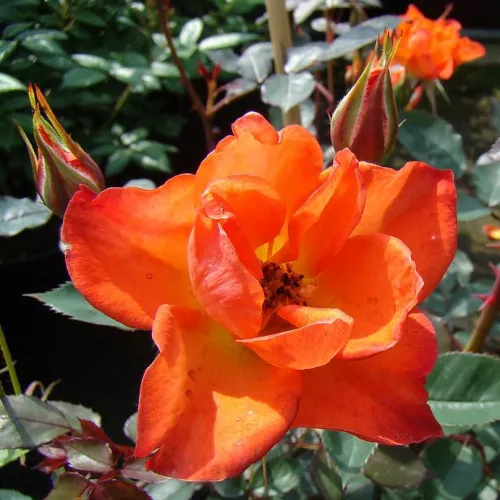
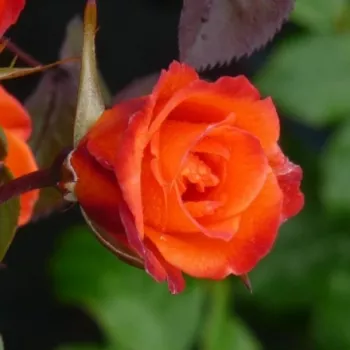
WARM WELCOME – orange climbing rose – Warner
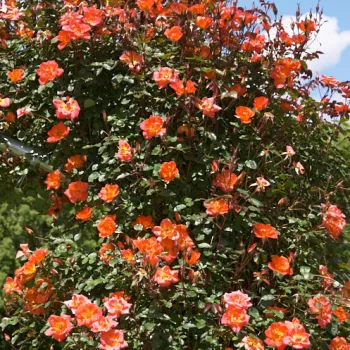
This compact climber is designed for easy success in real family gardens, offering manageable growth, reliable remontant blooming and a naturally tidy habit that suits walls, arches and entrances. Its vivid orange flowers with a warm golden undertone light up smaller spaces without overwhelming them, while the semi-double form and medium self-cleaning keep the display looking fresh with modest deadheading. On its own roots it settles in steadily and builds a durable framework for long-term longevity, adapting well even where heavy soils need thoughtful drainage in wetter British winters. With sensible watering and a simple, once-a-year prune, you can let it root in during year one, build its climbing framework in year two and by year three enjoy the full ornamental effect along your chosen support.
Usage options
| Target area |
Reasoning |
| House wall or sunny fence |
Medium-height canes (around 1.7–2.8 m) make it easy to cover a modest wall or garden fence without creating an unmanageable tangle, and its repeat flowering keeps colour at eye level for months on end; ideal for the time-pressed homeowner. |
| Front-garden entrance or porch |
The bright orange and golden tones create an immediate sense of welcome around a doorway, while the compact spread makes it suitable for typical British front gardens where space is tight but impact matters; perfect for aesthetically minded beginners. |
| Small pergola, arch or arbour |
Its moderate height and flexible climbing shoots are well suited to training over a light pergola or metal arch, building a graceful framework over two to three seasons that does not demand complex pruning; reassuring for the occasional gardener. |
| Feature column or obelisk in a border |
The slim spread and clustered flowers work well when spiralled around a post or obelisk, giving vertical colour without stealing light from neighbouring plants and fitting neatly into cottage-style mixed borders; attractive for colour-focused designers. |
| Large container on patio or terrace |
Own-root plants adapt well to big pots of at least 40–50 litres, where regular watering and feeding will reward you with a long flowering season and a controllable climber for rented or paved spaces; convenient for balcony and patio owners. |
| Small group planting along a boundary |
Planted at 55–65 cm intervals, it forms a loose, flowering screen whose moderate density and dark green foliage give structure for many years, especially once the own-root framework has matured; suited to long-term-minded planners. |
| Mixed cottage-style bed with perennials |
The warm orange blends beautifully with blues and creams, pairing well with plants like daylilies or agapanthus, while its remontant flowering keeps the border lively through summer with only light trimming; appealing to cottage-garden enthusiasts. |
| Partially shaded side passage or courtyard |
Its tolerance of partial shade and good structural hardiness make it reliable in cooler, more enclosed spots where wind and rain are channelled along paths, remaining stable once established in heavier soils with adequate drainage; reassuring for cautious starters. |
Styling ideas
- Porch-frame glow – Train along a simple trellis around the front door, underplant with white geraniums to highlight the orange blooms – ideal for style-conscious homeowners.
- Cottage arch – Let it climb an arch and pair with soft blue nepeta and cream foxgloves to create a relaxed, traditional entrance – perfect for cottage-garden enthusiasts.
- Patio column – Grow in a 50-litre container with an obelisk, adding trailing thyme at the base for scent and ground cover – suitable for small-plot urban gardeners.
- Warm boundary – Plant a short run along a fence with daylilies and dwarf pines for season-round structure and colour – appealing to low-maintenance planners.
- Court-yard duo – Use two plants either side of a gate or path, weaving shoots horizontally for a soft, welcoming screen – attractive for entrance-focused designers.
Technical cultivar profile
| Trait |
Data |
| Name and registration |
Warm Welcome (CHEWizz), exhibition climbing rose in the Climbing rose collection; ARS exhibition name Warm Welcome, mini-climber type used as a compact garden climber. |
| Origin and breeding |
Bred by Christopher H. Warner in the United Kingdom (1986), from complex parentage including Elizabeth of Glamis and Galway Bay lines; introduced by Whartons Nurseries in 1990. |
| Awards and recognition |
Holds the RHS Award of Garden Merit since 1993 and multiple New Zealand rose trial honours, including Best Climber and novelty awards, confirming strong, proven garden performance. |
| Growth and structural characteristics |
Medium climber, typically 1.7–2.8 m high with a 70–110 cm spread; moderately thorny, with slightly glossy, dark green foliage and a manageable, well-branched climbing habit. |
| Flower morphology |
Semi-double blooms, 13–25 petals, small flower size in clustered trusses on the canes; remontant with abundant second flush, especially when light deadheading is carried out regularly. |
| Colour data and phenology |
Vibrant warm orange with golden undertones (RHS 28A outer, 24A inner); opens fiery, then softens to peach-orange while holding the main tone; clusters repeat from early summer to autumn. |
| Fragrance and aroma |
Mild, fresh fruity scent that does not overpower nearby seating areas; semi-double form offers only limited pollen access, so it is modestly attractive to pollinating insects. |
| Hip characteristics |
Produces small numbers of ellipsoid orange-red hips, 8–12 mm in diameter; decorative late in the season if not deadheaded too thoroughly, adding a subtle autumn accent. |
| Resistance and winter hardiness |
Hardy to about −18 to −21 °C (RHS H7, USDA 6b, Swedish zone 3); disease resistance is moderate to the main rose diseases, benefiting from basic protection in humid seasons. |
| Horticultural recommendations |
Suited to walls, fences, pergolas, arbours, columns and large containers; prefers sun or partial shade, regular watering in drought, and annual pruning to renew flowering stems. |
Warm Welcome Climbing rose CHEWizz offers compact height, generous repeat flowering and long-lived own-root reliability, making it an excellent choice for a colourful, easy-care vertical feature you can enjoy for many seasons.