VIOLET HOOD – violet-purple park rose - Lens
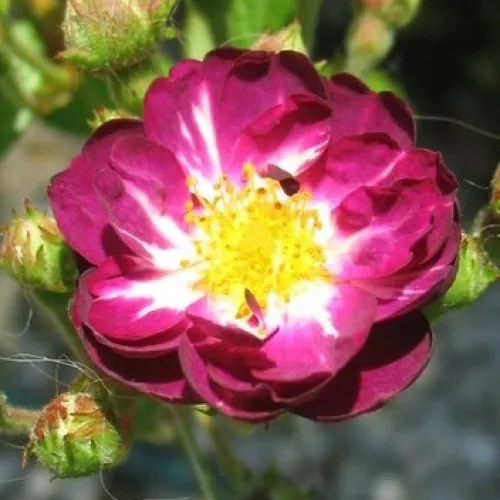
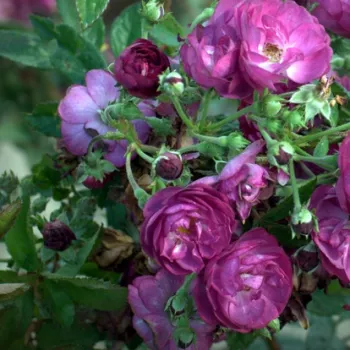
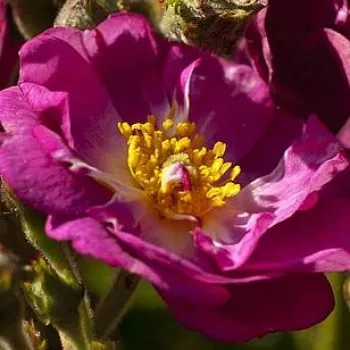
Effortless planting meets reliable colour with Violet Hood, a compact shrub that settles quickly into typical British front gardens and cottage-style borders. Its semi-double blooms open from near-black buds to rich violet-purple, then soften to mauve, keeping a orderly look as clusters repeat through summer and into autumn. As an own-root, 2-litre plant it anchors itself well, adapting steadily even where soils are heavy and drainage needs a little attention. Over time the bush forms a balanced, moderately dense framework that suits neat hedges, small groups or a single specimen by the path. You can expect an appealing development arc: strong roots in the first year, confident shoots in the second, then full ornamental value by the third, when flower clusters, dark foliage and red hips combine to create a quietly lasting feature for your family garden.
Usage options
| Target area | Reasoning |
|---|
| Front-garden focal shrub |
The compact 90–140 cm height and 50–80 cm spread make Violet Hood ideal beside gates, paths or bay windows, giving a defined focal point without overwhelming a small front garden; it suits those wanting attractive structure with minimal complexity for the beginner. |
| Low flowering hedge |
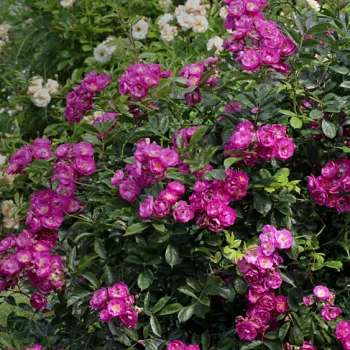
Planted 50 cm apart, the moderately thorny, branching habit knits into a low, informal hedge that flowers repeatedly and then carries red hips, giving a soft boundary along drives or front paths that remains manageable with light annual pruning for the homeowner. |
| Small mixed border groups |
In groups of 3–5 plants at about 60 cm spacing, the clustered purple blooms create a strong colour block that partners well with perennials and ornamental grasses, suiting classic cottage-style borders where you want reliable repetition without intricate planting schemes for the stylist. |
| Cottage-style rose and grass combinations |
The semi-double, violet clusters contrast beautifully with airy grasses and compact shrubs, echoing traditional British cottage gardens while remaining compact and tidy, helpful where you need the rose to “sit well” among existing plants for the aesthetic. |
| Feature shrub in large containers |
In a 40–50 litre or larger container, Violet Hood forms a balanced, compact shrub whose repeat flowering and dark foliage dress patios, roof terraces or small courtyards, providing long-season colour without demanding complex maintenance from the urbanite. |
| Seasonal colour with autumn interest |
The flowering repeats well after the first flush, and spent flowers can develop many small, spherical red hips, extending interest well into autumn and supporting a more natural, gently changing garden picture for the observer. |
| Family garden borders with moderate care |
Medium disease resistance and sturdy shrub structure offer dependable performance in everyday family gardens; with simple watering and occasional checks for common problems, it copes well even where wind and rain are frequent near exposed coasts for the busy. |
| Long-term structure in established beds |
As an own-root shrub, Violet Hood gradually forms its permanent framework in situ, rebuilding from the base if pruned harder and providing stable, long-lived structure that integrates steadily into established planting schemes for the planner. |
Styling ideas
- Cottage Harmony – Combine Violet Hood with lavender, catmint and soft pink perennials for a classic cottage feel that stays compact and welcoming – ideal for lovers of traditional front gardens.
- Violet Ribbon – Plant a low hedge along a drive or path, underplanting with groundcover geraniums to soften the base and highlight the purple clusters – suited to homeowners wanting a gentle boundary.
- Patio Accent – Grow a single shrub in a 50 litre pot with trailing thyme or white alyssum spilling over the rim, creating long-season colour in tight spaces – perfect for balcony and patio gardeners.
- Grasses Contrast – Pair with fountain grass or compact New Zealand flax to set the velvety purple blooms against fine or architectural foliage – for design-conscious gardeners seeking simple drama.
- Autumn Echo – Let spent blooms form hips, then echo their red tones with sedums and bronzed foliage shrubs nearby for a gentle late-season display – appealing to those who enjoy subtle, evolving colour.
Technical cultivar profile
| Parameter | Data |
|---|
| Name and registration |
Violet Hood is a shrub, Hybrid Musk park rose in the Park - shrub rose group, listed as a verified cultivar with premium bronze quality rating for garden use. |
| Origin and breeding |
Bred by Louis Lens in Belgium from ‘Robin Hood’ × ‘Baby Faurax’, introduced and registered in 1975 by Lens Roses, combining musk shrub character with violet-toned cluster flowering. |
| Awards and recognition |
Recipient of a Silver Medal at the Kortrijk International Rose Exhibition in 1978, acknowledging its ornamental value and performance among contemporary shrub and park roses. |
| Growth and structural characteristics |
Compact shrub reaching about 90–140 cm high and 50–80 cm wide, with moderately dense, slightly glossy dark green foliage showing a brownish tinge and a moderately thorny framework. |
| Flower morphology |
Semi-double, flat flowers with 13–25 petals are produced in clusters of small blooms, repeating well through the season so that the second flush is also notably abundant in normal summers. |
| Colour data and phenology |
Flowers open from deep, almost black-purple buds to intense lavender purple (RHS 79A–79B), then fade evenly to matte mauve with lighter edges and a brownish-mauve, crimson-tinged tone before dropping. |
| Fragrance and aroma |
No noticeable fragrance has been recorded; the variety is classed as scentless, though semi-double blooms offer moderate stamen accessibility and are considered only moderately attractive to pollinators. |
| Hip characteristics |
After flowering, the bases can develop into numerous small, spherical red hips around 6–10 mm across, giving additional ornamental interest in autumn and hinting at the rose’s Hybrid Musk background. |
| Resistance and winter hardiness |
Rated H7 with approximate hardiness between −21 and −18 °C, showing medium resistance to mildew and black spot, good rust resistance, and generally reliable performance in USDA zone 6b conditions. |
| Horticultural recommendations |
Best in a sunny position for borders, hedges, specimens or large containers, with medium maintenance needs including occasional pest and disease control and light pruning to maintain shape and flowering. |
Violet Hood offers compact structure, repeat violet-purple flowering and autumn hips, and as an own-root shrub it establishes into a long-lived, dependable feature; a thoughtful choice if you want lasting colour with manageable care.