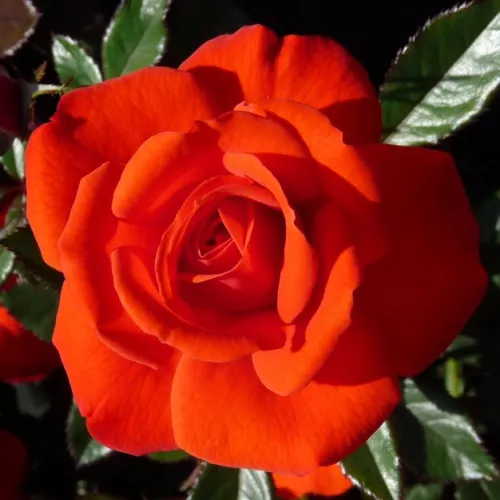
TOP HIT® – orange dwarf-mini rose – POUltop
Compact and tidy, TOP HIT® PatioHit® POUltop is a dwarf miniature rose that brings colour right to the front of the garden without taking over your space, ideal for edging, pots and low borders that must stay neat in everyday family life and cope well with blustery, damp British weather in smaller plots. Its bushy, well-shaped habit is naturally orderly, so you can enjoy a clean outline and clusters of fiery orange blooms without complicated pruning or constant deadheading. The plant repeats flowering generously, with self-cleaning blooms that drop away on their own to keep the plant looking fresh and reduce maintenance to a few seasonal checks. As an own-root rose it establishes steadily and then ages gracefully, building a durable little shrub that recovers well after trimming or winter, following a natural rhythm of stronger roots in the first year, fuller top growth in the second, and confident ornamental presence by the third in a typical family garden.
Usage options
| Target area |
Reasoning |
| Front-garden edging along paths or drives |
The naturally low, bushy habit keeps lines crisp along paths without blocking access or visibility. Plants stay compact, so you can space them regularly and achieve an even, formal edging with minimal shaping beyond an annual tidy. This is especially helpful where you want a smart welcome but do not have time or confidence for complex pruning, making it ideal for the design-conscious beginner homeowner. |
| Small patio containers and balcony tubs |
The modest height and spread suit containers where space is tight but you still want strong colour close to seating areas. In a 40–50 litre pot it forms a stable, rounded shrub that does not outgrow the container quickly, allowing you to underplant or mix with low perennials. Occasional feeding and watering are usually enough for steady performance, so care fits easily around busy urban life gardener. |
| Miniature rose beds in compact family gardens |
TOP HIT® gives vivid orange clusters on a uniform, dwarf framework, perfect for low beds that need to look organised rather than sprawling. Plants can be set on a simple grid, and because they keep their shape well you avoid constant clipping to hold a defined outline. Over time the own-root structure supports a long-lived, reliable bed that can be refreshed by light cutting back rather than frequent replacement beginner. |
| Cottage-style borders mixed with perennials |
The bright orange tones sit well with blues and silvers, echoing classic cottage mixes while remaining compact at the front of a border. Its repeat flowering provides splashes of colour between perennial peaks without overwhelming nearby plants. Once settled, it returns reliably each year, helping you maintain a long-lasting composition rather than replanting gaps every season, particularly appealing for time-poor but style-conscious owners. |
| Mass planting for low, colourful groundcover |
Used in groups at the recommended spacing, this rose forms a continuous, low shrub layer that suppresses visual emptiness and brings strong colour. The self-cleaning flowers help the area look tidy without constant deadheading across many plants. Over the longer term, own-root resilience supports a durable groundcover solution rather than a planting that thins quickly and demands wholesale renewal, suiting cost- and effort-aware garden planners. |
| Foundation planting near entrances and terraces |
Its compact stature sits neatly below windows and along terraces, so you gain brightness against brick or render without shading light or views. The shrub’s stable framework copes well with breezy corners and changeable moisture around downpipes, remaining structurally steady once rooted. With only moderate maintenance needs, it offers a dependable, welcoming accent by doors and sitting areas for those who prefer simple, robust choices householders. |
| Children’s or family areas needing safe, low structure |
Although moderately thorny, the dwarf habit keeps most growth below eye level, making it easier to site thoughtfully near play lawns or family seating. The plant’s ordered, rounded form reads clearly as a small shrub, helping to define spaces without sharp hedging. The limited height also makes routine checks for pests or pruning straightforward for less experienced carers, supporting confident involvement from all family members. |
| Low, colour-focused displays in windy or exposed spots |
The tight, compact growth helps the plant stay anchored and less wind-rocked in modestly exposed gardens, supporting a stable outline even where taller roses struggle. Clusters of orange blooms give strong impact from a distance, useful where beds are viewed from windows or across a lawn. Once rooted, the shrub copes reliably with blustery conditions and variable showers typical of many British sites, reassuring less confident rose buyers. |
Styling ideas
- Front-border ribbon – Plant a single, close-spaced line along the front of a bed to create a crisp orange ribbon that frames mixed perennials – ideal for owners wanting a neat, colourful edge without intricate shaping.
- Patio focal pot – Use one plant in a 50 litre terracotta container with trailing thyme or ivy at the rim for a compact yet eye-catching feature – suited to balcony and terrace gardeners seeking bold colour in small spaces.
- Cottage contrast – Combine with lavender and silver-foliage perennials to offset the fiery flowers against cool tones – perfect for cottage-garden enthusiasts who favour classic mixes but easy-care, low shrubs.
- Low colour block – Arrange in a simple rectangular bed at recommended density to form a uniform carpet of orange – for practical homeowners who prefer structured, long-lived planting over seasonal bedding.
- Pathway accents – Place short groups of three on either side of a garden path to punctuate the route with repeated colour – ideal for beginners wanting a straightforward way to link different parts of the garden visually.
Technical cultivar profile
| Property |
Data |
| Name and registration |
Miniature dwarf rose, registered as POUltop, marketed as TOP HIT® PatioHit® POUltop; also shown under the exhibition name Carrot Top in specialist miniature rose and show contexts. |
| Origin and breeding |
Bred in Denmark in 1991 by L. Pernille and Mogens Nyegaard Olesen from unnamed seedlings; introduced by Poulsen Roser A/S in 1996 and distributed internationally, including by Weeks in the United States. |
| Growth and structural characteristics |
Compact, bushy shrub reaching about 45–55 cm in height and 35–45 cm in spread, with medium-density dark green foliage and moderate prickles; naturally rounded habit suits edging, bedding and container use. |
| Flower morphology |
Semi-double, cup to chalice-shaped blooms with around 13–25 petals carried in clusters; small-flowered (approximately 0.5–1.5 inches) with good repeat, including an especially abundant second flush in suitable conditions. |
| Colour data and phenology |
Radiant orange blooms with a fiery red-tinged outer edge; buds dark burgundy-orange; colour lightens through pastel orange towards peach as flowers age; ARS code ob, RHS 30A outer, 30B inner, moderately stable before fading. |
| Fragrance and aroma |
Fragrance very weak and barely perceptible, so it is chosen more for its colour effect and compact structure than for scent; semi-double form offers limited but not absent attraction for visiting pollinating insects in the garden. |
| Hip characteristics |
Rose hips form only occasionally because of the semi-double structure; where present they are small, spherical, red hips about 5–7 mm in diameter, contributing minor seasonal interest rather than a major ornamental feature. |
| Resistance and winter hardiness |
Rated H7 with approximate hardiness between –21 and –18 °C, broadly matching USDA zone 6b; disease resistance is medium to main rose diseases such as black spot, mildew and rust, needing routine but not intensive monitoring. |
| Horticultural recommendations |
Best at 25–45 cm spacing depending on use, allowing 13–15 plants per m² for massing; moderate maintenance, occasional pest and disease checks, and regular feeding and watering support long-term, reliable performance. |
TOP HIT® PatioHit® POUltop offers compact habit, vivid repeat flowering and a tidy, self-renewing shrub on its own roots, making it a practical, long-lived choice for those planning an easy, colourful garden accent.