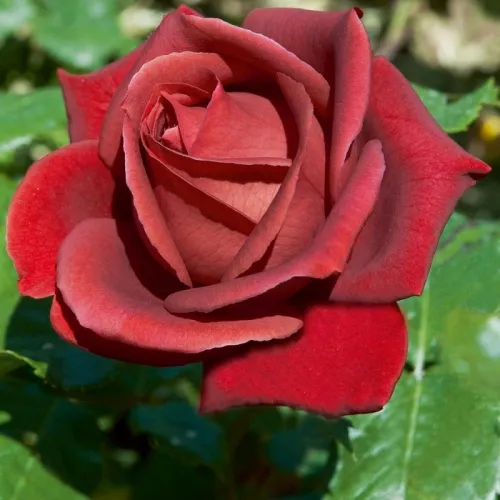
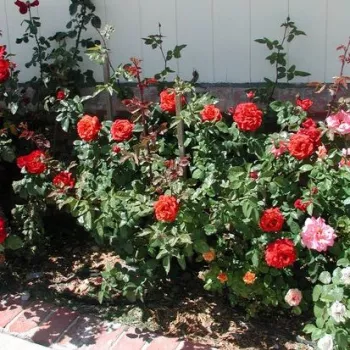
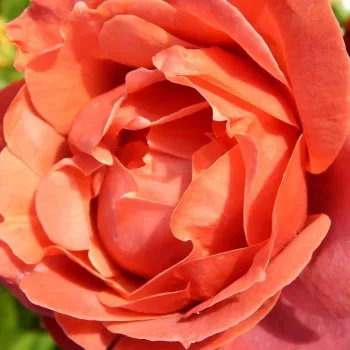
Warm, reddish-brown shade with orange-leaning tones and a silky texture. - hybrid tea rose - very weak, barely noticeable scented rose - scent description not available
– Striking brick-red Hybrid Tea blooms
– Extra-large, double flowers for showy displays
– Reliable repeat flowering through the season
– Upright, bushy habit with dense dark foliage
– Sparsely thorned stems, easier to handle
– Special feature: Award-winning cut flower with unique fired-clay colouring.
Unfortunately, we are currently unable to ship to the United Kingdom; we only deliver to countries within the European Union. For more information, please contact us!
4(6070)
TERRACOTTA® – brick-red tea-hybrid rose - Simpson
Terracotta brings a warm, brick-red focal point to classic British front gardens, its large, cup-shaped blooms ideal for both borders and cutting for the vase. This upright, bushy hybrid tea forms a well-filled, sparsely thorned framework that is easy to handle in smaller spaces and along paths. In typical UK conditions it appreciates regular watering, coping well with breezier sites and heavier soils when you ensure good drainage in wetter spells. As an own-root rose, it establishes steadily, offering a reassuring lifespan with reliable regrowth from the base if pruned harder or after tougher winters. Medium maintenance needs mean you can keep the plant in good shape with a simple annual prune and occasional disease checks, rather than specialist routines. Its remontant nature rewards consistent care with repeat flowering, providing waves of XL, brick-red blooms from summer well into autumn. The large, long-stemmed flowers lend themselves beautifully to cutting, so a pair of shrubs near the house can supply indoor arrangements for much of the season. In the first year the plant concentrates on roots, the second on stronger shoots, and by the third season it achieves its full ornamental value and stable presence in the garden. Whether planted singly as a specimen or in a small group, it settles into family gardens as a dependable, characterful rose.
Closed bud of Terracotta®, showing the dark reddish-brown outer petals and deep orange-brown interior.
Usage options
Target area
Reasoning
Front-garden specimen near the entrance
The warm brick-red blooms and upright habit make an immediate visual statement beside a front door or path, while the own-root form builds a durable, well-balanced framework over the years – ideal for newcomers wanting character without complex training, especially beginners.
Small mixed border in a family garden
Its medium height and bushy structure fit neatly into a mixed border with perennials and grasses, providing repeat colour without overwhelming nearby plants and needing only basic annual pruning and feeding, which suits busy-owners.
Dedicated rose bed of 3–5 plants
Planting several bushes together at the recommended spacing creates a unified block of colour with remontant flowering, and the own-root base supports a long-lived stand that can be refreshed by simple hard pruning if needed, reassuring long-term-planners.
Cutting corner for home arrangements
The XL, solitary, long-stemmed flowers are ideal for cutting, and regular harvesting encourages further blooms, allowing you to enjoy colour both in the garden and indoors with only modest care, a pleasure for home-florists.
Container on patio or roof terrace
In a 40–50 litre container with good compost and steady watering, its upright, moderately vigorous growth is easy to manage, giving strong seasonal impact in tight urban spaces while remaining within the reach of city-gardeners.
Low, informal hedge or boundary line
Planted at hedge spacing, the dense foliage and repeat-flowering habit form a semi-formal line that softens paths or drive edges; occasional disease checks and pruning keep it tidy without specialist skills, appealing to practical-owners.
Part-shade cottage-style bed
Its tolerance of partial shade allows planting alongside traditional cottage plants where sun is filtered, and the warm tones blend well with soft pastels, while moderate disease resistance remains manageable for casual-gardeners.
Coastal or wind-exposed suburban garden
The sturdy, upright framework and dense foliage cope well with typical suburban breezes when combined with well-drained soil, giving reliable flowering without elaborate shelter, which offers peace of mind to coastal-owners.
Styling ideas
Clay-Toned Focus – Use TERRACOTTA® as a single focal shrub framed by soft ornamental grasses, letting the brick-red flowers echo terracotta pots and paths – ideal for design-conscious homeowners.
Cottage Trio – Plant 3 roses in a loose triangle with low Gypsophila and pastel perennials for a relaxed, cottage-style front bed – perfect for romantically minded beginners.
Cutting Row – Arrange a short row along a sunny fence, underplanted with neat edging plants, to harvest tall stems through summer – suited to home florists and allotment growers.
Patio Statement – Grow one plant in a 40–50 litre clay-look container with trailing herbs to soften the rim, placing it by seating for close-up enjoyment – great for small-plot urban gardeners.
Warm Hedge Line – Create a low boundary hedge with evenly spaced plants, backed by evergreen shrubs to highlight the changing flower tones – appealing to those seeking a tidy, structured look.
Technical cultivar profile
Parameter
Data
Name and registration
Hybrid tea rose, registered as SIMchoca, marketed as Terracotta® Hybrid tea rose SIMchoca; ARS exhibition name Terracotta; part of the hybrid tea commercial group for garden and cutting use.
Origin and breeding
Bred by Nola M. Simpson from ‘Princesse’ × ‘Hot Chocolate’, introduced and first distributed by Meilland Richardier (France) in 2001, combining modern flower form with an unusual brick-red colour range.
Awards and recognition
Awarded New Zealand Silver Star in 2001 and a Gold Medal at Durbanville in 2006, reflecting its ornamental value and performance under trial conditions in different international test gardens.
Growth and structural characteristics
Upright, bushy shrub reaching about 90–125 cm in height and 60–85 cm spread, with dense, matte, dark green foliage and relatively sparse prickles, forming a manageable framework in medium-sized gardens.
Flower morphology
Large XL, double, cup-shaped hybrid tea blooms with 26–39 petals, produced mainly singly on stems; remontant with plentiful second flowering, well suited to cutting while maintaining garden presence.
Colour data and phenology
Brick-red to warm reddish-brown with orange tones; buds open rust-brown, deepening in cooler weather and lightening in strong sun; colour retention moderate, offering nuanced, clay-like tones across the season.
Fragrance and aroma
Fragrance very weak and barely noticeable, making it chosen primarily for its distinctive colour, flower form and cutting potential rather than scent, useful where strong perfume is not desired near seating areas.
Hip characteristics
Rose hip set is generally slight; when present, produces small, ellipsoid orange-red hips about 10–14 mm in diameter, adding occasional late-season interest without dominating the plant’s appearance.
Resistance and winter hardiness
Winter hardy to about -21 to -18 °C (RHS H7, USDA 6b, Sweden zone 3); disease resistance moderate to common fungal issues, needing routine monitoring and standard preventive care in humid conditions.
Horticultural recommendations
Prefers well-drained soil with regular watering, not prolonged drought; spacing 40–75 cm depending on use; maintenance level medium, with basic annual pruning, feeding and occasional pest and disease control recommended.
TERRACOTTA® Hybrid tea rose SIMchoca offers distinctive brick-red blooms, reliable repeat flowering and an easy-to-manage upright habit on a durable own-root plant, making it a thoughtful choice for long-term, characterful garden planting.
Detailed product attributes
Product Identification Data
Product Name:
TERRACOTTA® – brick-red tea-hybrid rose - Simpson
Product Type:
pharmaROSA® ORIGINAL - 2-litre own-root potted rose
Pollinator Attraction:
The strongly double, button-centred flower form limits access to the stamens, so it is much less attractive to pollinators.
Pollinator-Friendly Rating:
Its double, button-centred flowers partly conceal the stamens, so it is only limited pollinator-friendly and is primarily an ornamental variety.
Hip Comment:
Rose hip formation is expected to be slight due to the double‑flowered blooms; occasionally an ellipsoid, orange‑red (RHS 32A i) rose hip 10–14 mm in diameter may develop.
Our product is a rose grown with pharmaROSA®’s unique cultivation technology!
2-litre, own-root, potted rose.
With a shoot system appropriate to the season.
With a root system that thoroughly permeates the growing medium.
Quality compliant with the requirements of the E.N.A. (European Nurserystock Association).
Supplied in unique packaging that prevents damage.
Can be planted during frost-free periods.
True-to-variety rose bush with a unique identifier.
The pharmaROSA® own-root potted rose is a well-rooted plant that supports reliable establishment when planted and cared for properly, so it can be planted whenever the soil is not frozen.
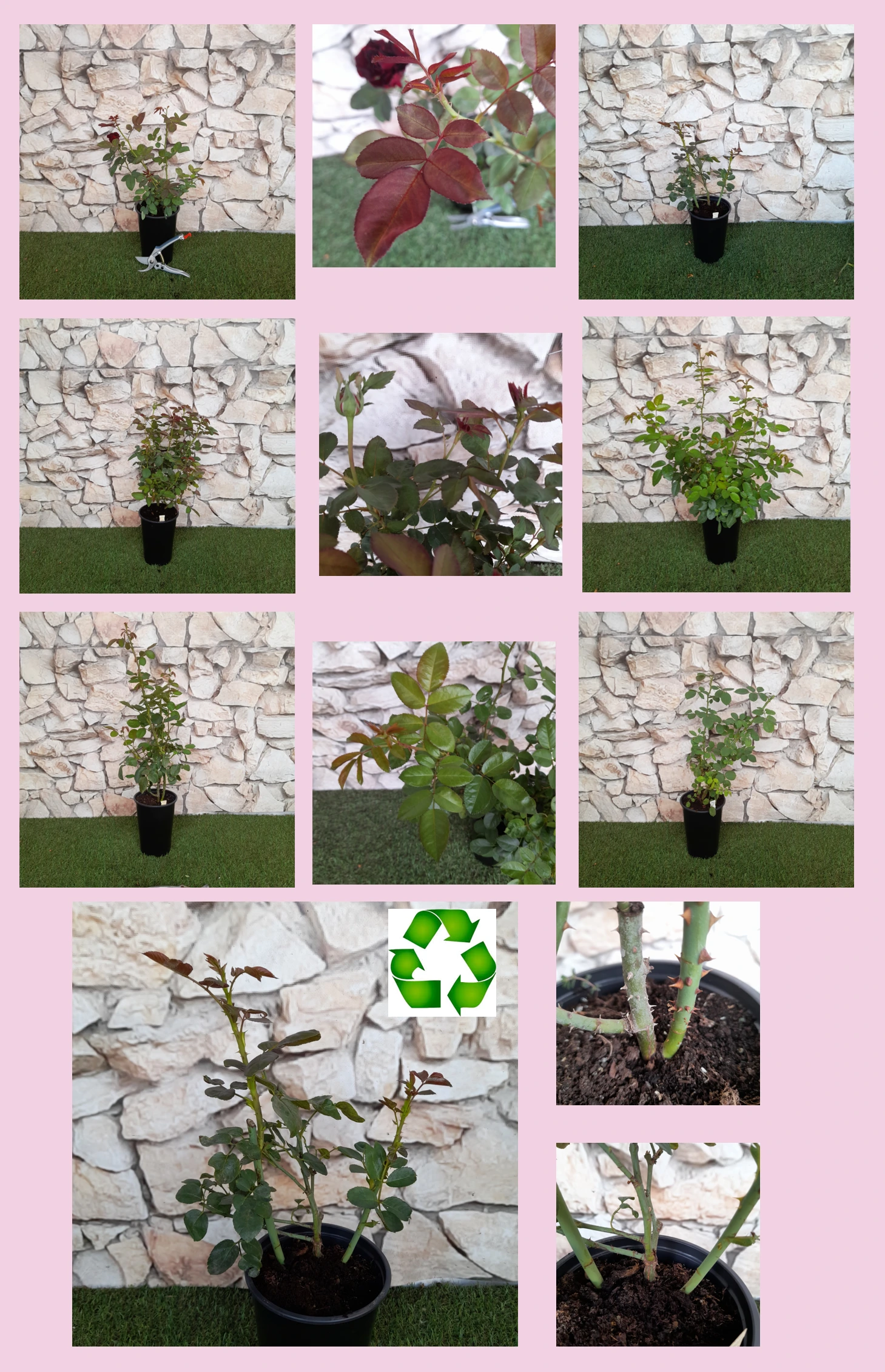
Crop overview: several varieties and growth stages in a short crop section.Shoot system: intensive growth of fresh basal shoots on a young plant.Root system: demonstration of a vigorous root system permeating the growing medium, by removing the pot.Balance: mature plant with root system and shoots in harmony with each other.
Information about the videos
The video series is not a “seasonal showcase”; it illustrates the essence of pharmaROSA® own-root cultivation in a tangible way: how the plant is built up, what the root system is like and how the shoot system regenerates. The recordings were therefore made at different times and with plants at various stages of development, so mixed foliage levels and differing stages of growth may appear in the videos. They are not a ‘sample’ of the batch dispatched, but a visual explanation of how the technology works. The current condition of the rose available to order — typical for the given period and similar to what you can expect to receive in the parcel — is shown in the upper part of the product page.
Pages for private customers Garden roses for the family garden, with minimal care → ORIGINAL® Premium garden roses – instant impact, a truly showpiece garden → EXTRA® Pages for professionals and private customers Roses for public spaces – large areas, sustainable maintenance → NATURAL® Roses for projects – hedge and row planting, fast implementation → RAPID® For professional partners only Production – propagation material for garden roses, wholesale → NEONATAL®
Company details
PharmaRosa Ltd. Company registration number: 01-09-717479 VAT number: 13075314-2-43 Plant health registration no.: HU130721 Bank account (IBAN): HU85117631891388688400000000 BIC (SWIFT): OTPVHUHB Bank name: OTP Bank Nyrt.