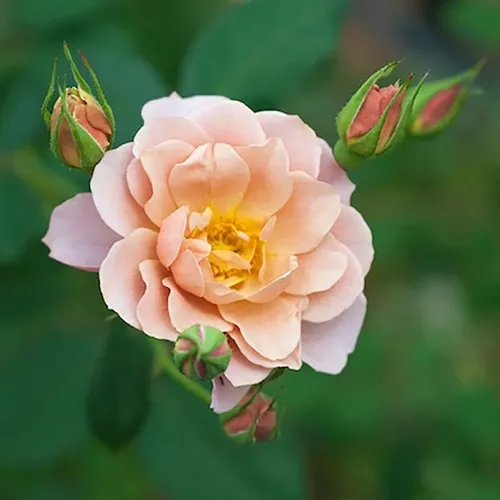
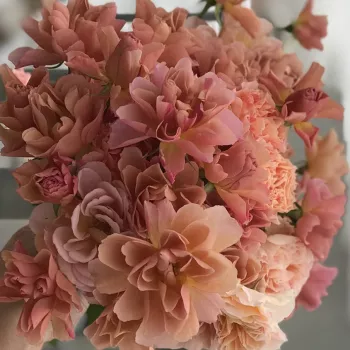
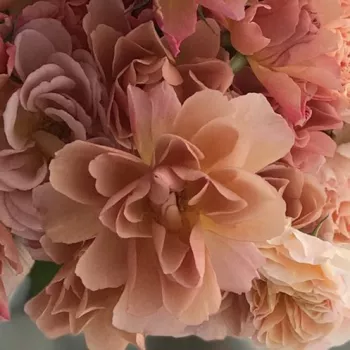
Dusty lavender-pink base with a subtle beige-pink tint in the centre. - flower bed, floribunda, rose - unscented rose - no detectable fragrance
– Semi-double Sola blooms in airy clusters.
– Elegant dusty lavender-pink, softly changing tones.
– Abundant repeat flowering over the season.
– Dense, healthy foliage on upright plants.
– Excellent disease resistance and H7 winter hardiness.
– Special feature: Prize-winning Proflora 2021 garden rose, ideal both for beds and cutting.
Thinking about your garden’s future – Open to feedback
pharmaROSA® ORIGINAL 2-litre own-root potted rose
21,20 £
Unfortunately, we are currently unable to ship to the United Kingdom; we only deliver to countries within the European Union. For more information, please contact us!
5(7055)
SOLA – pink bedding floribunda rose - Kunieda
Effortless planting meets low‑maintenance reliability in SOLA, a compact floribunda bred in Japan for generous clusters of semi‑double, dusty lavender‑pink blooms that soften to peach‑beige with silvery petal edges. Its upright, medium‑sized bush and dense, healthy foliage create a tidy, structured look that suits classic British front gardens, paths and mixed cottage borders, even where winds and rain are frequent near exposed coasts. Abundant repeat flowering in well‑spaced groups quickly builds an elegant, modern‑cottage mood with minimal fuss, while the own‑root habit supports long‑term stability and easy regeneration after pruning or weather damage. With good disease resistance and no need for complex spraying regimes, you can focus on placing its colour harmonies beside perennials and grasses, knowing that year one focuses on roots, year two on framework growth, and by year three you enjoy full ornamental impact. Ideal for busy households who want dependable flowering structure rather than high‑maintenance specimens.
Freshly opened Sola rose with lavender-pink outer petals and a soft beige-pink centre.
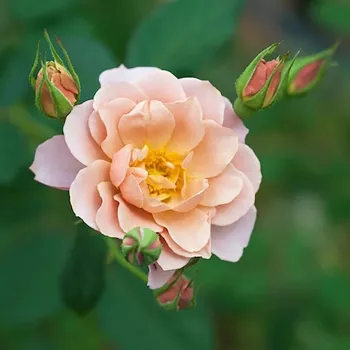
Sola showing its semi-double, cup-shaped flowers in full bloom.
Sola in closed bud stage, showing a deep greyish-lilac tone.
Mid-green foliage of Sola bedding rose.
Usage options
Target area
Reasoning
Front garden beds by the house
The compact, upright habit and dense mid‑green foliage give a neat, composed look close to the front door, while the muted lavender‑to‑peach blooms feel refined rather than overpowering. Regular repeat flowering delivers colour across the season with straightforward care routines, suiting beginners.
Small mixed cottage borders
Semi‑double clusters sit well among lavender, coreopsis and meadow sage, picking up mauve and soft yellow tones for a relaxed cottage feel. The flower colour shifts gently as each spray ages, adding movement without needing complex planting schemes, ideal for aesthetes.
Low, informal flowering hedge
Planted at recommended hedge spacing, SOLA forms a coherent, shoulder‑high line with good foliage cover and reliable rebloom. Own‑root plants knit together over time into a stable hedge that responds well to light trimming, matching the needs of homeowners.
Feature groups of 3–5 in small lawns
Massed in groups, the medium‑sized, cup‑shaped flowers create a soft, hazy colour block that reads clearly from windows and patios. Low maintenance and disease resistance mean the group stays attractive without constant deadheading, reassuring families.
Near patios and seating areas
Although unscented, the continually forming sprays and fine colour gradations offer plenty of visual interest at close quarters. The tidy outline and moderate height avoid blocking views, while occasional rose‑hip formation adds late‑season detail for relaxed gardeners.
Urban and courtyard gardens
The medium footprint suits narrow borders and compact plots where space is limited but long‑season colour is still desired. Reliable rebloom on a sturdy, upright framework reduces the need for replacement planting, fitting the lifestyle of busy city‑dwellers.
Raised beds in challenging soils
In areas where drainage is improved in raised beds, own‑root plants establish steadily, building a resilient root system that underpins future growth and flowering. This long‑term structure gives confidence to those planning ahead as practical planners.
Large containers from 40–50 litres
In generous containers with good compost and watering, SOLA forms a compact, reblooming shrub whose foliage and flower clusters stay in scale with the pot. Good disease resistance helps maintain a clean look in exposed, windy spots, appreciated by balcony owners.
Styling ideas
Soft-border accent – Plant 3 SOLA in a loose triangle and underplant with Nepeta and soft grasses to echo the muted lavender‑pink sprays – suits cottage‑style lovers seeking gentle colour shifts.
Classic front-frame – Line a short path with SOLA on both sides, edging with low box or thyme to frame the door with tidy structure and seasonal flower colour – ideal for owners of traditional terraces.
Pastel container duo – Use a single SOLA in a 50‑litre pot with trailing ivy and pale violas to create a long‑season feature for patios or balconies – perfect for time‑pressed urban gardeners.
Perennial partnership – Combine SOLA with Salvia nemorosa and threadleaf coreopsis for a soft contrast of textures and mauve‑yellow tones – appealing to those building easy, wildlife‑friendly borders.
Low privacy ribbon – Set SOLA in a staggered row along a front fence to create a light, flowering screen that defines boundaries without feeling heavy – suited to families wanting attractive, simple structure.
Technical cultivar profile
Parameter
Data
Name and registration
SOLA – bedding floribunda shrub rose from the Bedding rose collection; commercial bed rose type with current trade name SOLA Bedding rose Kunieda, verified authenticity for garden use.
Origin and breeding
Bred by Keiji Kunieda in Japan, with parentage not disclosed; introduced internationally in 2021 primarily as a cut‑flower spray rose and now adapted for consumer garden planting.
Awards and recognition
Proflora Variety Contest 2021, Garden Rose category: grower award, 3rd place, recognising ornamental value and performance within professional production, supporting confidence in long‑term garden planting.
Growth and structural characteristics
Upright shrub reaching around 80–120 cm in height and 50–75 cm spread, with moderately thorny stems and dense, slightly glossy mid‑green foliage giving good visual cover in beds and borders.
Flower morphology
Semi‑double, cup‑shaped flowers with approximately 17–25 petals, medium sized at about 4–7 cm across, borne in cluster‑flowered sprays, remontant with a notably abundant second flush in season.
Colour data and phenology
Dusty lavender‑pink base tones with beige‑pink centre; buds greyish lilac, opening to lavender‑pink with beige, then fading to peach‑beige with silvery petal edges, offering moderate colour retention and gentle transitions.
Fragrance and aroma
No detectable fragrance recorded; selected primarily for flower form, colour nuance and garden performance rather than scent, making it suitable where visual effect is the main design requirement.
Hip characteristics
Produces moderate numbers of small ovoid hips around 8–12 mm in diameter, colouring orange‑red later in the season, adding a subtle decorative element without dominating the autumn appearance.
Resistance and winter hardiness
Good overall disease resistance with recorded resistance to powdery mildew, black spot and rust; hardy to approximately −21 to −18 °C (RHS H7, USDA 6b), suitable for most UK garden conditions.
Horticultural recommendations
Best at 45–55 cm spacing in beds or low hedges, or 90 cm as a solitary; low maintenance needs, responding well to standard pruning and regular feeding, with own‑root plants supporting long service life.
SOLA offers reliable repeat flowering, tidy medium growth and strong disease resistance on a long‑lived own‑root framework, making it a thoughtful choice if you would like a quietly elegant rose that looks after itself.
Detailed product attributes
Product Identification Data
Product Name:
SOLA – pink bedding floribunda rose - Kunieda
Product Type:
pharmaROSA® ORIGINAL - 2-litre own-root potted rose
Closed Bud:
Deep, greyish-lilac shade with a slight beige tone.
Newly Opened Flower:
Ruffled, lavender-pink outer petals, with a soft beige-pink on their inner surfaces.
Full Bloom:
The outer petals are a pale, slightly greyish lavender, the centre suffused with a beige-pink.
Before Fading:
Faded peach-beige pink, the petal edges are silvered.
Colour Fading Description:
During opening, the greyish‑purple, lavender tones gradually fade and shift to a peachy–beige pink; prior to the end of flowering the petal edges become silvery.
Pollinator Attraction:
The semi‑double flowers, with exposed stamens that increase pollen accessibility compared with fully double forms, attract pollinators.
Pollinator-Friendly Rating:
Because its stamens are exposed, it moderately attracts pollinators and is therefore only partially pollinator-friendly.
Our product is a rose grown with pharmaROSA®’s unique cultivation technology!
2-litre, own-root, potted rose.
With a shoot system appropriate to the season.
With a root system that thoroughly permeates the growing medium.
Quality compliant with the requirements of the E.N.A. (European Nurserystock Association).
Supplied in unique packaging that prevents damage.
Can be planted during frost-free periods.
True-to-variety rose bush with a unique identifier.
The pharmaROSA® own-root potted rose is a well-rooted plant that supports reliable establishment when planted and cared for properly, so it can be planted whenever the soil is not frozen.
Crop overview: several varieties and growth stages in a short crop section.Shoot system: intensive growth of fresh basal shoots on a young plant.Root system: demonstration of a vigorous root system permeating the growing medium, by removing the pot.Balance: mature plant with root system and shoots in harmony with each other.
Information about the videos
The video series is not a “seasonal showcase”; it illustrates the essence of pharmaROSA® own-root cultivation in a tangible way: how the plant is built up, what the root system is like and how the shoot system regenerates. The recordings were therefore made at different times and with plants at various stages of development, so mixed foliage levels and differing stages of growth may appear in the videos. They are not a ‘sample’ of the batch dispatched, but a visual explanation of how the technology works. The current condition of the rose available to order — typical for the given period and similar to what you can expect to receive in the parcel — is shown in the upper part of the product page.
Pages for private customers Garden roses for the family garden, with minimal care → ORIGINAL® Premium garden roses – instant impact, a truly showpiece garden → EXTRA® Pages for professionals and private customers Roses for public spaces – large areas, sustainable maintenance → NATURAL® Roses for projects – hedge and row planting, fast implementation → RAPID® For professional partners only Production – propagation material for garden roses, wholesale → NEONATAL®
Company details
PharmaRosa Ltd. Company registration number: 01-09-717479 VAT number: 13075314-2-43 Plant health registration no.: HU130721 Bank account (IBAN): HU85117631891388688400000000 BIC (SWIFT): OTPVHUHB Bank name: OTP Bank Nyrt.