SCARMAN'S GOLDEN RAMBLER – yellow rambler climbing rose - Scarman
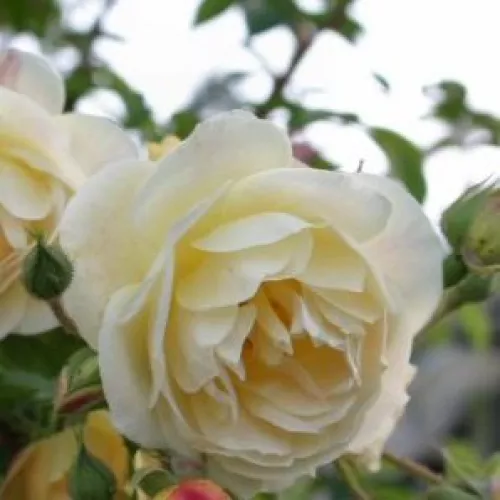
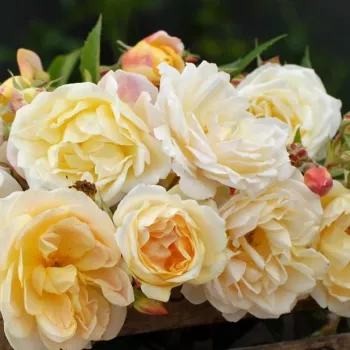
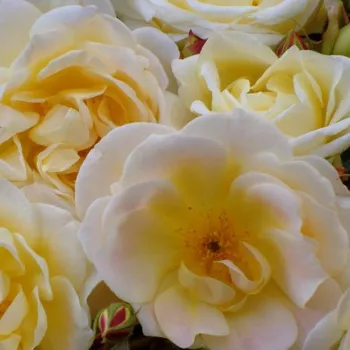
If you dream of a classic cottage-style climber that is both vivid and manageable, SCARMAN'S GOLDEN RAMBLER offers luxuriant arcs of golden flowers with reassuringly reliable remontant performance from summer into early autumn. Its semi-double, ball-shaped blooms open in clustered sprays, creating a romantic curtain of colour that softens pergolas, arches and fences without demanding fussy pruning. Introduced by John Scarman in 2003, this rambler forms a well-anchored framework that copes steadily with typical British breezes and damp spells, giving you confidence along more exposed boundaries. The warm yellow gradually shifts to apricot and cream, lending varied tones through the season and harmonising beautifully with mixed cottage borders. As an own-root plant in the pharmaROSA® ORIGINAL 2‑litre container, it establishes securely and matures into a long-lived structure, with roots building in year one, stronger shoots following in year two, and full ornamental impact by year three for truly enduring, easy-care garden colour that suits busy households and less experienced gardeners alike.
Usage options
| Target area | Reasoning |
|---|
| Front-garden rose arch by the entrance path |
The long, flexible canes make it ideal for training over arches, creating a welcoming tunnel of colour that reads beautifully from the street. Its remontant flowering means the entrance remains inviting for much of summer, even with minimal rose experience – perfect for the style-conscious beginner. |
| Pergola or seating area screen |
Its vigorous, climbing habit and mid-green foliage quickly form a leafy canopy that filters light over a bench or terrace, while the strong classic fragrance adds a sense of enclosure. Abundant clusters soften hard structures, suiting families wanting a scented outdoor “room” – ideal for the relaxed homeowner. |
| Fence cover in a small to medium family garden |
This rambler’s height and spread allow it to clothe panel fences and wire boundaries, providing a softer outlook from kitchen or living-room windows. The own-root form develops a stable, long-lived framework that can be pruned flexibly once established – reassuring for the busy gardener. |
| Cottage-style mixed border backdrop |
The shifting golden-yellow to creamy-peach tones blend naturally with perennials and ornamental grasses, giving layered colour behind lower planting. Semi-double blooms keep the effect light rather than heavy, suiting informal cottage schemes without precise colour-matching – attractive for the creative planner. |
| Obelisk or free-standing feature in lawn |
Trained up an obelisk, its long, pliable shoots spiral easily to form a column of flowers that draws the eye from a distance. This creates strong vertical interest without complex training systems, ideal where you want instant impact from a single planting point – helpful for the time-poor owner. |
| Warm, south-facing wall in southern regions |
Recommended for warmer southern sites, it responds particularly well to a sunny, sheltered wall where the wood ripens and flowering is maximised. In such positions it copes steadily with the UK’s humid spells and breezier days, provided soil is not waterlogged – a sound choice for the climate-aware buyer. |
| Small group planting along a boundary run |
Spacing several plants along a fence or hedge line creates a continuous ribbon of yellow and cream tones, while the recommended planting distances prevent overcrowding. The remontant habit keeps colour returning without complex feeding schedules – reassuring for the low-maintenance-focused household. |
| Large container near patio (minimum 40–50 litres) |
In a generous, deep container of at least 40–50 litres, this own-root rambler can be grown on a sturdy pot trellis, giving climber drama where in-ground planting is limited. Regular watering and feeding are straightforward tasks, offering a manageable way into rose growing – suitable for the space-conscious urbanite. |
Styling ideas
- Golden welcome – Train over a simple metal arch with white foxgloves and lavender below for a classic cottage entrance – ideal for front-garden romantics.
- Sunlit pergola – Combine on a pergola with pale pink climbers and honeysuckle to create a layered scented tunnel – suited to families who linger outdoors in the evenings.
- Warm cottage mix – Use as a backdrop with Penstemon ‘Husker Red’ and soft grasses for rich contrast of yellow, burgundy foliage and airy seedheads – perfect for artistic border planners.
- Golden boundary – Repeat three plants along a fence, underplanted with hardy geraniums, to give a flowing ribbon of colour and easy weed-suppression – good for low-maintenance seekers.
- Patio statement – Grow in a large terracotta pot (50 litres) with trailing thyme at the base and a slim obelisk for height – appealing to balcony and courtyard gardeners.
Technical cultivar profile
| Parameter | Data |
|---|
| Name and registration |
Scarman's Golden Rambler is a rambler-type climbing rose marketed as a yellow climbing rambler; exhibition name Scarman’s Golden Rambler, collection category climbing rose. |
| Origin and breeding |
Bred by John Scarman and first introduced in Germany around 2003, later distributed by Landhaus Ettenbühl and Scarman Roses; parentage and registration data remain unknown. |
| Growth and structural characteristics |
Strong rambler climber reaching about 400–650 cm high with 250–450 cm spread; moderately dense, mid-green foliage, moderately thorny stems, suited to training over supports. |
| Flower morphology |
Semi-double, ball to pompon-shaped flowers with around 13–25 petals; medium-sized clustered blooms, remontant with a notably abundant second flush in suitable conditions. |
| Colour data and phenology |
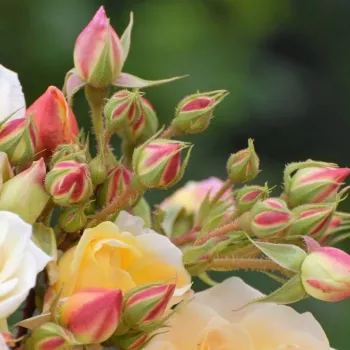
Opens clear golden yellow (RHS 14A outer, 14C inner), buds orange-tinted; colour gradually fades through creamy yellow to soft apricot-cream, giving a varied, evolving display. |
| Fragrance and aroma |
Strong, long-lasting scent with a classic rose character, noticeable around arches and seating areas; semi-double structure offers limited pollen access, so pollinator value is modest. |
| Hip characteristics |
Only occasionally produces small hips, typically 0–6 mm in diameter; hips are not a prominent ornamental feature and usually secondary to the climbing and flowering effect. |
| Resistance and winter hardiness |
Hardy to about −21 to −18 °C (RHS H7, USDA 6b, Swedish zone 3); disease resistance is medium, so monitoring for black spot, mildew and rust, plus timely care, is advisable. |
| Horticultural recommendations |
Best in full sun on warm sites with reasonable soil; tie in new canes to arches, pergolas or fences, water during prolonged dry periods, and prune after flowering to renew growth. |
SCARMAN'S GOLDEN RAMBLER brings scented golden arches, repeat flowering and lasting structure, with the own-root form settling into a dependable long-term feature; a thoughtful choice if you want enduring cottage charm with modest upkeep.