SALLY HOLMES™ – white park rose - Holmes
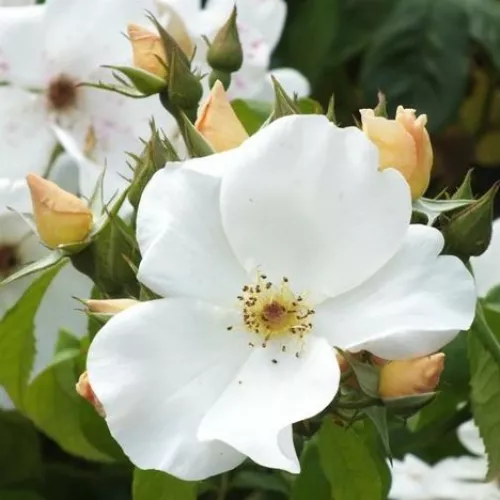
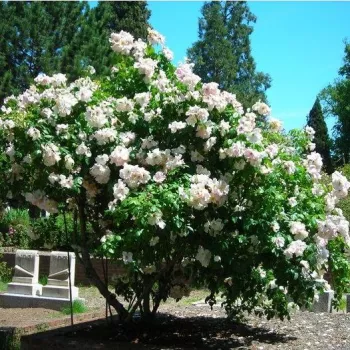
This celebrated shrub rose brings a quietly impressive presence to smaller British gardens, combining generous flowering with reassuringly low-input maintenance. Large, open clusters of creamy-white blooms appear in waves from early summer and repeat well, so even with modest deadheading and feeding you gain a long, luminous display. Its upright, bushy habit can be guided as a fence-covering shrub or lightly trained as a short climber, giving you flexible structure without intricate pruning plans. Own-root growth develops steadily into a durable framework with good capacity to regenerate, helping the bush age gracefully for long-term reliability. Over the first three seasons roots establish, then the framework fills out, and finally the plant reaches its full ornamental character. The simple, muscatel-scented flowers offer a subtly romantic fragrance and a partially pollinator-friendly landing place, while moderate natural disease tolerance keeps care simple in typical UK conditions, even where damp weather and fungal issues demand extra attention. Sparsely thorned stems and glossy foliage make day‑to‑day handling in family spaces more comfortable.
Usage options
| Target area |
Reasoning |
| Front garden focal shrub |
Placed near the entrance or along a path, this rose’s generous clusters of creamy-white flowers create a welcoming focal point that looks impressive without elaborate pruning or staking. Its adaptable shrub form suits the scale of typical front gardens and forms an easy-care, permanent feature that matures steadily year after year for homeowners seeking dependable structure and bloom in a compact space – ideal for the enthusiastic beginner gardener. |
| Mixed cottage border |
In a cottage-style border, the free-flowering clusters weave naturally among perennials such as salvias and yarrows, providing a long season of colour that ties changing plant combinations together. The airy, single to semi-double blooms avoid looking heavy, so they mix well with traditional cottage favourites while the moderate disease resistance helps them cope in humid, closely planted schemes. Over time, the shrub forms a stable backbone in the planting, reducing the need for frequent redesigns – well suited to cottage-garden lovers everywhere. |
| Small group planting (1–3 roses) |
Planting one to three specimens together creates a billowing, cohesive look that reads as a single, abundant shrub while remaining simple to manage. Because the plant builds a strong own-root framework, it fills space reliably over several years, giving a sense of established maturity sooner than many slower shrubs. This makes it a good choice for those wanting a tidy, impactful rose corner or boundary highlight without juggling many different varieties – perfect for time-pressed urban gardeners. |
| Light training on fence or low arbour |
The tall, upright, bushy growth can be guided along wires or over a low arbour to soften boundaries and entrances without requiring the full commitment of a large climber. Long, flexible stems allow gentle tying-in, while the clustered blooms provide generous coverage in summer and a second flush later on. Moderate prickliness keeps training work more comfortable than with heavily armed climbers, so you can maintain a graceful, flower-laden outline with a few seasonal ties – appealing to practical home owners. |
| Partially shaded side garden |
This cultivar tolerates partial shade, making it valuable where sun is limited by neighbouring houses or fences. In such positions, it still offers a satisfying display of light-reflecting blooms that brighten narrower side gardens or north-east facing beds, giving useful vertical and visual interest where other roses may struggle. With steady own-root development, it becomes a dependable long-term shrub in these trickier spots – reassuring for small-plot gardeners. |
| Large container on patio or terrace |
Grown in a generous container of at least 40–50 litres, this rose forms an elegant, upright accent for patios or terraces, giving height and flower clusters without taking floor space. The own-root nature helps it recover well from periodic repotting and light pruning, supporting extended life in containers. Regular watering and feeding are straightforward routines, repaid with a summer-long presence that softens hard landscaping – particularly suitable for busy balcony and terrace owners. |
| Family seating area backdrop |
Behind a bench or seating nook, the tall, bushy habit and moderate fragrance create a gently scented, semi-informal screen that frames the space without harsh lines. Sparsely thorned shoots reduce the risk of scratches where children or pets pass close by, while the medium maintenance needs centre on simple seasonal pruning and basic health checks. Its moderate disease resistance and tolerance of exposed, breezy spots make it a sensible choice where coastal winds and showery weather can challenge more delicate roses – practical for relaxed family gardens. |
| Seasonal interest with hips for wildlife |
After flowering, the moderate crop of small, orange-red hips adds a soft autumn accent and modest wildlife value, extending the plant’s appeal into the cooler months. Leaving some clusters un-deadheaded balances visual interest with low effort, reducing the need for precise spent-flower removal. This seasonal rhythm suits those who enjoy a naturalistic look, with the shrub providing quiet structure and colour beyond peak bloom – attractive to nature-conscious home gardeners. |
Styling ideas
- Cottage Trio – combine with lavender and pink geraniums for a loose-edged border where soft whites and pastels bloom across the season – for lovers of traditional cottage settings.
- Shaded Walk – place along a partially shaded side path with ferns and hostas to brighten dimmer areas while keeping upkeep modest – for homeowners taming awkward side gardens.
- Patio Sentinel – grow in a 50-litre terracotta pot flanking French doors, underplanting with trailing thyme for scent and texture – for terrace-focused city gardeners.
- Soft Screen – train lightly along discreet wires with meadow sage and yarrow in front to create a flowering veil without a solid hedge – for those wanting privacy without heaviness.
- Seasonal Drift – mass 3 plants with ornamental grasses so white clusters rise from a shifting tapestry that needs only yearly tidying – for busy families preferring simple, once-a-year care.
Technical cultivar profile
| Parameter |
Data |
| Name and registration |
Shrub, Hybrid Musk park rose; registered as ‘Sally Holmes’, marketed as Sally Holmes™ for garden and park use, including occasional cutting of flowering stems. |
| Origin and breeding |
Bred in the United Kingdom by Robert A. Holmes from ‘Ivory Fashion’ × ‘Ballerina’, introduced in 1976 through Fryer’s Nursery Ltd. as a robust garden and landscape shrub. |
| Awards and recognition |
Gold Medals at Monza (1979), Baden-Baden (1980), Portland (1993), Best Fragrance Glasgow (1993), and inducted into the World Federation of Rose Societies Rose Hall of Fame in 2012. |
| Growth and structural characteristics |
Tall, upright, bushy shrub 240–330 cm high and 135–225 cm wide, sparsely thorned, with dense, glossy dark green foliage; can be trained as a short climber on supports. |
| Flower morphology |
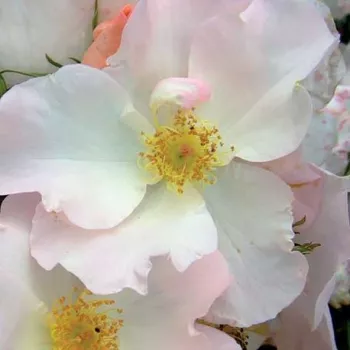
Single to semi-double blooms with 5–12 petals, small (0.5–1.5 in) but produced in large clusters on the stems; flowers are flat-faced and self-cleaning is moderate. |
| Colour data and phenology |
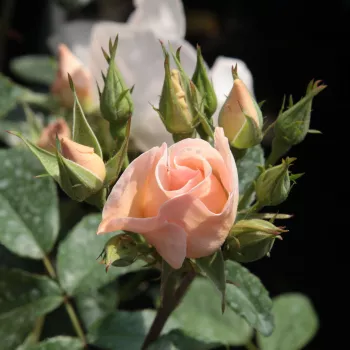
Buds light apricot-yellow, opening creamy white with slight pink flush, then pure white with vanilla tint before fading to greenish-white; remontant with a notably strong second flush. |
| Fragrance and aroma |
Mild, muscatel-style fragrance; scent is noticeable at close range without overwhelming nearby seating areas, lending a gentle perfume to paths, patios and open windows. |
| Hip characteristics |
Produces moderate quantities of small, spherical hips, around 8–12 mm in diameter, maturing to an attractive orange-red that adds light autumn interest and soft seasonal colour. |
| Resistance and winter hardiness |
Hardy to around −26 to −23 °C (RHS H7, USDA 5b); good heat tolerance with watering in drought; black spot generally resisted, with moderate sensitivity to mildew and rust. |
| Horticultural recommendations |
Best at 125–220 cm spacing depending on use; suits borders, hedging, pergolas, fences and larger containers; maintenance moderate with basic plant protection where disease pressure is high. |
Sally Holmes combines generous repeat flowering, versatile shrub-or-climber use and a long-lived, regenerating own-root habit, making it a thoughtful choice when you would like a reliable, easy-going rose for your garden.