Rosa rubrifolia – pink wild rose – Pourret
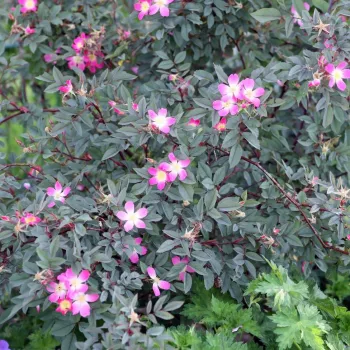
This distinguished wild shrub rose offers an effortlessly naturalistic presence for British family gardens, combining dusky foliage, soft pink summer flowers and autumn hips in one long-lived plant. Its arching habit and bluish-purple leaves lend instant structure and character to mixed borders, hedges and front gardens, while the once-flowering display is followed by decorative berries that support wildlife year-round. Single blooms with open centres are highly attractive to pollinators, making it an ideal choice for relaxed, low-intervention schemes where you prefer simple pruning to complex rose care. As an own-root shrub it forms a stable, well-anchored framework that matures steadily, giving you reliable longevity and easy regeneration after harder pruning. Over time the shrub settles comfortably into typical UK conditions, even in exposed gardens where wind and weather test less robust plants, offering a quietly dependable backdrop for cottage-style combinations and modern, informal planting alike.
Usage options
| Target area | Reasoning |
|---|
| Informal front-garden feature shrub |
The tall, arching habit and blue-green to purplish foliage give year-round structure, while soft pink summer flowers and dark red hips add seasonal interest without fussy upkeep, ideal for a single statement shrub near the front door for the design-conscious beginner. |
| Relaxed, low-maintenance hedge |
Planted at hedge spacing, the bushy species character creates a semi-informal screen that needs only occasional shaping, with self-cleaning flowers and decorative hips reducing deadheading work, suiting those who prefer gentle trimming to detailed pruning, particularly the time-pressed homeowner. |
| Naturalistic, wildlife-friendly border |
Single flowers with exposed stamens are highly attractive to bees and other insects, and the abundant hips provide autumn and winter food and shelter, making this an easy backbone plant for pollinator-rich, chemical-light schemes favoured by environmentally aware gardeners. |
| Park-style or larger family lawn specimen |
Its eventual height and spread form a graceful fountain of arching shoots that read well from a distance; once established it copes well with heat and drier spells, so it works as a low-input anchor shrub where irrigation is minimal, useful for spacious-plot owners. |
| Mixed cottage border with shrubs and perennials |
The muted blue-green foliage and pink, once-flowering display combine beautifully with perennials and grasses, then retreat into a calm backdrop while hips carry the interest, supporting layered cottage borders that still remain simple to manage for style-focused beginners. |
| Urban green space and streetside planting |
This robust species-type shrub tolerates typical city conditions and short dry spells, needs only moderate maintenance and offers a neat, self-cleaning habit, making it suitable for public or communal areas where long service life and low input are valued by urban residents. |
| Partial-shade side garden or boundary |
Tolerant of partial shade, it can brighten less-sunny corners with its distinctive foliage colour and light pink flowers, without demanding constant attention, ideal for side paths and boundaries that are visited less often but still important to busy householders. |
| Loose shrub group in exposed or windy plots |
Planted in small groups, the arching shrubs knit together into a stable thicket that rides out poor weather and frames other planting; over the first three years it roots deeply then fills out, providing an enduring structure appreciated by long-term-minded gardeners. |
Styling ideas
- Cottage-hedgerow – run a loose line along a front boundary, interplanting with foxgloves and hardy geraniums for a soft, semi-wild screen – ideal for romantic cottage-garden lovers.
- Dusky-feature – use a single shrub as a focal point, underplant with Heuchera and spring bulbs to echo the leaf tones – perfect for design-conscious small-garden owners.
- Wildlife-border – combine with native grasses, Cornus and pollinator perennials to create a low-input, wildlife-led strip – suited to eco-focused family gardeners.
- Urban-thicket – plant a small group in a tough corner with ornamental grasses and groundcovers for a resilient, low-care screen – good for shared or streetside spaces.
- Pastel-mix – weave it into a border of pale pinks, whites and soft blues so the foliage and hips extend interest beyond flowering – appealing to colour-focused beginners.
Technical cultivar profile
| Parameter | Data |
|---|
| Name and registration |
Rosa rubrifolia (Rosa glauca) botanical rose by Pourret; wild, species shrub used as a bushy species rose, marketed as RUBRIFOLIA – pink wild rose – Pourret for garden planting. |
| Origin and breeding |
Natural species of unknown parentage, historically associated with Pierre André Pourret and introduced around 1830; unregistered variety now widely used as an ornamental botanical shrub. |
| Awards and recognition |
Recognised with the RHS Award of Garden Merit in 1993 and selected by Great Plant Picks in 2002, confirming its longstanding reliability, ornamental value and general garden performance. |
| Growth and structural characteristics |
Strong, upright to arching shrub reaching about 200–300 cm tall and 120–190 cm wide, moderately thorny, with moderately dense, matt foliage tinted blue-green to purplish for season-long structure. |
| Flower morphology |
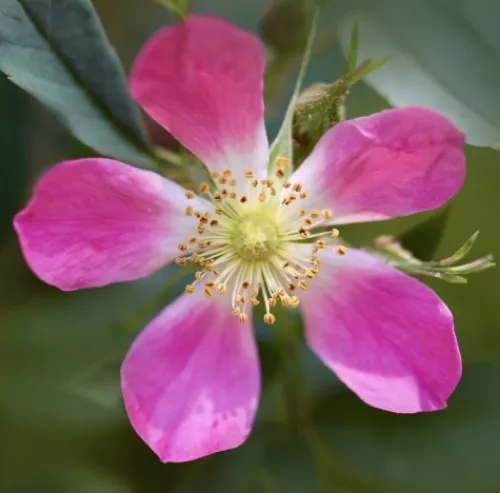
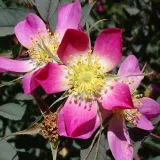
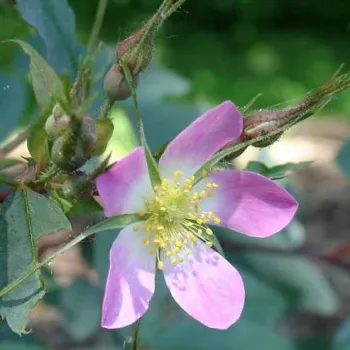
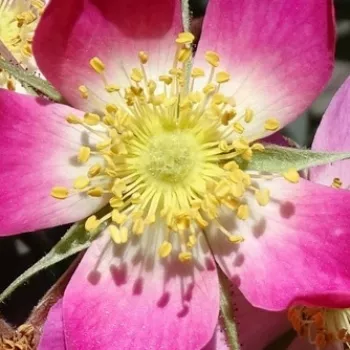
Single, flat flowers with 5–12 petals, small in size and borne in clusters; non-remontant, giving one main summer flush, but with good self-cleaning so spent blooms drop and hips remain visible. |
| Colour data and phenology |
Flowers open dark carmine pink, then vivid deep pink with paler centre, gradually fading to pale pink and near white; ARS DPk, RHS 55C and 65D, providing gentle colour transitions through flowering. |
| Fragrance and aroma |
Blooms carry a mild, restrained rosy fragrance, subtle rather than overpowering, adding a gentle scent note that complements rather than dominates nearby plantings in mixed borders and hedges. |
| Hip characteristics |
Produces moderately abundant, spherical dark-red hips about 12–18 mm in diameter; ornamental in autumn and winter, adding colour and supporting wildlife interest after the flowering season. |
| Resistance and winter hardiness |
Very hardy shrub tolerating down to about -46 °C (RHS H7, USDA 2a); medium disease resistance, with moderate susceptibility to common rose diseases and very good heat and drought tolerance once established. |
| Horticultural recommendations |
Suited to parks, hedges, naturalistic gardens and urban green spaces; plant at 90–165 cm depending on use, in sun or partial shade, with moderate maintenance and occasional pest and disease monitoring. |
Rosa rubrifolia offers distinctive dusky foliage, pollinator-friendly single blooms and decorative hips on a hardy, own-root shrub that settles in for decades, making it a thoughtful choice if you prefer an easy, quietly characterful rose.