ROYAL GOLD – golden-yellow climbing rose - Morey
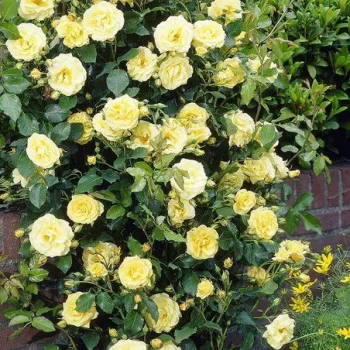
For those who dream of a classic climbing rose that simply performs, ROYAL GOLD offers generous, fragrant golden-yellow blooms on a robust climber that settles quickly into typical British family gardens. Its strong growth and remontant flowering create reliable vertical colour on fences, pergolas or sunny house walls, while glossy mid-green foliage keeps the plant looking neat between flushes. As an own-root rose in a 2‑litre pot, it establishes steadily and is easy to manage over time, coping well with breezy sites and wetter spells with proper drainage. In many gardens you will see roots building in the first year, stronger shoots and structure in the second, and full ornamental value by the third, giving you lasting confidence that it will mature into a well-shaped climber. Its medium maintenance needs are straightforward, focusing on simple pruning and occasional deadheading, making it a reassuring choice for busy gardeners who still want a rich display. ROYAL GOLD is ideal where you want dependable structure and repeated flowering without complex training systems, forming an attractive vertical backdrop for classic British planting. With good heat tolerance and moderate drought resilience once established, it suits many UK microclimates, giving you enduring impact from a single, well-placed plant.
Usage options
| Target area |
Reasoning |
| Front garden climber on house wall |
Use ROYAL GOLD on a sunny south- or west-facing wall to bring a steady supply of golden-yellow blooms right to the front of your home. Its strong climbing habit and glossy foliage build a permanent vertical feature, while own-root vigour supports a long-lived, reliable display that suits those wanting lasting structure with minimal fuss – ideal for the beginner. |
| Pergola or arbour focal point |
Trained over a pergola or arbour, ROYAL GOLD creates an inviting tunnel of colour and scent in small to medium family gardens. The long canes cover overhead structures effectively, and the strong, sweet fragrance enhances seating or play areas, giving you a classic cottage-garden atmosphere without needing specialist pruning skills – perfect for the homeowner. |
| Fence and boundary softening |
Along a fence, its medium-dense foliage and repeated flowering soften hard boundaries and add privacy without overwhelming narrow beds. Once established, it copes well with typical British weather, including periods of wind and rain when given reasonably free-draining soil, so you get consistent coverage and colour with straightforward seasonal care – reassuring for the urbanite. |
| Specimen climber in a mixed border |
Planted as a specimen at the back of a mixed border, ROYAL GOLD offers a tall, luminous column of yellow that contrasts beautifully with perennials and shrubs. Its medium maintenance level and own-root resilience mean the framework thickens gradually, supporting stable flowering from year to year without complex renovation, anchoring the whole scheme visually – well suited to the stylist. |
| Cutting garden and exhibition use |
The large, double, golden-yellow blooms with strong scent make ROYAL GOLD an excellent climber for cut flowers and informal exhibition use. Solitary, well-formed flowers on long stems are easy to select, and the plant’s reliable remontant habit keeps vases filled over a long season, giving satisfying results from a single, well-managed plant – appreciated by the collector. |
| Small group planting on larger walls |
On a long wall or large facade, planting 2–3 ROYAL GOLD plants at the recommended spacing creates a continuous ribbon of colour. The combination of good heat tolerance and moderate drought resilience, once roots are deep, supports stable growth in more exposed or warmer spots, reducing the need for intensive watering – helpful for the busy. |
| Large container on patio or courtyard |
Where ground planting is limited, ROYAL GOLD can be grown in a large container of at least 40–50 litres with a sturdy support. In well-drained compost and with regular feeding, it offers the same scented, golden display while remaining manageable in size, ideal for brightening paved spaces or rented gardens without permanent changes – designed for the renter. |
| Classic cottage-style front border |
Partner ROYAL GOLD with traditional cottage plants such as Lychnis, Lantana or Gaillardia to recreate an informal yet structured look. The rose’s repeat flowering and good colour retention give continuity while companion plants fill lower levels, meaning you can enjoy a full, layered effect from spring onwards without complex design work – inspiring for the creative. |
Styling ideas
- SunnyEntrance – Train ROYAL GOLD over a porch or beside the front door, using its strong scent and golden colour to welcome visitors – ideal for appearance-conscious homeowners.
- CottageFrame – Combine it with Lychnis viscaria 'Alba' and other soft perennials to frame windows with a loose cottage style – suited to lovers of traditional British gardens.
- GoldenScreen – Let it clothe a side fence, using its repeat blooms and glossy foliage to create a living screen – good for families seeking privacy with charm.
- PatioArbour – Grow in a large 40–50 litre container at the base of a small arbour, enjoying fragrance and shade in compact spaces – perfect for courtyard and terrace gardeners.
- FeatureWall – Use several plants along a sunny wall to build a continuous band of yellow, giving structure and long-season colour – attractive to planners of larger family plots.
Technical cultivar profile
| Parameter |
Data |
| Name and registration |
Large-flowered climbing rose; registered cultivar name and ARS exhibition name: Royal Gold. Current trade name: Royal Gold Climbing rose Royal Gold. Unregistered variety in formal registration terms. |
| Origin and breeding |
Bred by Dr Dennison Harlow Morey, USA, 1957; parentage Cl ‘Goldilocks’ × ‘Lydia’ (HT, 1949). Initially distributed by Jackson & Perkins Co. Introduced as a golden-yellow climbing garden and exhibition rose. |
| Growth and structural characteristics |
Vigorous climbing habit reaching about 260–400 cm high and 200–320 cm spread. Moderately dense, mid-green, glossy foliage; moderately thorny canes. Needs support and tying, forming a substantial framework over time. |
| Flower morphology |
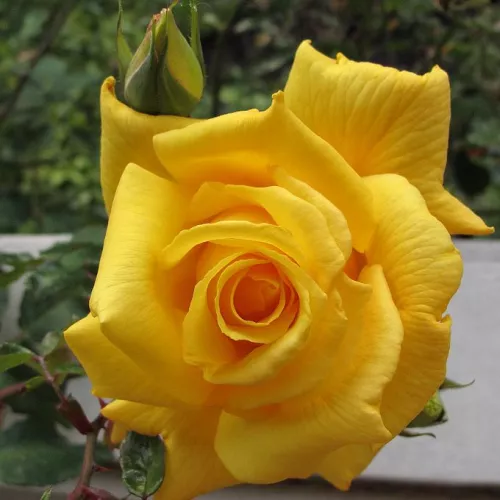
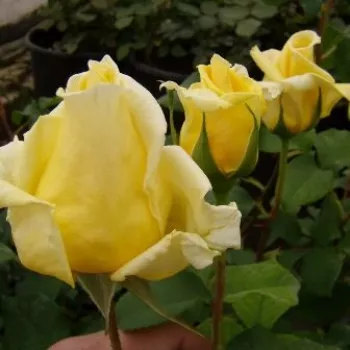
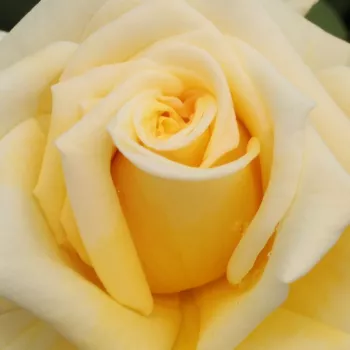
Large, double, cup-shaped blooms with 26–39 petals, typically borne singly on stems. Remontant flowering with a good second flush, suitable for cutting. Medium self-cleaning; some spent blooms benefit from deadheading. |
| Colour data and phenology |
Deep, saturated golden-yellow flowers (RHS 12A outer, 12B inner), with lemon-yellow toning at petal edges. Colour long-lasting; may lighten slightly in heat, deepen in cooler weather. Good colour retention in normal garden conditions. |
| Fragrance and aroma |
Strong, sweet, fruity scent characteristic of classic scented climbers. Well-perceived at close quarters and along paths or seating areas. Primarily ornamental; double blooms limit pollinator access despite overall attractiveness. |
| Hip characteristics |
Small, ovoid, orange-red hips, about 10–15 mm in diameter, produced only occasionally. Not a primary ornamental feature but can add modest seasonal interest if some flowers are left uncut. |
| Resistance and winter hardiness |
Rated to about –21 to –18 °C (RHS H7, Swedish zone 3, USDA 6b). Disease resistance medium overall: good against black spot and powdery mildew, moderate against rust. Good heat tolerance and moderate drought resilience when established. |
| Horticultural recommendations |
Best in full sun with reasonably well-drained soil; avoid waterlogging. Recommended spacing 250 cm in mass plantings, 235 cm for hedging, 400 cm as specimen. Medium maintenance: tie in shoots, prune after flowering, and feed annually. |
ROYAL GOLD offers strongly scented, long-lasting golden-yellow blooms on a vigorous, dependable climber whose own-root form supports long life and stable performance, making it a thoughtful choice for creating a lasting focal point in your garden.