ROTILIA® – carmine-red bedding floribunda rose - Kordes
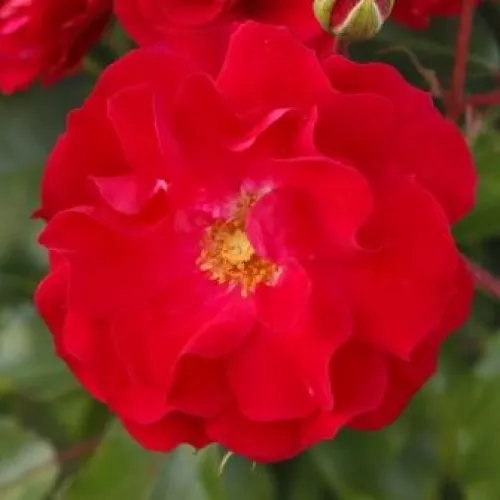
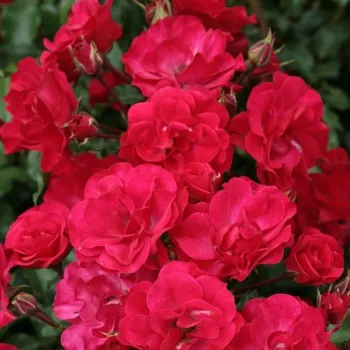
Reliable and richly flowering, ROTILIA® brings effortless carmine-red colour to everyday gardens with a compact, bushy habit that stays neat at the front of borders even in exposed, breezy sites with careful attention to drainage on heavy soils. Its disease-resistant foliage remains glossy and dark, setting off the vivid blooms that appear in generous clusters from early summer well into autumn with minimal intervention. As an own-root plant it develops naturally into a stable, long-lived bush, quietly building strength below ground in year one, then increasing top growth in year two and reaching full ornamental effect by year three. Good self-cleaning means spent flowers drop away on their own, keeping the plant tidy for you between occasional trims. Suitable for beginners yet satisfying for experienced gardeners, it copes well in partial shade and typical British summers, holding its cool-toned carmine colour without looking tired. It is equally at home in small front gardens and easy-care groundcover plantings where you want a dependable, no-fuss rose.
Usage options
| Target area |
Reasoning |
| Small front garden bed near the house |
The upright, compact habit fits comfortably into modest front gardens, giving a structured, tidy look without overwhelming the space. Reliable repeat flowering from early summer onwards adds welcoming colour by the path or front door with little work for the busy homeowner. |
| Low edging along paths or driveways |
ROTILIA® naturally forms a low, continuous line, ideal for edging paths and drives where you want definition and colour together. Planting at the recommended spacing creates a dense, coherent strip that stays easy to maintain and visually neat for the detail-focused gardener. |
| Small group planting in mixed borders |
The cluster-flowering habit gives strong blocks of carmine-red when 3–5 plants are grouped, anchoring mixed borders of perennials and cottage-style planting. The uniform height and shape make border planning straightforward and predictable for the style-conscious beginner. |
| Groundcover in problem corners |
The bushy, well-foliated structure and good self-cleaning make it effective as a flowering groundcover in sunny or lightly shaded problem spots. It suppresses visual gaps and reduces the need for constant deadheading, suiting the time-pressed family. |
| Urban and coastal gardens |
Strong disease resistance and tolerance of heat and moderate drought mean it copes well with reflective heat from walls and paving, as well as exposed, windy positions with suitable drainage. This resilience under typical town conditions reassures the practical urban gardener. |
| Informal low hedge or boundary line |
Planted at hedge spacing, ROTILIA® creates a low, flowering boundary that reads as a soft, informal hedge. Its own-root vigour supports long-term structure and easy renewal if individual stems age, making planning simpler for the long-range planner. |
| Large containers on patios and terraces |
The compact size and upright shape make it suitable for substantial containers of at least 40–50 litres, where the roots have room to develop and the bush can flower repeatedly. This brings durable colour to paved areas for the space-limited balcony-owner. |
| Cottage-style and wildlife-friendly schemes |
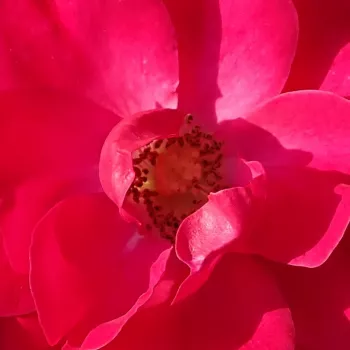
Semi-double blooms with accessible stamens provide a modest resource for bees while still giving the generous clusters associated with floribundas. The classic carmine colouring blends easily with perennials and grasses, pleasing the nature-conscious enthusiast. |
Styling ideas
- Cottage-front – Combine with blue Agastache and soft pink perennials for a relaxed, cottage-style entrance bed – ideal for lovers of traditional front gardens.
- Red-ribbon – Use a single row along a driveway, underplanted with low groundcovers, to create a crisp red line of colour – suited to homeowners wanting easy structure.
- Grass-partner – Mix with Panicum virgatum ‘Sangria’ and other airy grasses for a contemporary, low-maintenance border – good for design-aware but busy gardeners.
- Family-corner – Group 3–5 plants in a sunny corner with hardy daylilies for season-long colour in a child-friendly play garden – perfect for young families.
- Patio-focus – Plant in a 50-litre terracotta pot with trailing herbs to bring vivid red blooms onto patios and terraces – ideal for balcony and small-space gardeners.
Technical cultivar profile
| Parameter |
Data |
| Name and registration |
Floribunda bed rose from the RigoRosen® collection; registered as KORvillade, traded as Rotilia®; exhibition floribunda shrub rose class, with ARS exhibition name Rotilia®. |
| Origin and breeding |
Bred in Germany in 1992 by Wilhelm Kordes III and introduced after 2006 by W. Kordes’ Söhne, embodying the firm’s focus on healthy, garden-worthy roses. |
| Awards and recognition |
Highly decorated: multiple Gold and Silver Medals across European trials from 2001, Den Haag Gold Rose, plus ADR certification (2002) and Gold Standard award (2008). |
| Growth and structural characteristics |
Compact, upright, bushy shrub about 60–85 cm high and 40–60 cm wide, with dense, glossy dark green foliage and moderate prickles, forming a tidy, low-maintenance outline. |
| Flower morphology |
Semi-double, flat blooms with 9–16 petals, medium-sized clusters on each stem, freely repeat-flowering with an abundant second flush that maintains display over the season. |
| Colour data and phenology |
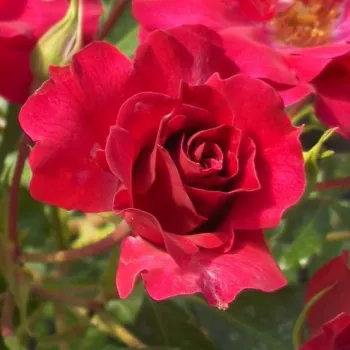
Cool-toned, saturated carmine-red (RHS 53B–53C), fiery in bud and newly opened, lightening slightly to raspberry red with a subtle silvery edge; colour generally holds well in sun. |
| Fragrance and aroma |
Very light scent with a simple wild-rose character, briefly perceptible at close quarters; primarily grown for its colour effect and flower mass rather than strong perfume. |
| Hip characteristics |
Produces moderate numbers of small, spherical rose hips, about 7–10 mm across, in a bright scarlet-red tone (RHS 46A), adding modest late-season interest for wildlife-friendly gardens. |
| Resistance and winter hardiness |
Classed as resistant to powdery mildew, black spot and rust, with H7 hardiness and USDA Zone 6b tolerance, thriving down to about −21 °C in typical UK garden conditions. |
| Horticultural recommendations |
Best for beds, borders, edging and groundcover; plant 30–55 cm apart depending on use; tolerates partial shade, heat and moderate drought, preferring well-drained but fertile soils. |
ROTILIA® (KORvillade) offers compact, cluster-rich flowering, excellent disease resistance and dependable own-root longevity, making it a thoughtful choice if you’d like a vibrant yet undemanding rose for your garden.