Rosige Landdrostei® bedding rose – KORteidros
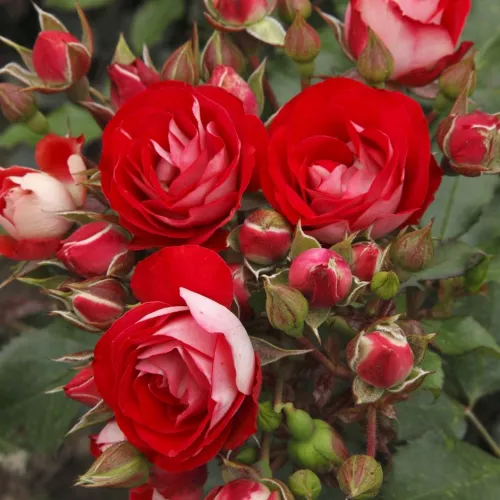
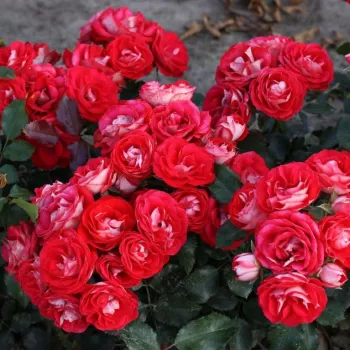
Rosige Landdrostei® is a compact floribunda designed for reliable performance in everyday family gardens, giving dense clusters of ball-shaped blooms in a vivid two-tone red and cream that hold their colour well even in sun. Its naturally compact, bushy habit keeps borders neat without complex pruning, while dark, glossy foliage adds a permanent structure to beds and front gardens. Own-root plants settle steadily and build up a long-lived framework, so after planting you can focus mainly on basic watering and feeding. In typical British conditions it copes well with breezy, unsettled weather and helps manage drainage concerns when planted in improved or raised beds. It repeats generously, so a modest group of 3–5 plants can provide a long season of flowering colour along paths, drives or low hedges, maturing from root establishment through leafy build-up to full ornamental effect over three seasons.
Usage options
| Target area | Reasoning |
|---|
| Front garden beds by paths or drives |
The bushy, compact habit keeps a tidy outline close to paths, while the mid-red, cream-backed blooms draw the eye without overpowering a small space. This makes it easy to achieve a well-kept frontage with simple yearly pruning, ideal for the time-pressed homeowner. |
| Small mixed borders in family gardens |
Its moderate height and dense foliage give useful structure near the front or middle of a mixed border, combining well with perennials such as lavender or cranesbill. Repeat flowering adds ongoing interest so borders never look bare, suiting the style-conscious beginner. |
| Low flowering hedge or edging |
Planted at closer spacing, its slightly spreading, uniform growth knits into a low seasonal hedge that frames lawns, patios or vegetable beds. The neat outline needs only light shaping once a year, which simplifies care for the busy gardener. |
| Cottage-style rose and perennial mixes |
The pompon, ball-shaped flowers and two-tone colouring give a soft, traditional look that blends well with classic cottage companions such as geraniums and variegated weigela. This helps recreate relaxed, romantic planting without specialist knowledge, appealing to cottage-garden enthusiasts. |
| Containers and large patio planters |
The compact size and bushy build suit large pots of at least 40–50 litres, where roots have space to develop a stable, long-lived framework. This provides reliable flowering on patios and terraces with only basic seasonal feeding and watering, perfect for urban balcony-owners. |
| Sunny but wind-exposed spots |
The sturdy, medium-height framework and moderately thorny stems cope well where beds are open to wind, helping the plant stay upright and balanced. In breezy British weather this makes it a dependable choice for uncluttered, open plantings valued by coastal-area residents. |
| Partially shaded borders around the house |
Suitable for partial shade, it still forms dense foliage and good flowering where light is filtered for part of the day, such as east- or west-facing walls. This flexibility widens planting options around typical homes, reassuring more cautious gardeners. |
| Long-term, low-fuss rose groupings |
As an own-root rose it gradually builds a resilient bush that regenerates well after pruning, supporting a long garden life with modest care needs. Over the years this offers steady ornamental value and simple upkeep, especially appreciated by long-term planners. |
Styling ideas
- Cottage-Ribbon Border – Plant a wavy line along the front of a border with Geranium ‘Rozanne’ and soft grasses for an informal cottage feel – ideal for relaxed front-garden owners.
- Patio Focus Pot – Use a single plant in a 50-litre terracotta container with trailing thyme and dwarf lavender to enjoy colour close to seating – suited to patio-focused households.
- Driveway Framework – Create a low edging on both sides of a drive, spacing plants evenly for a neat, welcoming frame – perfect for those wanting simple kerb appeal.
- Family-Friendly Mix – Combine with variegated Weigela and hardy perennials in a small bed for season-round interest that copes with everyday family use – good for busy family gardens.
- Urban Courtyard Strip – Line a sunny wall in an airy spot, adding gravel mulch to support drainage and a clean outline – suitable for compact urban spaces.
Technical cultivar profile
| Characteristic | Data |
|---|
| Name and registration |
Rosige Landdrostei® bedding rose, floribunda bed rose; registered as KORteidros, commercial type flower bed floribunda rose, exhibition category shrub rose within the bedding rose collection. |
| Origin and breeding |
Bred by Wilhelm-Alexander Kordes, W. Kordes’ Söhne, Germany; parentage (unknown seedling × ‘KORpeligo’) × ‘KORfloci08’; introduced and registered in the EU CPVO in 2017. |
| Growth and structural characteristics |
Bushy, compact, slightly spreading shrub to around 80–120 cm high and 40–60 cm wide; dense, dark green, glossy foliage; moderately thorny stems forming a stable, rounded framework over time. |
| Flower morphology |
Small, double blooms with 26–39 petals, ball to pompon-shaped; borne in clusters of 3–10 per stem; repeat-flowering through the season with a generous second flush after the main display. |
| Colour data and phenology |
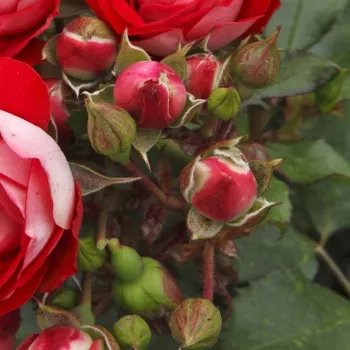
Vivid medium red with creamy-white reverse and silvery sheen; ruby-red buds open bright red outside, creamy within; colour fades slowly to raspberry tones yet remains fresh and contrasting on the bush. |
| Fragrance and aroma |
Classically rose-scented but only very faint, offering a delicate perfume close up rather than a strong garden-wide scent; chosen more for visual impact than fragrance-led planting schemes. |
| Hip characteristics |
Hip set is generally sparse due to the double flowers; occasional small, spherical hips 6–10 mm across may develop, coloured orange-red (RHS N30A), adding minor late-season interest if present. |
| Resistance and winter hardiness |
Rated H7, hardy approximately to –26 to –23 °C (USDA 5b, Swedish zone 4); moderate heat and drought tolerance with regular watering; medium resistance to black spot, mildew and rust. |
| Horticultural recommendations |
Use in beds, edging, containers, parks and urban green spaces; plant about 30–55 cm apart; prefers airy sites with average watering; in enclosed, humid courtyards expect some plant protection needs. |
Rosige Landdrostei® offers compact structure, repeat flowering and a durable own-root framework for long-lived, easy-care beds and containers, making it a considered choice for dependable colour in everyday gardens.