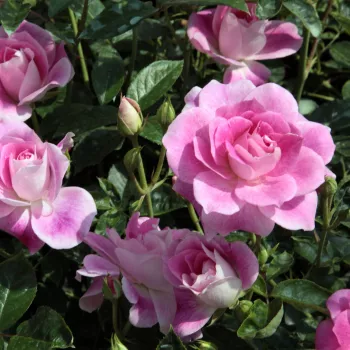
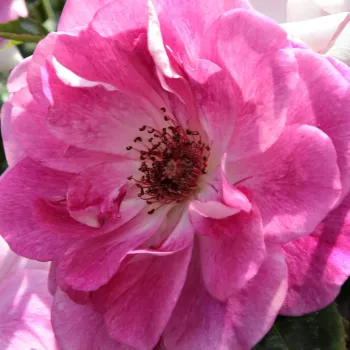
Regensberg™ – pink-white bedding floribunda rose – McGredy
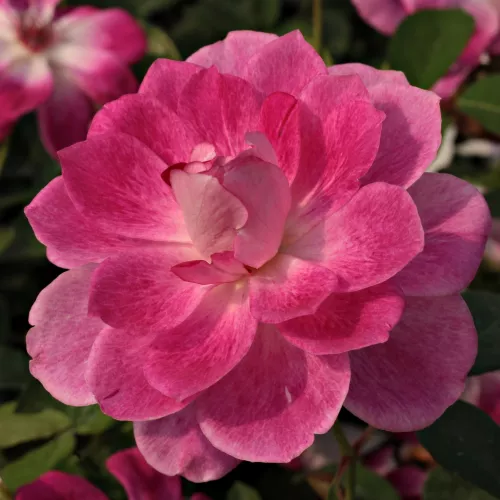
Hand-painted petals give Regensberg™ its instantly recognisable, cottage-garden charm, with medium-sized, semi-double blooms carried in free-flowering clusters on a compact, bushy plant that fits perfectly into small to medium front gardens and low borders. This own-root rose establishes steadily, forming a long-lived, well-anchored shrub that copes reliably even where soils need better drainage or raised beds to manage persistent wetness. In a sunny spot and with straightforward care, it repeats generously from early summer, providing a lively, colourful display against its healthy, glossy foliage. The medium-height habit makes it easy to place near paths, windows and seating areas, where its clearly noticeable, fruity fragrance can be enjoyed. In larger containers of at least 40–50 litres, it adapts well, creating a tidy, low-maintenance feature on patios and terraces. Year by year, you will see roots settle in the first season, stronger shoots and shaping in the second, and full, reliable flowering effect by the third.
Usage options
| Target area | Reasoning |
|---|
| Front garden focal shrub |
Ideal for a compact, eye-catching feature near the entrance, with its distinctive, hand-painted pink-and-white flowers showing well at eye level on a bushy, 50–70 cm plant that stays neat without complex pruning, suiting beginners. |
| Low edging along paths |
The even, medium height and dense branching allow Regensberg™ to form a soft, colourful edging that frames paths and driveways without overwhelming the space, easy to trim back lightly in winter for those with only basic tools, fitting busy-gardeners. |
| Small bedding groups (3–5 plants) |
Planted in loose drifts, repeated clusters of blooms create a vibrant, painterly band of colour; its moderate maintenance needs are manageable, while own-root growth supports long-term structure for those planning ahead, reassuring homeowners. |
| Mixed cottage-style borders |
The mid-pink and white tones blend effortlessly with perennials such as lavender cotton, calamint and sage, lending a relaxed, informal look while the bushy habit fills gaps quickly for lower-effort borders, appealing to cottage-gardeners. |
| Patio and terrace containers |
Performs well in larger pots of 40–50 litres or more, where its moderate size is easy to manage and regular repeat flowering gives a long season of colour, provided watering is consistent, which suits urban-owners. |
| Sunny, heat-exposed spots |
Good tolerance of warmth makes it suitable for sunnier south- or west-facing aspects, where it continues to flower provided you water during prolonged dry spells, reducing worry about heat stress for time-poor. |
| Family seating and play areas |
The clearly noticeable, fruity scent and showy clusters give plenty of visual and sensory interest around patios and lawns, while the medium height keeps prickles at a more manageable level for shared spaces, giving confidence to families. |
| Long-term structure in small gardens |
As an own-root floribunda, it develops a stable, rounded framework over the years, adapting naturally to local soil and care levels, even where drainage has been improved to handle wetter conditions, which benefits cautious starters. |
Styling ideas
- Painted-border – Repeat Regensberg™ in a short row along the front of a mixed bed, weaving between existing shrubs to create a continuous ribbon of pink-and-white clusters – ideal for owners refreshing a tired front border.
- Cottage-mix – Combine with lavender cotton, calamint and common sage in a loose, billowing planting for a traditional, softly structured cottage look – well suited to lovers of romantic, informal gardens.
- Patio-feature – Plant a single shrub in a 50–60 litre terracotta pot, underplant with low herbs for contrast and enjoy repeat flowering beside outdoor seating – perfect for balcony and terrace gardeners.
- Driveway-edge – Use small groups at recommended spacing to mark both sides of a drive, forming a low, colourful edging that remains easy to maintain and simple to prune – useful for busy households wanting order.
- Family-focus – Place near a main seating area where the fruity fragrance and painterly flowers can be appreciated at close range, framed by simple grasses or hardy perennials – appealing for families who entertain outdoors.
Technical cultivar profile
| Attribute | Data |
|---|
| Name and registration |
Regensberg™ (registered as MACyoumis), a floribunda bedding rose in the Hand Painted Roses collection; also exhibited under the American Rose Society approved name Regensberg. |
| Origin and breeding |
Bred by Samuel Darragh McGredy IV of McGredy Roses International from ‘Geoff Boycott’ × ‘Old Master’; selected in the early 1970s and introduced and registered internationally in 1979. |
| Awards and recognition |
Recognised with a Certificate of Merit at the Belfast rose trials in 1979, reflecting its garden performance and distinctive hand-painted flower effect valued by breeders and collectors. |
| Growth and structural characteristics |
Compact, bushy shrub reaching about 50–70 cm in both height and spread, with dense, mid-green, glossy foliage and moderate prickliness, forming a rounded, balanced habit under standard pruning. |
| Flower morphology |
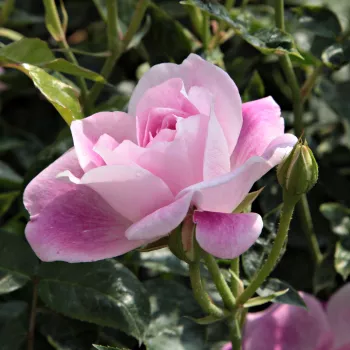
Bears medium-large, semi-double, cup-shaped flowers with approximately 17–25 petals, produced mainly in clusters; repeats well through the season, with an especially strong second flush in good conditions. |
| Colour data and phenology |
Hand-painted effect in mid-pink and white; buds open pastel pink, deepening towards the centre, then gently fade to blush-ivory tones; colour contrast is stronger in cooler weather and softens more quickly in heat. |
| Fragrance and aroma |
Noticeable, medium-strength fruity scent, readily perceptible at close range around seating areas; flowers have limited appeal to pollinators due to their semi-double form and more concealed stamens. |
| Hip characteristics |
Occasionally sets small, spherical orange-red hips about 6–10 mm across; hips are produced only sparsely because of the semi-double flower form and regular deadheading in many garden settings. |
| Resistance and winter hardiness |
Hardy to around −21 to −18 °C (RHS H7, USDA 6b, Swedish zone 3); shows moderate resistance to black spot, mildew and rust, with some protection and spring frost care advised in exposed gardens. |
| Horticultural recommendations |
Prefers a sunny position with well-drained soil; spacing varies from about 35–65 cm depending on use, equating to roughly 5–7 plants per m²; occasionally needs pest and disease control and spring frost protection. |
Regensberg™ offers compact, bushy growth, painterly repeat-flowering clusters and a clearly fruity scent on a long-lived own-root plant that settles in reliably over the years, making it a thoughtful choice when planning an easy-care garden.