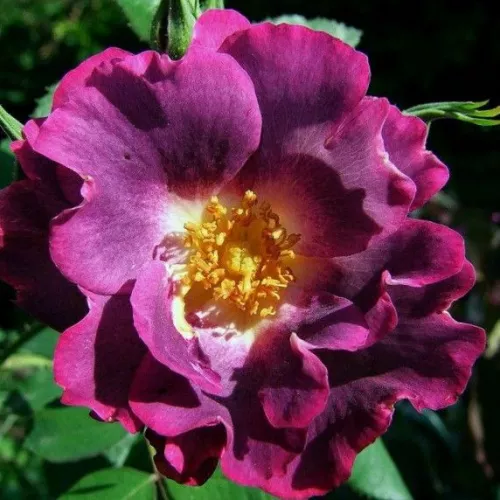
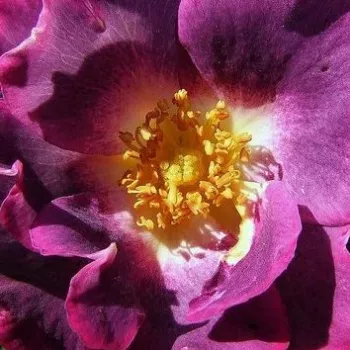
Deep violet-purple inner petals, with paler pastel-purple undersides. - climber, climbing rose - strong, long-lasting scented rose - spicy sweet aroma
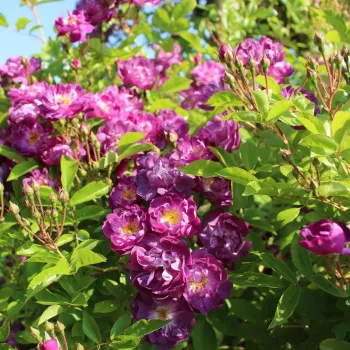
– Large, cupped clusters in rich purple tones.
– Strong, long‑lasting spicy sweet fragrance.
– Reliable repeat flowering with generous second flush.
– Hardy climber to H7, suitable for colder sites.
– Good heat tolerance, manages summer extremes.
– Special feature: Multi‑award‑winning climber praised in international trials.
Elegant spaces – Grower care
pharmaROSA® ORIGINAL 2-litre own-root potted rose
19,30 £
Unfortunately, we are currently unable to ship to the United Kingdom; we only deliver to countries within the European Union. For more information, please contact us!
5(9018)
P. S. DE LUXEMBOURG™ – purple climbing rose – Orard
This vigorous climbing rose combines colour, height and long flowering to create an elegant vertical focus around porches, fences and cottage-style front gardens, while coping well with breezy, damp conditions near the coast. Its deep violet-purple blooms open in generous clusters, fading gently to lavender for a soft, romantic effect that works beautifully against brick, timber or painted walls. Strong, spicy-sweet fragrance adds character to paths and seating areas, and the dense, dark green foliage keeps structures clothed even between flushes. As an own-root plant it settles in steadily, forming a durable framework that is easy to maintain over many years, following the natural rhythm of Year 1 roots, Year 2 shoots and Year 3 full impact. Provided with adequate watering and basic feeding, it offers dependable, remontant performance for busy gardeners who want a stylish, long-lived climber without complicated care.
Semi-double violet-purple blooms with a yellow stamen centre.
Usage options
Target area
Reasoning
House wall or sunny front façade
Ideal for training up wires or trellis on south or west-facing walls, where the generous height and dense foliage quickly soften brick or render. The repeating clusters of purple blooms give a classic cottage feel with relatively simple seasonal pruning, suiting busy homeowners.
Arch, pergola or walkthrough
The tall, flexible canes lend themselves to arches and pergolas, creating a scented passage with strong, spicy-sweet flowers at head height. Semi-double clusters give good colour without overwhelming narrow spaces, fitting gardens where you want structure and romance for family visitors.
Garden fence or boundary screen
Planted at the base of a sturdy fence, it forms a leafy, flowering screen that breaks up long boundaries and offers privacy without needing intricate training. Moderate maintenance and good hardiness are helpful in typical British plots exposed to wind and persistent damp, benefitting suburban gardeners.
Feature pillar or obelisk in a border
Used on a free-standing pillar or tall obelisk, it becomes a vertical accent among perennials and shrubs, adding drama in purple tones above lower planting. Regular dead-heading keeps the display tidy, while own-root growth ensures the framework rebuilds well over time for style-conscious beginners.
Small group in a mixed cottage border
Two or three plants spaced along a bed can be trained on discrete supports to echo each other, picking up purples and blues from companion perennials. The colour fade from deep violet to lavender blends easily into informal cottage schemes, appealing to flower-focused homeowners.
Part-shade side return or courtyard
Tolerates partial shade, so it suits side passages, courtyards or north-east aspects where full sun is limited but you still want a climbing feature. The long flowering season provides interest through much of summer with straightforward care, reassuring time-poor gardeners.
Trainable flowering hedge or screen
When spaced as recommended, it forms a loose, trainable hedge along driveways or garden divisions, combining vertical shoots and lateral tying for a tailored outline. Heat and light are handled comfortably, while regular trimming keeps it within bounds, making it practical for family gardens.
Large container with support
In a minimum 40–50 litre container with good drainage and regular watering, it can be grown on a trellis or obelisk for patios and roof terraces. The remontant flowering and manageable growth habit offer a refined vertical accent for urban balcony owners.
Styling ideas
Cottage-porch – Train up either side of a front door with Alchemilla mollis at the base, softening steps and paths in a classic purple-and-chartreuse palette – ideal for lovers of traditional British entrances.
Romantic-arch – Grow over a metal or wooden arch, underplanting with Rudbeckia fulgida and late perennials for gold-and-violet contrast – suited to gardeners seeking a picturesque walkthrough focus.
Contemporary-fence – Use against slatted timber with simple, repeated grasses for a clean, graphic look broken by clusters of purple blooms – for design-aware owners of modern family gardens.
Courtyard-focus – Place in a large container with a slim obelisk, adding silver-foliage Artemisia nearby to highlight the lavender fade of the flowers – perfect for compact urban terraces.
Parkland-line – Plant as a loose row along a path or boundary, mixing with shrubs and informal perennials for a semi-wild yet structured feel – good for those planning generous, naturalistic spaces.
Technical cultivar profile
Parameter
Data
Name and registration
Climbing rose, large-flowered. Registered as ORAfantanov, traded as P. S. de Luxembourg™; ARS exhibition name Stormy Weather. Belongs to the Climber and Shrub rose groups.
Origin and breeding
Bred in France by Pierre Orard (Roseraies Orard) in 2006 from Heart ’n’ Soul × Rhapsody in Blue; introduced and registered in 2010 by Roseraies Orard and SAS R.O.S.E.
Awards and recognition
Highly decorated landscape climber: multiple gold medals in Baden-Baden, Rome and Nagaoka (2007), silver in Adelaide and Monza, plus Barcelona and Mesa awards for landscape and climbing performance.
Growth and structural characteristics
Vigorous climbing habit reaching about 260–380 cm high with 120–200 cm spread. Dark green, matt, dense foliage on moderately thorny canes; self-cleaning is partial, so some dead-heading is beneficial.
Flower morphology
Semi-double, cupped blooms with 13–25 petals, produced in clustered trusses. Large-flowered (around 2.75–3.95 inches), with strong remontant character and a generous second flush in suitable conditions.
Colour data and phenology
Deep violet-purple inner petals with paler undersides; buds dark purple with silvery edges. Colour lightens to lavender in full bloom and further in strong sun; RHS 79A inner, 76D outer, ARS code m.
Fragrance and aroma
Strong, long-lasting scent with a spicy-sweet character that carries well near paths and seating areas. Semi-double form offers partially accessible stamens with moderate pollinator attraction overall.
Hip characteristics
Rosehip set is generally sparse; where present, small spherical hips 8–12 mm across develop, coloured orange-red and adding limited late-season interest without dominating the plant’s appearance.
Resistance and winter hardiness
Hardy to about −26 to −23 °C (RHS H7; USDA 5b; Swedish zone 4). Disease resistance moderate to mildew, black spot and rust; tolerates heat well but needs watering during prolonged dry spells.
Horticultural recommendations
Suited to walls, arches, fences and park plantings. Prefers well-drained soil; in heavy clay, improve drainage or use raised beds. Maintenance moderate: training, pruning and occasional plant protection required.
P. S. DE LUXEMBOURG™ offers rich purple colour, generous height and strong fragrance on a long-lived own-root climber, making it a refined, dependable choice for those planning lasting structure in the garden.
Detailed product attributes
Product Identification Data
Product Name:
P. S. DE LUXEMBOURG™ – purple climbing rose - Orard
Product Type:
pharmaROSA® ORIGINAL - 2-litre own-root potted rose
Competition and Show Awards:
Baden‑Baden – Gold medal (2007); Rome – Gold medal (2007); Nagaoka, Japan – Gold medal (2007); Adelaide, Australia – Silver medal (2007); Monza – Silver medal (2007); Barcelona – Best landscape rose (2007); Mesa, Arizona, USA – Best climbing rose (climati
Closed Bud:
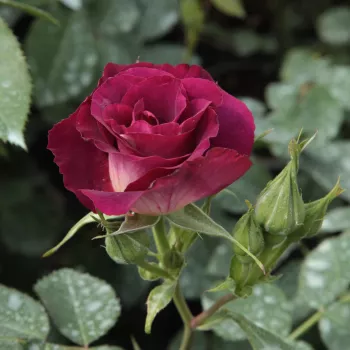
Dark purple, with a delicate silvery sheen at the edge.
Newly Opened Flower:
Intense, velvety purple outer petals with a slightly darker tone towards the centre.
Full Bloom:
Double violet-purple with a yellow ring of stamens in the centre that enhances the colour depth.
Before Fading:
Fading lavender colour with a silvery sheen along the edges.
Colour Fading Description:
The colour gradually fades as the flower opens: the deep violet–purple lightens to a lavender shade, and it fades further in strong sunlight.
Our product is a rose grown with pharmaROSA®’s unique cultivation technology!
2-litre, own-root, potted rose.
With a shoot system appropriate to the season.
With a root system that thoroughly permeates the growing medium.
Quality compliant with the requirements of the E.N.A. (European Nurserystock Association).
Supplied in unique packaging that prevents damage.
Can be planted during frost-free periods.
True-to-variety rose bush with a unique identifier.
The pharmaROSA® own-root potted rose is a well-rooted plant that supports reliable establishment when planted and cared for properly, so it can be planted whenever the soil is not frozen.
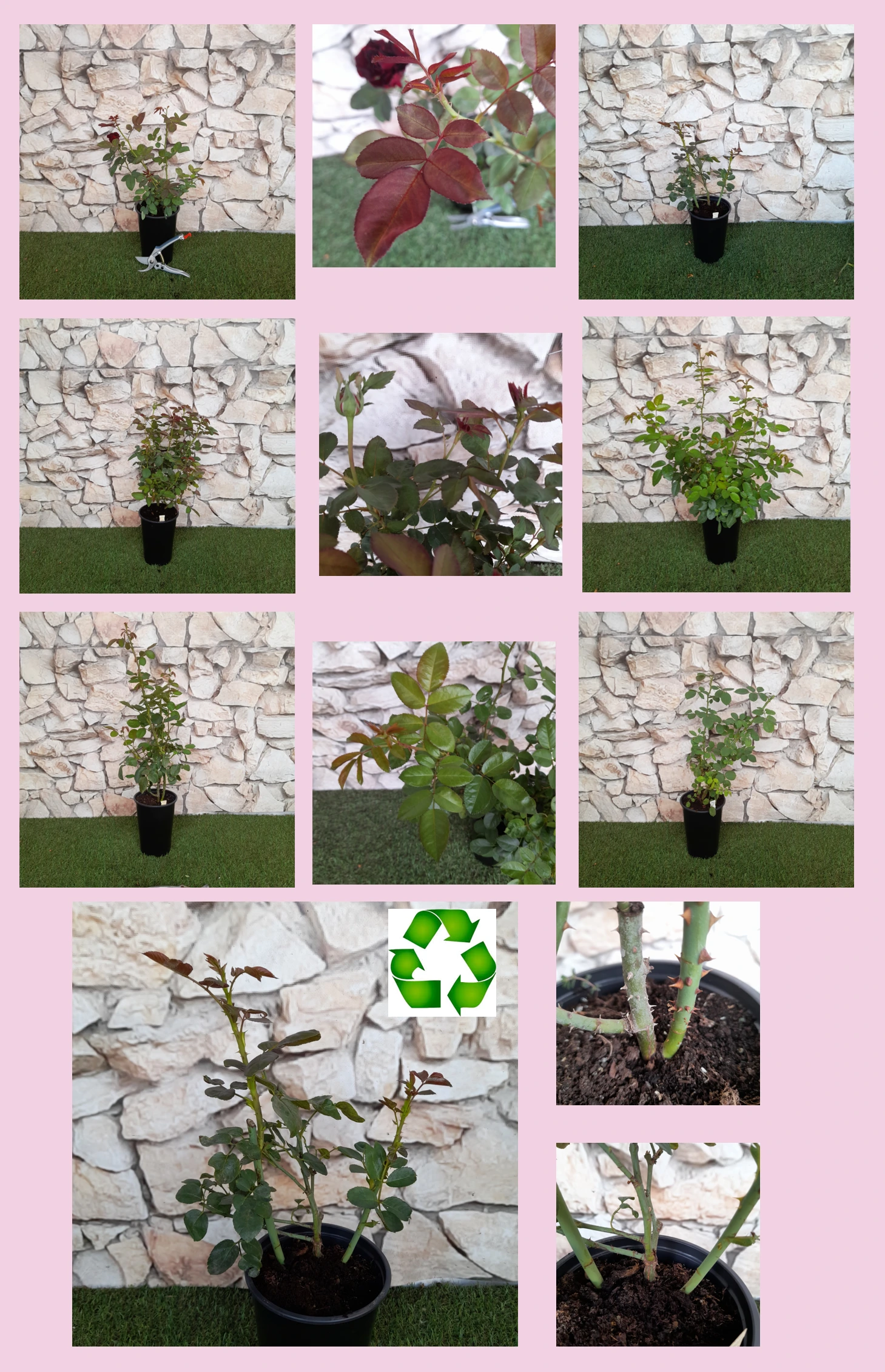
Crop overview: several varieties and growth stages in a short crop section.Shoot system: intensive growth of fresh basal shoots on a young plant.Root system: demonstration of a vigorous root system permeating the growing medium, by removing the pot.Balance: mature plant with root system and shoots in harmony with each other.
Information about the videos
The video series is not a “seasonal showcase”; it illustrates the essence of pharmaROSA® own-root cultivation in a tangible way: how the plant is built up, what the root system is like and how the shoot system regenerates. The recordings were therefore made at different times and with plants at various stages of development, so mixed foliage levels and differing stages of growth may appear in the videos. They are not a ‘sample’ of the batch dispatched, but a visual explanation of how the technology works. The current condition of the rose available to order — typical for the given period and similar to what you can expect to receive in the parcel — is shown in the upper part of the product page.
Pages for private customers Garden roses for the family garden, with minimal care → ORIGINAL® Premium garden roses – instant impact, a truly showpiece garden → EXTRA® Pages for professionals and private customers Roses for public spaces – large areas, sustainable maintenance → NATURAL® Roses for projects – hedge and row planting, fast implementation → RAPID® For professional partners only Production – propagation material for garden roses, wholesale → NEONATAL®
Company details
PharmaRosa Ltd. Company registration number: 01-09-717479 VAT number: 13075314-2-43 Plant health registration no.: HU130721 Bank account (IBAN): HU85117631891388688400000000 BIC (SWIFT): OTPVHUHB Bank name: OTP Bank Nyrt.