PAUL'S HIMALAYAN MUSK RAMBLER – pale pink rambler climbing rose - Paul
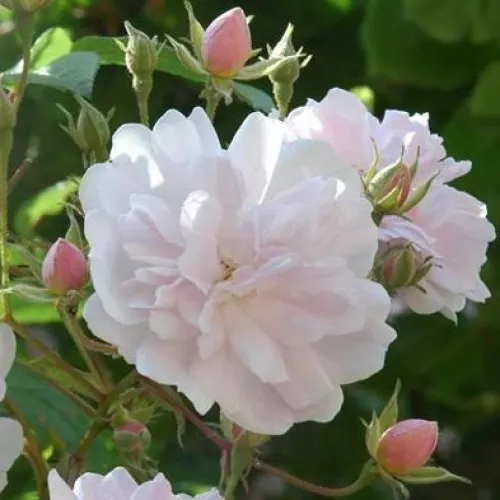
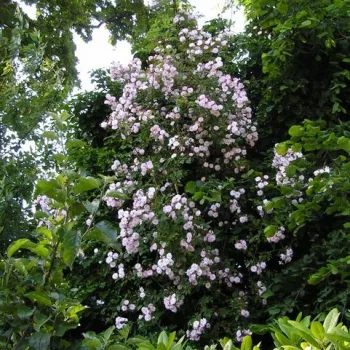
Cottage front gardens and classic pergolas come alive with the airy, pale pink clouds of Paul’s Himalayan Musk Rambler, a once-blooming cascade of flowers that covers walls, arches and mature trees with scented summer garlands. Its very strong musk fragrance drifts across the garden, while the dense, sea-green foliage clothes long, flexible canes that readily weave through supports and older trees. This own-root climber settles in reliably and, with simple pruning, builds a long-lived framework that anchors structures even where heavier soils need careful drainage. In a typical family garden it rewards patient planting with the natural rhythm of year-on-year maturity, moving from establishing roots to strong new shoots and then to full ornamental value over several seasons, offering a romantic vertical accent with modest ongoing care.
Usage options
| Target area | Reasoning |
|---|
| Large pergola or arbour in a family garden |
Ideal where you want a single dramatic flush of flowers smothering an arbour or pergola: the very strong musk scent and dense clusters create a memorable focal point in early summer, while once-blooming habit keeps maintenance straightforward for beginners. |
| Training into a mature tree for a romantic “rose in the canopy” effect |
Exceptionally long, flexible canes and vigorous rambler growth allow you to thread the plant into established trees, giving clouds of pale pink blooms high in the canopy and a long-lived structure that, as an own-root rose, regenerates reliably for owners. |
| Front-garden boundary, wall or tall fence |
Perfect where vertical space is available but ground space is limited: it covers tall walls and fences quickly, the dense foliage providing attractive screening even after flowering, helping busy householders achieve impact without complex pruning for households. |
| Large cottage-style border backdrop |
Used at the back of a deep border, it offers a soft, pale pink curtain behind perennials and grasses, with self-cleaning flowers that drop cleanly, reducing deadheading and keeping a traditional cottage look manageable for style-conscious gardeners. |
| Family seating area or terrace edge |
When trained over an arch or frame by a seating area, the very strong musk fragrance and early-summer flower clouds create a seasonal “event” space, rewarding simple annual tying-in and light pruning for scent-loving visitors. |
| Partial-shade side garden or north–east aspect |
Suited to aspects with only part-day sun, it still flowers abundantly when roots are well fed and watered, making use of awkward side passages or shaded corners that many climbers dislike, especially for space-conscious urban residents. |
| Large container or planter by an entrance |
In a 40–50 litre or larger container with a strong obelisk or frame, it forms a tall, graceful column of bloom and foliage; own-root vigour and good winter hardiness support long-term use when watering is kept regular by busy but enthusiastic starters. |
| Exposed site or open, windy garden edge |
Once established on a sturdy support, its vigorous framework and reliable hardiness give reassuring permanence even in breezier spots where a strong, anchored climber is needed and where heavy soils may need careful attention to moisture and drainage management for families. |
Styling ideas
- COTTAGE ARCH – Train over a timber or metal arch and underplant with foxgloves, hardy geraniums and catmint to create a soft, romantic entrance – ideal for lovers of traditional British cottage style.
- TREE VEIL – Thread canes into an established apple or ornamental tree, letting pale pink clusters spill from the canopy – perfect for creative gardeners seeking a storybook, “rose in a tree” feature.
- PERGOLA WALK – Cover a long pergola and edge the path with lavender and low grasses for a scented early-summer tunnel – suited to families wanting maximum impact from simple, once-a-year care.
- FRAGRANT CORNER – Place a bench beneath a wall-trained plant and combine with shade-tolerant ferns and hostas – attractive to those who value an intimate relaxation spot with powerful seasonal fragrance.
- ROMANTIC SCREEN – Use along a tall boundary with loose, naturalistic companions such as Liatris ‘Alba’ and Carex ‘Blue Zinger’ – great for homeowners who prefer soft screening over hard fencing.
Technical cultivar profile
| Parameter | Data |
|---|
| Name and registration |
Paul's Himalayan Musk Rambler, commercial rambler / climbing rose; ARS exhibition name Paul’s Himalayan Musk; unregistered cultivar used widely in gardens and landscape plantings. |
| Origin and breeding |
Bred by George Paul Jr. of W. Paul & Son Nursery, England; introduced 1916. Parentage Rosa brunonii × Rosa brunonii hybrid, reflecting strong musk fragrance and vigorous rambler growth. |
| Awards and recognition |
Holds the Royal Horticultural Society Award of Garden Merit, indicating proven garden performance, reliability and ornamental value under typical UK conditions when given suitable support. |
| Growth and structural characteristics |
Very vigorous rambler with climbing habit, 800–1100 cm high and 450–800 cm spread. Dense, slightly glossy sea-green foliage on moderately thorny canes; good for large supports and tree training. |
| Flower morphology |
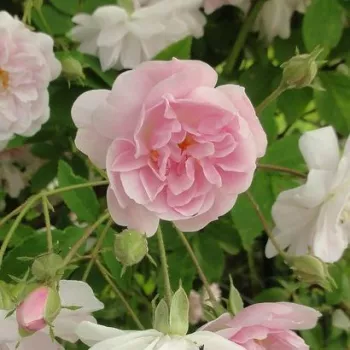
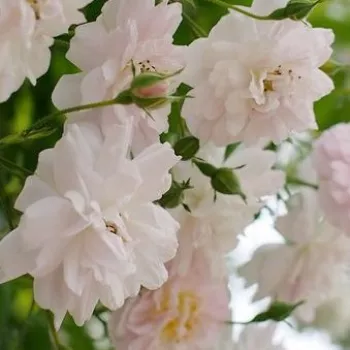
Small, double, flat blooms (0.5–1.5 in) in large, many-flowered clusters. Petal count typically 26–39. Not remontant, giving one abundant main flush; petals fall cleanly, so spent heads rarely need removal. |
| Colour data and phenology |
Pale pink blooms, RHS 65C outer, 65D inner; soft pastel tones fading to nearly white in strong sun. Buds pearly pink, opening to translucent blooms that lightly veil supports in early summer. |
| Fragrance and aroma |
Very strong musk fragrance, noticeable from a distance in still air. Scent reminiscent of classic musk roses, intensifying around peak bloom and especially effective over seating areas or paths. |
| Hip characteristics |
Forms small ovoid red hips, about 5–7 mm diameter. Usually moderate in quantity; primarily ornamental, adding a discreet seasonal accent without significantly affecting the plant’s overall appearance. |
| Resistance and winter hardiness |
Hardy to about -32 to -29 °C (RHS H7, USDA 4b, Swedish Zon 5). Disease tolerance moderate overall: good black spot resistance, with powdery mildew and rust manageable by occasional protection. |
| Horticultural recommendations |
Suited to pergolas, walls, arbours and tree training; plant 430–750 cm apart depending on effect. Thrives in moist but well-drained soil; water during prolonged dry spells and tie in young growth. |
Paul's Himalayan Musk Rambler offers vigorous height, enchanting musk fragrance and a long-lived, own-root framework for arches, trees or walls; an inspired choice if you want a once-blooming summer spectacle with modest upkeep.