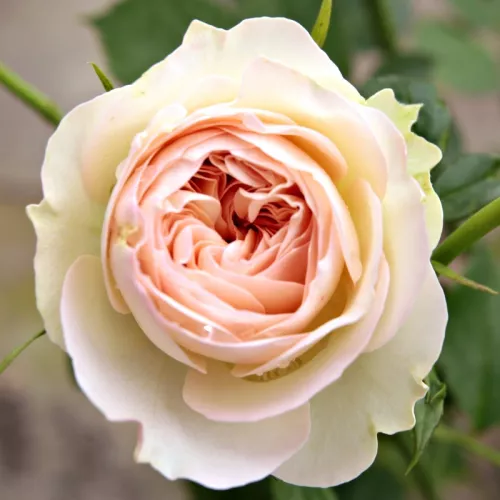
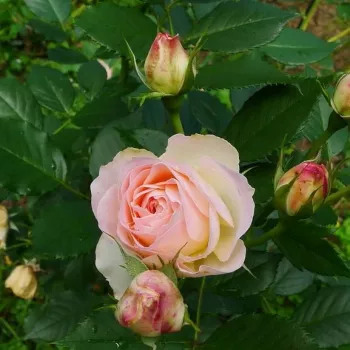
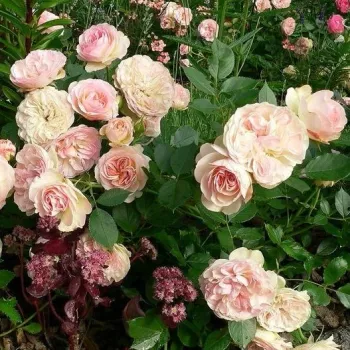
ORIENTICA – cream-pink bedding floribunda rose – pharmaROSA® ORIGINAL
Orientica brings a quietly refined presence to compact British gardens, with softly cream-pink rosettes held on an upright bush of dark, healthy foliage that copes well with breezy, damp conditions and typical garden borders. This bedding floribunda flowers repeatedly through the season, giving a dependable display without demanding complex care – an ideal choice when you want to plant, water and simply enjoy a cottage-style effect. As an own-root rose it builds strength year by year, supporting a long, steady life in the garden and recovering well from any occasional mishaps. Expect strong root establishment in the first year, fuller shoots in the second, and a rounded, satisfying display from the third, making it a reassuringly long-term investment for small groups, low hedges and front-garden plantings. Its medium maintenance needs remain manageable even for beginners, while medium disease resistance and good winter hardiness suit typical UK family plots on clay or chalk, where drainage and siting are more important than intensive upkeep. Planted in small drifts or paired with simple perennials, this floribunda offers a calm, reliable flowering rhythm that supports an easy-going garden routine and lets you focus on enjoying the view rather than constant attention.
Usage options
| Target area | Reasoning |
|---|
| Front garden feature group (3–5 plants) |
Planting Orientica in a small group near the front door or along a path gives an immediate, tidy focal point: upright, evenly proportioned bushes with dense foliage and softly shaded blooms that read clearly from the pavement. The repeat-flowering habit keeps the front garden looking presentable between routine maintenance visits, with only seasonal pruning and basic feeding required, which is reassuring for the occasional gardener. |
| Low rose hedge along drives or boundaries |
At around 105–135 cm high and 80–100 cm wide, Orientica naturally forms a low, structured hedge when planted at the recommended spacing, creating a gentle separation between drive, pavement and lawn without feeling overbearing. The steady, upright framework is easy to keep in line with light annual pruning, while own-root growth supports long-term regeneration after harder cuts, making hedge renewal less daunting for the home owner. |
| Mixed cottage-style border with perennials |
Orientica’s soft cream-pink, rosette-shaped flowers blend effortlessly with classic cottage-garden companions such as aubretia, yarrow and white verbena, giving a layered effect that looks considered yet informal. Its medium height allows perennials in front and behind, while repeat flowering stitches colour through gaps in the perennial cycle. Medium disease resistance and reliable hardiness mean it copes well in mixed borders subject to coastal wind and rain, providing continuity of structure for the style-focused beginner. |
| Compact bed in small family gardens |
For modest gardens where every square metre must earn its place, Orientica offers a balanced combination of size, colour and reliability. The bushy, dark foliage suppresses visual gaps, while successive flushes of blooms carry the bed from early summer to autumn without complex deadheading routines. Own-root plants settle in steadily and form a durable stand over the years, so the bed remains attractive as children, pets and daily life test the planting of a busy household. |
| Accent planting near patios and seating areas |
Placed beside a terrace or seating area, Orientica provides a calm, refined backdrop: rosette blooms in gentle pastel tones sit against slightly glossy foliage, softening hard paving and walls. The medium flower size reads well at close range without dominating, and remontant flowering ensures there is almost always something to enjoy on summer evenings. With only moderate maintenance needs, it suits those who want a pleasant view from the table rather than a major project. |
| Own-root long-term planting in established beds |
In established beds where you want a rose to mature in place without frequent replacement, the own-root form of Orientica is a practical asset. Over time it develops a stable framework from its own shoots, so even if winter or pruning reduces top growth, new canes arise from the base rather than relying on a graft. This supports a longer planting life, steady ornamental value and fewer replanting decisions for the long-range-minded planner. |
| Lightly tended family plots with medium care capacity |
For gardens where time is limited but basic tasks such as annual pruning, feeding and occasional pest checks are manageable, Orientica’s medium maintenance requirement fits comfortably. Medium disease resistance against black spot and powdery mildew reduces the need for frequent spraying under average UK conditions, especially if planted with reasonable air flow and decent soil preparation. This lets the plant deliver regular flowering and solid structure without daily attention, suiting the pragmatic, time-poor garden keeper. |
| Large container use on patios (minimum 40–50 L) |
In a well-drained container of at least 40–50 litres, Orientica’s upright habit and repeat-flowering performance translate well to terraces and paved front gardens with limited soil. Good root room allows the own-root plant to develop a stable, drought-resilient system, supporting year-on-year flowering without the instability of undersized pots. Its moderate size keeps the planting in proportion to typical townhouse spaces, making it a practical choice for the space-conscious urban resident. |
Styling ideas
- Cottage-Drift – Plant three Orientica in a loose triangle, underplant with aubretia and soft grasses for a relaxed cottage border – ideal for front-garden romantics who favour gentle, pastel schemes.
- Porcelain-Edge – Create a low hedge along a path with Orientica, interspaced with white verbena for vertical lightness – suited to homeowners seeking structured yet soft-edged front boundaries.
- Pastel-Pocket – Use a single Orientica as a specimen in a small bed, surrounded by pale yarrow and silvery foliage plants – perfect for compact gardens needing one reliable focal rose.
- Terrace-Anchor – Grow Orientica in a 50-litre container by a seating area, with trailing aubretia softening the rim – for urban gardeners who want long-term structure without complex care.
- Family-Frame – Line a short stretch of drive with evenly spaced Orientica to frame parking and play areas – aimed at busy families wanting order and colour without high-maintenance demands.
Technical cultivar profile
| Name and registration |
Orientica Bedding rose pharmaROSA®, a floribunda bed rose with cream-pink flowers; commercial type bedding floribunda rose. Exhibition and registration names are not recorded for this cultivar. |
| Origin and breeding |
Discovered in Germany in 1998 and introduced by PharmaRosa® Ltd. (Hungary); parentage and original breeding institution are unknown or not documented in current horticultural sources. |
| Growth and structural characteristics |
Medium-sized, upright bush 105–135 cm tall and 80–100 cm wide, with dense, slightly glossy, dark green foliage and moderate prickliness; forms a compact, well-furnished shrub suitable for beds and low hedges. |
| Flower morphology |
Medium-sized, double, rosette-shaped flowers with 26–39 petals, borne mainly in clusters; remontant flowering habit with an abundant second flush, providing regular colour across the main growing season. |
| Colour data and phenology |
Delicate cream to powder-pink blooms with pale peach undertones; buds ivory-cream with peach-pink flushing; colours gradually fade to cream-ivory with porcelain hints as the flower ages and the centre glow disappears. |
| Fragrance and aroma |
No reliable description or rating of fragrance is available; the strongly double flower form suggests any scent is likely to be light or incidental rather than a principal feature of this cultivar. |
| Hip characteristics |
Rosehip set is generally low because of the full, double flowers; where present, hips are small, spherical, red, typically around 10–14 mm in diameter, and are not considered a major ornamental feature. |
| Resistance and winter hardiness |
Rated to approximately –21 to –18 °C (RHS H7, Swedish zone 3, USDA 6b); medium overall disease resistance, with resistance to black spot and powdery mildew and moderate susceptibility to rust under pressure. |
| Horticultural recommendations |
Best at 55–65 cm spacing for hedging or mass planting, or 100 cm as a specimen; suits medium-maintenance regimes with occasional pest checks and benefits from fertile, well-drained soil and regular watering. |
ORIENTICA – cream-pink bedding floribunda rose – pharmaROSA® offers dependable repeat flowering, a compact upright habit and long-lived own-root resilience; a considered choice when you want lasting structure with manageable care.