NEUE REVUE® – red-white hybrid tea rose – Kordes
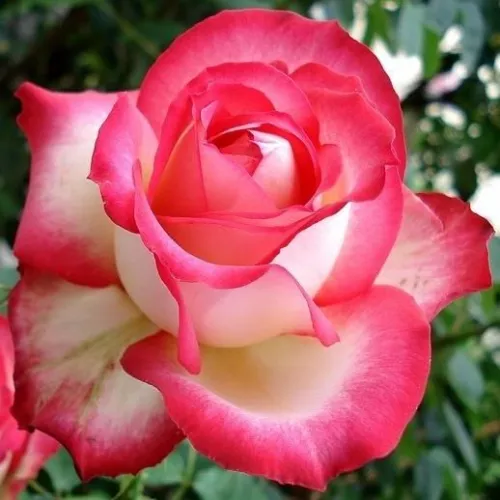
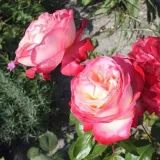
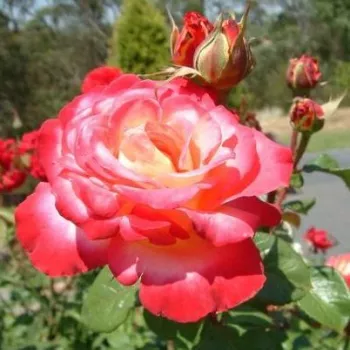
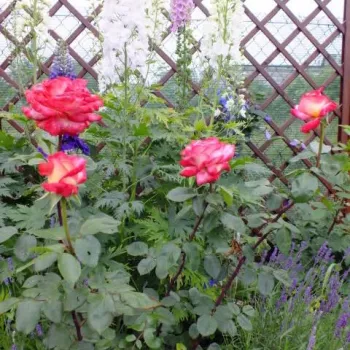
This elegant hybrid tea offers a reliable colour focus for classic British front gardens, with long, pointed buds opening to large, double blooms in a refined goblet form. Its bicolour petals – vivid scarlet edges around a creamy-white centre that softens to pink as they mature – create a timeless display both in the border and in the vase. Medium height and upright growth make it easy to place in small beds and narrow borders, while the dense foliage supports a neat structure that fits well with clipped shrubs and cottage perennials. In normal garden conditions it offers season-long repeat blooming with only moderate care, and as an own-root plant it develops a durable, regenerating bush that copes well with cool, damp spells and changeable UK summer weather.
Usage options
| Target area |
Reasoning |
| Front garden focal point |
Use as a single specimen near the entrance or beside a path where its upright habit and bi-coloured flowers read clearly from a distance. Regular deadheading and occasional feeding are enough to maintain a tidy, elegant look for beginners. |
| Small mixed border |
Its compact width suits narrow borders along fences or driveways, fitting among perennials and low evergreens without overwhelming them. The stable own-root framework matures steadily over several seasons, giving a long-lived structure for busy-owners. |
| Classic rose-and-lavender strip |
Planted in a row with dwarf lavender at the front, the scarlet and cream blooms stand out cleanly against the blue and grey foliage. Regular watering in dry spells and light pruning are usually sufficient for style-lovers. |
| Cutting bed for home bouquets |
The long, straight stems and large, double flowers with classic hybrid tea form are ideal for cutting. Grown in a small group, it provides a steady supply of strongly coloured, medium-scented blooms for simple home arrangements for home-florists. |
| Accent in a cottage-style mix |
Among loose perennials and traditional cottage plants, its defined shape and vivid blooms add a touch of formality without feeling stiff. The development from establishing roots to full ornamental effect over several years rewards patient gardeners. |
| Low, formal rose bed |
Planted at the recommended spacing, it forms a level, upright planting that reads almost like a low hedge of red-and-cream blooms. Occasional pest and disease checks keep the display clean enough for perfectionists. |
| Sunny patio in a large container |
In a 40–50 litre pot with good drainage and regular watering, it performs well as a patio feature, its upright growth leaving space beneath for underplanting with seasonal colour. This suits space-conscious courtyard-owners. |
| Sheltered coastal or windy sites |
The dense foliage and moderate height help the plant hold its shape where wind is an issue, provided the soil drains well after heavy rain and is enriched at planting. This gives confidence to exposed-site garden-owners. |
Styling ideas
- Entrance Elegance – flank a front path with single specimens underplanted with dwarf lavender for a simple, fragrant welcome – ideal for homeowners wanting easy formality.
- Cottage Contrast – mix with soft pink campanulas and white foxgloves so its upright, bi-coloured blooms add structure within a loose cottage scheme – for romantically inclined gardeners.
- Patio Feature – grow one plant in a 40–50 litre terracotta pot with trailing thyme at the rim for a compact yet striking summer focal point – suited to balcony and courtyard spaces.
- Cutting Corner – dedicate a sunny bed to a small group of plants with a neat box edge, providing classic, long-stemmed flowers for vases – perfect for those who enjoy arranging indoors.
- Formal Ribbon – plant a low strip along a driveway with ball-shaped hollies behind to echo its upright habit and tidy outline – for fans of structured, low-maintenance layouts.
Technical cultivar profile
| Characteristic |
Data |
| Name and registration |
Hybrid tea rose; registered as KORrev, marketed as Neue Revue® hybrid tea rose KORrev, approved exhibition name Neue Revue within the Hybrid Tea group. |
| Origin and breeding |
Bred by Reimer Kordes (W. Kordes’ Söhne, Germany) from ‘Colour Wonder’ × unknown; bred and registered 1962, introduced 1969 through W. Kordes’ Söhne. |
| Awards and recognition |
Holds the ADR (Allgemeine Deutsche Rosenneuheitenprüfung) award from 1969, indicating proven performance in independent German rose trials at the time of assessment. |
| Growth and structural characteristics |
Upright bush 60–85 cm high, 35–50 cm spread, moderately thorny shoots and dense, mid-green, slightly glossy foliage forming a compact, tidy shrub when regularly deadheaded. |
| Flower morphology |
Large, double flowers with 26–39 petals, typically borne singly on stems; buds open to cup- to goblet-shaped blooms, remontant with a generous second flush in suitable conditions. |
| Colour data and phenology |
Red-white bicolour: vivid scarlet outer margins (RHS 46B) with soft cream-white inner surfaces (RHS 158C); colours hold well, deepening slightly with age and lightening modestly in hot weather. |
| Fragrance and aroma |
Noticeable, medium-strength fragrance of classic rose character; sufficient to enjoy at close range in the garden and in cut arrangements, without being overpowering in smaller spaces. |
| Hip characteristics |
Hip set is usually limited due to the double flowers; when present, small spherical orange-red hips around 10–14 mm in diameter can develop towards the end of the season. |
| Resistance and winter hardiness |
Rated to around −21 to −18 °C (RHS H7, USDA 6b, Swedish zone 3); medium disease resistance to black spot, powdery mildew and rust, best supported by sunny, airy planting and hygiene. |
| Horticultural recommendations |
Best in full sun with regular watering in hot spells; medium maintenance with periodic deadheading and health checks; suitable for borders, specimen planting and as a cut-flower rose. |
NEUE REVUE® hybrid tea rose offers vivid bicolour blooms, classic cut-flower form and a compact, long-lived own-root bush that settles reliably into family gardens, making it a thoughtful choice if you would like a refined but manageable rose.