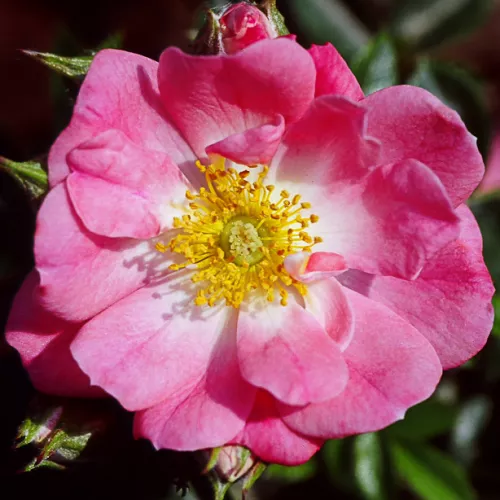
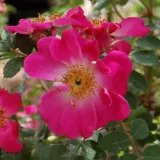
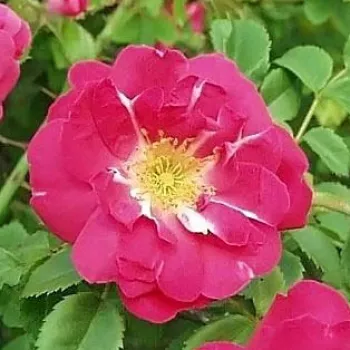
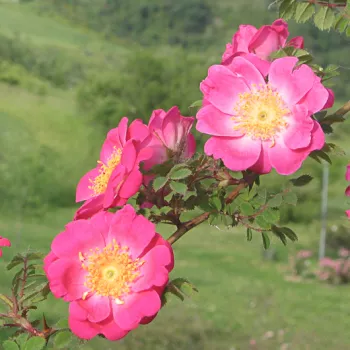
Solid vivid pink, with a lighter pink halo around the eye. - wild rose - very weak, barely noticeable scented rose - scent description not available
– Tall, upright shrub for striking hedges
– Vivid pink single blooms with golden stamens
– Decorative red bottle-shaped hips in autumn
– Good heat and periodic drought tolerance
– Hardy to severe frosts, USDA zone 4b
– Special feature: Supports pollinators and local wildlife all season.
Supports local wildlife – Long-term presence
pharmaROSA® ORIGINAL 2-litre own-root potted rose
18,70 £
Unfortunately, we are currently unable to ship to the United Kingdom; we only deliver to countries within the European Union. For more information, please contact us!
3.5(5893)
ROSA MOYESII 'EOS' – pink wild rose - Ruys
Bring a touch of dawnlight charm to your garden with Rosa moyesii ‘Eos’, a statuesque botanical shrub rose that settles in reliably and copes steadily with British summers, even where drainage can be challenging. This own‑root, durable wild rose builds up gradually – roots in the first year, shoots and framework in the second, and its full ornamental presence by the third – giving you confidence that your planting will mature naturally over time. Once established it is notably hardy, with good tolerance of heat and periodic drought, making it well suited to lower‑input family gardens. The single, pink flowers appear in generous clusters, self‑clean neatly, and are followed by decorative, bottle‑shaped red hips. Its upright, bushy habit creates a hedge or backdrop that anchors mixed borders and cottage‑style schemes without demanding constant attention. Flower form and open centres ensure it remains highly wildlife‑friendly, drawing in bees and other pollinators in early summer, then feeding birds with hips later in the year. Used as a specimen or in loose hedging, ‘Eos’ offers long‑term structure and seasonal interest with only moderate routine care, an enduring choice when you want a rose that simply works.
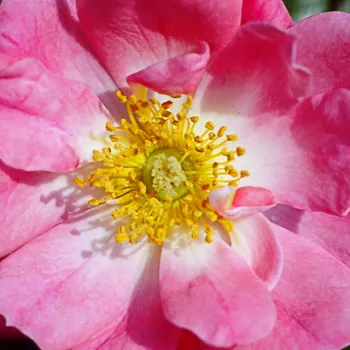
Golden-yellow stamens in the flower centre of Rosa moyesii 'Eos'.
Usage options
Target area
Reasoning
Informal flowering hedge along a boundary
The tall, upright, bushy growth and moderate thorniness make ‘Eos’ ideal for a soft, informal hedge that still discourages access. Plant at 120 cm spacing and allow it to build a natural wall of foliage and summer blossom with only periodic shaping – well suited to the family gardener.
Solitary specimen for lawn or front garden focus
As a free‑standing shrub at around 200–300 cm high, this rose becomes a strong vertical accent. Its wild character, single pink flowers and red hips provide changing interest from early summer into autumn, without the need for intricate pruning – appealing to the design‑conscious beginner.
Back of mixed cottage border
Placed at the rear of a bed, ‘Eos’ supplies height and a relaxed, natural outline that frames perennials and lower roses. Once rooted in, it copes well with sun and periodic summer dryness, giving a reliable backbone in smaller cottage‑style gardens – reassuring for the busy homeowner.
Wildlife‑friendly corner or pollinator strip
The single flowers with exposed golden stamens are easy for bees and other insects to use, and later hips offer food for birds. This makes ‘Eos’ a strong candidate for a wildlife strip where you want visible benefit without intensive management – perfect for the nature‑loving gardener.
Naturalistic hedge in urban green spaces
Its tolerance of sun, urban conditions and moderate drought, together with good winter hardiness, allows ‘Eos’ to serve as a sturdy, low‑input screening shrub. Once established, it forms a resilient, long‑lived line that needs only occasional rejuvenation pruning – ideal for the urban caretaker.
Long‑term structural planting in larger beds
The own‑root habit supports long lifespan and regeneration, so even if older stems age out, new shoots from the base keep the shrub productive. Over years it becomes a stable structural element, particularly in classic mixed borders – a sound choice for the long‑range planner.
Ornamental fruit display for autumn interest
After flowering, the shrub carries numerous bottle‑shaped red hips, 15–23 mm across, which light up hedges and backdrops in autumn. These hips provide both visual value and seasonal wildlife support with little extra work – attractive for the seasonal‑colour seeker.
Rural or coastal‑influenced gardens with challenging soil
‘Eos’ reaches 200–300 cm with a strong framework, anchoring beds where wind and exposure are factors, particularly if you provide improved soil in raised or well‑drained positions. This combination of stature and toughness suits exposed plots for the practical country gardener.
Styling ideas
Cottage‑hedgerow – Run ‘Eos’ as an informal hedge, underplanting with hardy geraniums and alchemilla to soften the base and echo its pink tones – for lovers of relaxed, traditional front gardens.
Lawn‑centrepiece – Use a single shrub in the middle of a small lawn, ringed with spring bulbs and summer perennials to highlight its seasonal flowers and hips – for homeowners wanting one easy focal point.
Wildlife‑border – Combine with echinacea and echinops to extend nectar through summer, letting ‘Eos’ provide height and hips for birds – for gardeners prioritising pollinators and biodiversity.
Natural‑screen – Plant a loose row at 120–140 cm spacings near boundaries, allowing the shrubs to knit together as a light, breathing screen – for those needing privacy without a hard fence line.
Botanical‑grove – Group three to five plants in a wide bed, mixing with ornamental grasses and Euonymus fortunei groundcover for a naturalistic, low‑maintenance thicket effect – for enthusiasts of wild, park‑style plantings.
Technical cultivar profile
Parameter
Data
Name and registration
Current trade name Rosa moyesii ‘Eos’, also shown as Eos in exhibition lists; an unregistered botanical shrub rose within the Rosa moyesii hybrid group, offered here as an own‑root garden shrub.
Origin and breeding
Bred in the Netherlands by Ruys at Koninklijke Kweekerij Moerheim, Dedemsvaart. A hybrid between Rosa moyesii and ‘Magnifica’, first introduced around 1950 as a robust botanical rose selection.
Growth and structural characteristics
Large, upright, bushy shrub reaching 200–300 cm in height and 150–260 cm spread. Moderately dense, matt medium‑green foliage on moderately thorny stems, forming a tall, naturalistic framework over time.
Flower morphology
Single to semi‑single flowers with 5–12 petals, medium sized at roughly 4–7 cm across. Produced in clusters on the upper parts of the shoots, flat in form, with one main summer flush rather than repeat blooming.
Colour data and phenology
Flowers open vivid fuchsia‑pink with lighter bases and golden stamens, ARS code RB, RHS 40B–40C. Colour softens to pastel pink with a lilac veil before petals fall; overall a strong pink early‑summer display.
Fragrance and aroma
Fragrance is very weak and often barely perceptible in garden conditions. The cultivar is chosen primarily for flower form, colour, hips and wildlife value rather than for notable scent character.
Hip characteristics
Forms moderately numerous bottle‑shaped rose hips, typically 15–23 mm in diameter, ripening to red by late season. Hips contribute to autumn display and provide an additional resource for birds and other wildlife.
Resistance and winter hardiness
Rated H7 for hardiness, tolerating approximately −32 to −29 °C and USDA zone 4b. Disease resistance is medium to major foliar issues, with generally good tolerance of sun, heat and periodic drought once established.
Horticultural recommendations
Best in full sun with reasonably well‑drained soil; suitable for hedging, solitary planting and naturalistic groupings. Allow space according to height, and prune mainly to remove old wood and maintain shape as needed.
Rosa moyesii ‘Eos’ offers tall, structural flowering, wildlife support and decorative hips, while its own‑root form underpins long life and dependable regrowth, making it a thoughtful choice for enduring garden planting.
Detailed product attributes
Product Identification Data
Product Name:
ROSA MOYESII 'EOS' – pink wild rose - Ruys
Product Type:
pharmaROSA® ORIGINAL - 2-litre own-root potted rose
Closed Bud:
Medium-deep raspberry pink, with a slightly velvety surface and a slightly darker edge.
Newly Opened Flower:
Vivid fuchsia-pink petals with a paler rosy flush at their bases, and golden-yellow stamens glowing from the centre.
Full Bloom:
Uniform intense rose/raspberry-pink effect, the petal tips are cooler, with a lighter rosy halo around the eye.
Before Fading:
The colour lightens and softens, fading to a pastel pink with a delicate lilac bloom.
Colour Fading Description:
As the bloom opens the vivid fuchsia–pink tone gradually lightens and fades to a pastel pink, finishing with a faint purplish-ashen veil.
Pollinator Attraction:
Its simple flowers, with 5–12 petals, attract pollinators; simple or semi‑double forms with exposed stamens and accessible nectaries are particularly appealing because they make pollen and nectar easy to reach, whereas fully double blooms with concealed s
Our product is a rose grown with pharmaROSA®’s unique cultivation technology!
2-litre, own-root, potted rose.
With a shoot system appropriate to the season.
With a root system that thoroughly permeates the growing medium.
Quality compliant with the requirements of the E.N.A. (European Nurserystock Association).
Supplied in unique packaging that prevents damage.
Can be planted during frost-free periods.
True-to-variety rose bush with a unique identifier.
The pharmaROSA® own-root potted rose is a well-rooted plant that supports reliable establishment when planted and cared for properly, so it can be planted whenever the soil is not frozen.
Crop overview: several varieties and growth stages in a short crop section.Shoot system: intensive growth of fresh basal shoots on a young plant.Root system: demonstration of a vigorous root system permeating the growing medium, by removing the pot.Balance: mature plant with root system and shoots in harmony with each other.
Information about the videos
The video series is not a “seasonal showcase”; it illustrates the essence of pharmaROSA® own-root cultivation in a tangible way: how the plant is built up, what the root system is like and how the shoot system regenerates. The recordings were therefore made at different times and with plants at various stages of development, so mixed foliage levels and differing stages of growth may appear in the videos. They are not a ‘sample’ of the batch dispatched, but a visual explanation of how the technology works. The current condition of the rose available to order — typical for the given period and similar to what you can expect to receive in the parcel — is shown in the upper part of the product page.
Pages for private customers Garden roses for the family garden, with minimal care → ORIGINAL® Premium garden roses – instant impact, a truly showpiece garden → EXTRA® Pages for professionals and private customers Roses for public spaces – large areas, sustainable maintenance → NATURAL® Roses for projects – hedge and row planting, fast implementation → RAPID® For professional partners only Production – propagation material for garden roses, wholesale → NEONATAL®
Company details
PharmaRosa Ltd. Company registration number: 01-09-717479 VAT number: 13075314-2-43 Plant health registration no.: HU130721 Bank account (IBAN): HU85117631891388688400000000 BIC (SWIFT): OTPVHUHB Bank name: OTP Bank Nyrt.