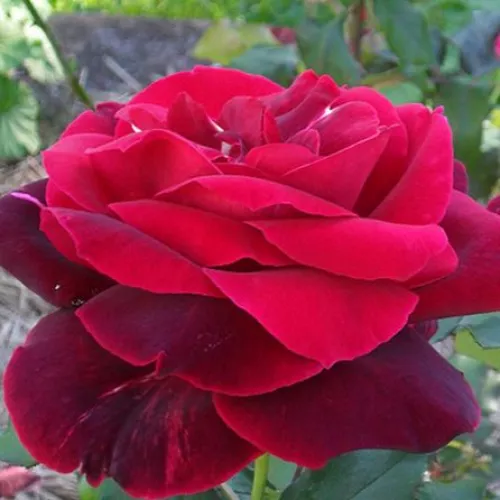
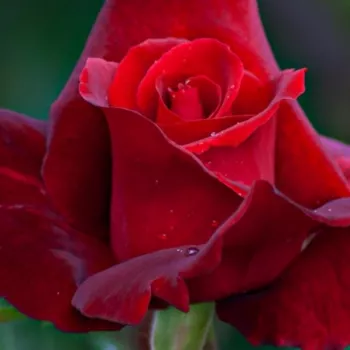
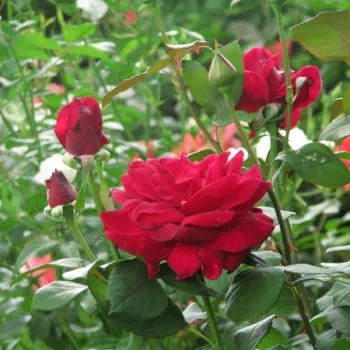
Mister Lincoln – deep red hybrid tea rose
Fragrance lovers appreciate ‘Mister Lincoln’ for its very strong, classic rose scent that carries across the garden, while its tall, upright habit and velvety, deep-red blooms give instant structure and drama to small beds and borders. This pharmaROSA® ORIGINAL own-root plant settles in reliably, forming a stable bush that matures steadily for a long garden life, even where persistent rain and wind call for anchorage and resilience. In typical British family plots it works as a front-garden focal point or in small groups, offering generous repeat flowering from summer onwards on a manageable, medium-maintenance regimen. With good sun and basic care it copes well with warmer spells, its heat tolerance and robust foliage helping the rich colour hold in hot weather. Over time the own-root structure supports regeneration after pruning or winter, so you can count on dependable rebloom and a consistent display. Planted with simple preparation and regular watering, it builds from establishing roots to stronger top growth and finally full ornamental presence over the first three years.
Usage options
| Target area |
Reasoning |
| Front garden feature rose |
The tall, upright growth and rich, velvety red blooms create an immediate sense of formality beside paths or front doors. Its strong, classic scent greets you and visitors as you pass, while the own-root base builds a long-lived, reliable shrub for beginners. |
| Small mixed border in family gardens |
Placed towards the middle or back of a typical small border, the 150–200 cm height rises neatly above perennials while the moderately dense foliage provides a dark green backdrop. Good heat tolerance helps it cope with warm, enclosed gardens for busy-owners. |
| Classic specimen near seating areas |
One plant set beside a bench or terrace showcases the cut-rose style, high-centred flowers and intense perfume at nose height. Regular deadheading keeps the shrub tidy and encourages further blooms, rewarding even modest care for scent-seekers. |
| Cutting patch for home bouquets |
The solitary, long-stemmed, exhibition-type flowers are ideal for vases, with large buds opening slowly and holding colour and shape indoors. Own-root vigour supports steady shoot replacement, so you can harvest stems each season with confidence for home-arrangers. |
| Paired planting at entrances or gates |
Two matching plants frame a doorway, gate or path, their upright habit and deep-red flowers giving a formal, welcoming look. Medium maintenance needs suit those happy to deadhead and feed a couple of times a year for style-conscious. |
| Rose border with cottage-style companions |
In a narrow border, its strong vertical habit rises behind lamb’s-ear or low perennials, while climbers such as clematis weave nearby without overwhelming it. This layering creates a traditional cottage feel without complex design work for cottage-lovers. |
| Wind-exposed suburban plots |
The firm, upright canes and own-root anchoring help the plant remain stable in open, breezier gardens where buildings funnel wind across the beds, provided the soil is prepared for good drainage in heavier ground for practical-gardeners. |
| Large containers on patios (40–50 litres) |
In a sufficiently large pot, its high-centred blooms and fragrance can be enjoyed close-up on patios or balconies. A 40–50 litre container allows root room for a durable, well-shaped shrub, as long as watering and feeding are kept regular for urban-owners. |
Styling ideas
- Entrance Drama – flank a front path with two Mister Lincoln roses underplanted with low lavender for contrast and scent layering – ideal for homeowners wanting instant kerb appeal.
- Classic Cottage – mix with foxgloves, hardy geraniums and lamb’s-ear so the tall red blooms rise through a soft tapestry – perfect for lovers of relaxed, traditional cottage borders.
- Evening Scent – plant near a terrace with white hydrangeas and pale violas to let the strong fragrance and dark blooms stand out at dusk – suited to those who unwind outdoors after work.
- Cutting Corner – group three plants in a sunny bed, spaced for airflow, to provide long, straight stems for vases through summer – for gardeners who enjoy arranging their own flowers indoors.
- Patio Statement – grow one plant in a 50 litre terracotta pot with trailing thyme at the rim for structure, scent and easy care – ideal for balcony or small-patio owners seeking a single bold feature.
Technical cultivar profile
| Parameter |
Data |
| Name and registration |
Hybrid tea rose, registered and marketed as Mister Lincoln; ARS exhibition name Mister Lincoln; hybrid tea rose commercial group and type, verified authenticity for garden use. |
| Origin and breeding |
Bred in the United States in 1964 by Herbert C. Swim and O. L. Weeks from ‘Chrysler Imperial’ × ‘Charles Mallerin’; introduced 1965 by Weeks and Star Roses. |
| Awards and recognition |
All-America Rose Selections winner 1965, James Alexander Gamble Fragrance Medal 2003, and Royal Horticultural Society Award of Garden Merit for proven garden performance. |
| Growth and structural characteristics |
Tall, upright shrub 150–200 cm high, 75–105 cm spread, moderately dense, slightly glossy dark green foliage, moderately thorny canes, weak self-cleaning so benefits from regular deadheading. |
| Flower morphology |
Large, double, 26–39 petal blooms, high-centred, pointed, solitary hybrid tea form; strong remontant character with abundant second flush, suitable for cutting and exhibition display. |
| Colour data and phenology |
Deep velvety red flowers, ruby-like in light; buds dark burgundy, violet-red veil at first opening, slight fade in heat; ARS code DR, RHS 53A outer and 187A inner petals, good colour retention. |
| Fragrance and aroma |
Very strong, long-lasting, classic rose fragrance; blooms carry well on warm still evenings, making the variety particularly suitable near seating areas or paths where scent is appreciated. |
| Hip characteristics |
Hip set is generally sparse due to full double flowers, with only occasional small ovoid red-orange hips 10–14 mm across, so ornamental impact is focused on the repeated flowering. |
| Resistance and winter hardiness |
Hardy to about –26 to –23 °C (RHS H7, USDA 5b, Swedish zone 4); resistant to powdery mildew and black spot, medium rust susceptibility; tolerates heat but needs watering in dry spells. |
| Horticultural recommendations |
Best in full sun with fertile, well-drained soil; medium maintenance including feeding and deadheading; plant 55–100 cm apart depending on use, with 2.5–2.9 plants/m² for massed schemes. |
Mister Lincoln offers tall presence, rich fragrance and repeat flowering on a durable own-root framework, making it a thoughtful choice when you want a dependable, characterful rose for your garden.