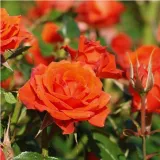
Mercedes® Bedding rose MERkor – orange-red floribunda rose
This compact floribunda is designed for easy front gardens and small beds, delivering reliable clusters of colour without demanding complex care. Its compact habit and moderate height make it ideal beside paths, bay windows or drives, where you want a neat, flowering structure that copes well with everyday British weather, including breezier, wetter spells near the coast. The vivid orange-red blooms repeat through summer, giving season-long impact from a modest footprint, while low-prickle stems support light cutting for the house. On its own roots, this rose builds long-term stability, regenerating from the base and settling into your soil over time for a dependable, long-lived display. You can expect strong roots in year one, fuller shoots in year two, and a rounded, fully developed ornamental presence by year three, all with minimal input. Plant, water, mulch and enjoy a quietly confident, low-maintenance rose that fits naturally into classic cottage-style borders.
Usage options
| Target area |
Reasoning |
| Front garden focal point near entrance or driveway |
The compact, upright habit and vivid orange-red clusters create an immediate welcome without overwhelming a small space. Positioned by a path, it stays within 70–95 cm, so it will not encroach on walkways or parked cars. Its low maintenance needs and reliable disease resistance reduce the workload for busy householders, offering a tidy, colourful front garden with only light annual pruning and occasional deadheading for beginners. |
| Small bedding groups in cottage-style borders |
Planted in groups of three to five at 40 cm spacing, Mercedes® builds a cohesive block of colour that ties together mixed herbaceous borders. The uniform orange-red tone reads clearly from the pavement, echoing classic cottage plantings without requiring intricate design work. The remontant habit provides successive waves of bloom through summer, letting you enjoy a traditional, richly coloured border with straightforward seasonal care for homeowners. |
| Low-maintenance flower borders around the house |
This variety’s good resistance to black spot, mildew and rust helps keep foliage clean and attractive even in humid, built-up settings, reducing the need for spraying or frequent interventions. Its compact, moderately dense foliage forms a neat base for repeated flowering, ideal along walls or fences where soil may be less than perfect. The own-root form gradually adapts and thickens, offering durable structure and dependable flowering for urban-gardeners. |
| Containers and large patio planters |
With a moderate height and tidy spread, Mercedes® suits large pots of at least 40–50 litres, where it can develop a stable root system and withstand seasonal drying. In a quality peat-free mix with regular watering, it flowers generously on balconies, terraces or paved front gardens. Its low-prickle stems make close-up maintenance and rearranging containers easier, providing a refined show of colour in compact outdoor living spaces for balcony-owners. |
| Family gardens needing robust, long-lived structure |
As an own-root rose, Mercedes® forms its framework from the base, so if stems are damaged by play, pets or pruning experiments, it regenerates reliably without the risk of suckers from a rootstock. Over time this produces a balanced, bushy plant that anchors borders visually and withstands years of family use. The steady, repeat flowering adds a stable backdrop to lawns and play areas with modest seasonal upkeep for families. |
| Simple cutting patch for casual home bouquets |
The cluster-flowered stems carry multiple medium-sized, double blooms in a uniform orange-red shade that blends well with neutral or pastel companions in a vase. While not bred as a formal exhibition rose, its neat goblet shape and good petal count give attractive, informal arrangements from a compact bed. Sparse prickles make cutting easier and reduce snagging, so you can pick a few stems as needed with minimal fuss for flower-lovers. |
| Borders in cooler or mixed-weather UK regions |
The variety tolerates heat but truly shines in typical British summers, where moderate temperatures help maintain richer colour and healthy foliage. Hardy down to around –20 °C, it can winter outdoors across most of the UK, returning reliably each year. Its disease resistance limits problems in damp spells, supporting a calm, low-intervention gardening routine for those who prefer simple, resilient plantings for time-poor. |
| Exposed or breezier suburban and coastal plots |
The compact, bushy structure and moderate height mean less wind-rock and fewer snapped stems than taller, lankier roses, helping it cope with regular gusts and showers. Once established, its own-root system anchors the plant securely, so it stands up well in open front gardens and less sheltered sites, offering consistent flowering even where wind and rain are frequent features of the local climate for coastal-gardeners. |
Styling ideas
- Cottage-Coordinated – Plant three Mercedes® in a triangle with soft pink geraniums and airy grasses to create a classic, low, cottagey drift – ideal for traditional front-garden owners.
- Front-Door-Frame – Flank a path or doorstep with paired roses in generous containers, underplanting with white lobelia for a welcoming, structured entrance – suitable for busy homeowners.
- Warm-Border-Glow – Combine Mercedes® with apricot echinacea and bronze heucheras to build a warm-toned bed that offers long-season colour from a compact footprint – perfect for design-conscious beginners.
- Family-Friendly – Use a short row of these low, stable bushes to edge a lawn, mixing them with easy perennials so the border stays attractive despite children and pets – good for family gardeners.
- Patio-Showpiece – Place a single rose in a 50-litre terracotta pot with a simple underplanting of trailing thyme for scented edging and simple care – suited to small-terrace or balcony gardeners.
Technical cultivar profile
| Parameter |
Data |
| Name and registration |
Floribunda bed rose registered as MERkor, marketed as Mercedes® Bedding rose MERkor; ARS exhibition name Mercedes, classed as floribunda and florists rose for garden and cutting use. |
| Origin and breeding |
Bred by Reimer Kordes of W. Kordes’ Söhne, Germany, from ‘Anabell’ × unknown seedling; bred 1974, registered 1974, introduced 1975, initially distributed by Jackson & Perkins, USA. |
| Growth and structural characteristics |
Compact shrub 70–95 cm tall and 50–70 cm wide, moderately dense mid-green foliage with slight gloss, sparsely prickled stems; requires some deadheading as spent clusters do not fully self-clean. |
| Flower morphology |
Medium-sized, double flowers with 26–39 petals, cup to goblet shaped, borne in clusters; remontant with abundant second flush, suitable for bedding, borders and informal cutting from a compact bush. |
| Colour data and phenology |
Uniform vivid orange-red tone, RHS 34B outer and 34A inner; buds deep fiery orange-red, opening to shining centres, then softening in strong sun while staying richer in cooler conditions. |
| Fragrance and aroma |
Fragrance very faint and barely noticeable; cultivated primarily for strong, consistent colour effect and bedding performance rather than scent, making it suitable where fragrance is not a priority. |
| Hip characteristics |
Produces few hips; when present they are small spherical orange-red fruits around 10–14 mm in diameter, offering occasional late-season interest without significant self-seeding issues. |
| Resistance and winter hardiness |
Good resistance to black spot, powdery mildew and rust; hardy approximately –21 to –18 °C (RHS H7, USDA 6b, Swedish zone 3); tolerates heat with watering during extended dry periods. |
| Horticultural recommendations |
Prefers sunny positions with well-prepared soil; suitable for borders, mass bedding, hedging and large containers; plant 35–65 cm apart depending on use, with 5.7–6.5 plants per m² for dense massing. |
Mercedes® Bedding rose MERkor offers compact, colourful flowering, disease resistance and long-lived own-root reliability, making it a thoughtful choice if you want a neat, low-effort rose that will quietly earn its place over time.