Mellite – golden-yellow flowerbed shrub rose – Tanjga
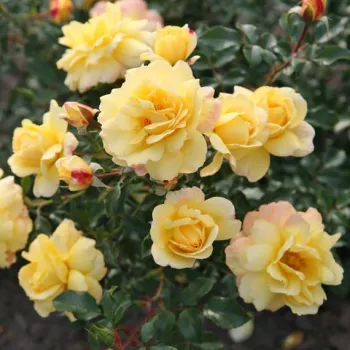
Honeyed clusters of warm golden-yellow blooms and a compact, bushy habit make Mellite a natural choice for tidy front borders and small cottage-style beds, even where you face frequent rain and need reliable wet-weather resilience. Its rounded shape and dense, mid-green foliage remain pleasingly orderly, giving structure all season with minimal shaping. As an own-root rose, it establishes steadily for long-term longevity, recovering more easily from winter or pruning setbacks. In year one it concentrates on roots, in year two on leafy shoots, and by year three it delivers its full ornamental display of rich golden-yellow, sweetly fragrant flowers. Ideal in beds, low hedging, or a generous 40–50 litre container, it offers dependable summer colour in everyday family gardens.
Usage options
| Target area |
Reasoning |
| Small front-garden flowerbed |
Mellite’s compact, bushy growth to around 40–60 cm keeps front gardens looking neat without complex pruning, while the golden-yellow clusters provide a bright, welcoming focus by the path or drive – ideal for the busy beginner |
| Low edging along paths or lawns |
The variety’s uniform growth and proportional arrangement make a tidy, low edging line, helping to define lawn edges or gravel paths; regular spacing at 35–40 cm creates a cohesive, structured border – reassuring for the order-loving homeowner |
| Small group planting in mixed cottage borders |
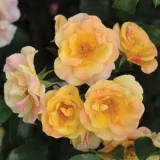
Planted in groups of three to five, Mellite forms a harmonious, rounded shrub mass that sits comfortably among perennials, its honey-yellow flowers weaving naturally into classic cottage-style schemes – attractive to the style-focused gardener |
| 40–50 litre terrace or patio container |
Compact height, dense foliage and medium-sized clusters make this rose highly suitable for generous containers of at least 40–50 litres, providing stable growth and a long-season focal point close to seating areas – perfect for the space-conscious urbanite |
| Feature rose in small borders |
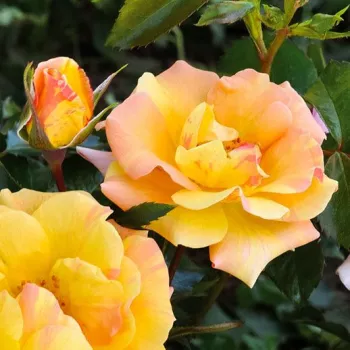
With its warm golden-yellow to apricot colour transitions and medium, double blooms, a single well-placed plant can act as a discrete focal point in a modest border, offering visual interest without overwhelming the space – ideal for the understated stylist |
| Long-term structural planting in family gardens |
As an own-root shrub, Mellite gradually adapts to soil and care, building a stable bush that can recover from harder pruning or weather damage and remain part of the garden for many years – reassuring for the long-term planner |
| Borders exposed to frequent rain and wind |
The dense foliage and sturdy, low framework help it hold its shape in unsettled weather, making it useful in exposed British gardens where calm days are rare and planting needs to cope gracefully with repeated showers – helpful for the coastal homeowner |
| Relaxed yet tidy family seating areas |
Clusters of medium-sized, sweetly scented flowers and a rounded habit give a soft but orderly look around patios or play areas, providing colour and fragrance without intrusive height or spread – well suited to the family-focused gardener |
Styling ideas
- Honey-border focus – Combine Mellite with soft creams and pale apricots in a narrow front border to echo its honeyed tones and keep the overall look calm – suited to the house-proud homeowner
- Cottage carpet – Underplant with creeping thyme and low Heuchera to soften the shrub’s base, creating a gentle cottage feel without losing its clear, compact outline – ideal for romantic border enthusiasts
- Golden path edge – Use repeated plants at 35–40 cm intervals along a front path for a low, structured edging that stays within bounds yet flowers generously – perfect for those who like precise lines
- Patio statement pot – Place a single plant in a 40–50 litre container with fine-textured companions, such as dwarf grasses, to emphasise its rounded form and easy reach for light pruning – suited to balcony and courtyard gardeners
- Family-friendly mix – Weave small groups of Mellite through mixed borders with long-flowering perennials to create a stable, low shrub layer that anchors the planting over many seasons – ideal for low-fuss family gardens
Technical cultivar profile
| Parameter |
Data |
| Name and registration |
Shrub rose registered as BOZangfre, marketed as Mellite in the Mella collection; a bed and flowerbed shrub rose offered as an own-root, container-grown plant for garden and landscaping use. |
| Origin and breeding |
Bred by Biljana Božanić Tanjga for Pheno Geno Roses, with unknown parentage; introduced and registered in 2017 by PhenoGeno Roses, initially distributed from Serbia into European markets. |
| Growth and structural characteristics |
Compact, bushy shrub reaching about 40–60 cm in both height and spread, forming dense, slightly glossy mid-green foliage on moderately thorny shoots, creating a rounded, even, well-filled bush. |
| Flower morphology |
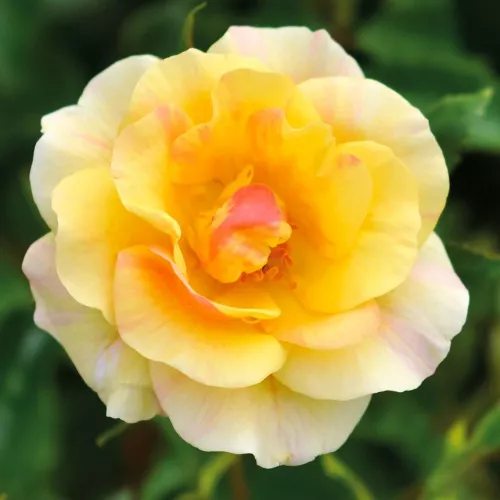
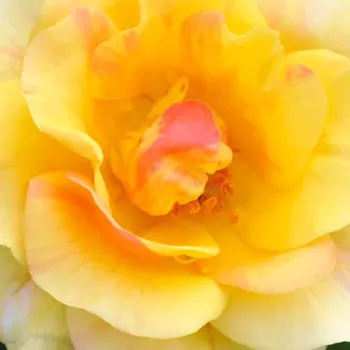
Medium-sized, double, flat to slightly rosette-like cluster-flowered blooms with 26–39 petals; repeat-flowering through the season with particularly abundant second flushes after the main early summer display. |
| Colour data and phenology |
Flowers open deep golden-yellow with a salmon sheen, then warm honey yellow with pale peach centres, fading towards light apricot and creamy tones, retaining colour well before petal drop in normal garden conditions. |
| Fragrance and aroma |
Clearly perceptible medium-strength scent characterised as pleasantly sweet, noticeable at close quarters around the bush; principally ornamental rather than a strong perfumed feature for cutting or indoor use. |
| Hip characteristics |
Fruit set tends to be slight due to the double flowers; where formed, hips are small, spherical, orange-red, about 6–10 mm in diameter, adding occasional discrete late-season interest without dominating the plant. |
| Resistance and winter hardiness |
Hardy in USDA zone 6b, RHS H7 and Swedish zone 3, tolerating approximately −21 to −18 °C; disease resistance is weak, with notable susceptibility to powdery mildew and black spot, requiring regular protective care. |
| Horticultural recommendations |
Best in well-drained soil with regular feeding and attentive disease management; suitable for beds, groups, low hedges and large containers, spaced 35–60 cm depending on use, with seasonal pruning to maintain shape. |
Mellite offers compact golden-yellow flowering, a naturally tidy habit and long-lived own-root growth, making it a thoughtful choice for gardeners seeking stable colour with considered care.