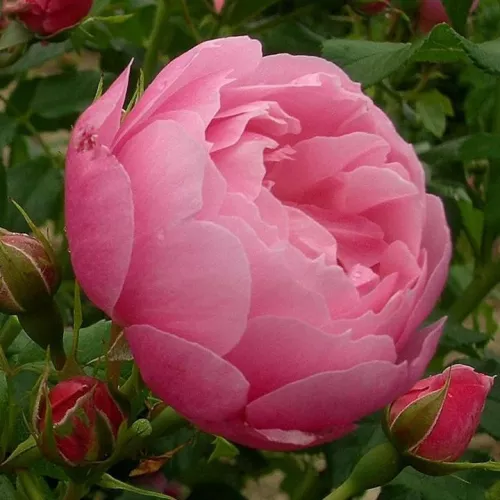
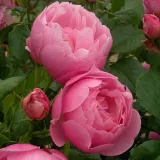
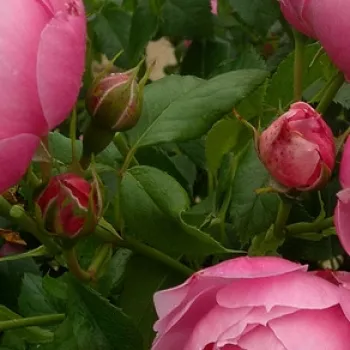
MARIE BLANCHE PAILLÉ – pink bedding floribunda rose – Rateau
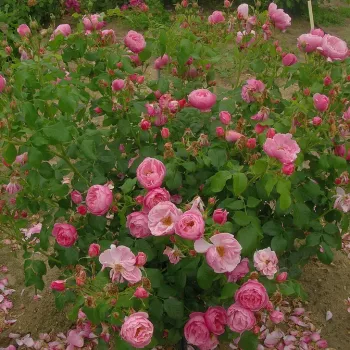
Effortless planting, naturally healthy growth and lasting flowering make Marie Blanche Paillé an easy choice when you want reliable colour in a family garden without complex care. This compact, upright floribunda forms a dense, tidy bush that fits beautifully into classic British front gardens and small borders, its ball-shaped, medium-large clusters opening in waves of raspberry-pink that gently soften to powder pink. Good self-cleaning means most spent petals fall away by themselves, helping the bed stay neat even if you only garden at weekends, while strong disease resistance reduces the need for spraying in damp, fungus-prone regions with heavy soils and capricious weather. As an own-root rose, it settles steadily, building roots in the first year, then stronger shoots in the second, before reaching full ornamental value by year three, giving you dependable floral structure and colour over the long term.
Usage options
| Target area | Reasoning |
|---|
| Front garden feature rose |
The upright, compact habit and tidy, dense foliage create an elegant, orderly shrub that sits well near the house, front path or entrance. Good self-cleaning helps the plant look neat between visits, ideal for image-conscious homeowners and the occasional gardener beginner |
| Bedding and small rose borders |
As a bedding floribunda, it thrives in small groups, providing repeat flushes of soft pink clusters that knit together into a coherent, low-maintenance display. Regularly remontant flowering keeps borders lively through summer for those wanting steady colour with minimal intervention busy-owners |
| Cottage-style mixed planting |
The shifting shades from raspberry pink to powder pink blend gently with perennials and grasses, echoing classic cottage gardens without demanding constant deadheading. Its moderate height suits layered planting schemes for style-focused gardeners seeking traditional charm with easy care cottage-lovers |
| Low-maintenance urban planting |
Strong resistance to black spot, mildew and rust means it performs reliably even where humidity, pollution and close planting can challenge roses, needing only basic watering and feeding. This simplifies rose growing for people managing small city plots and shared spaces urban-gardeners |
| Specimen rose in a feature bed |
Planted singly with space around it, the spherical clusters and subtly fading pink tones become a focal point that looks refined from bud to full bloom. Occasional autumn hips add a gentle seasonal accent, suiting gardeners who enjoy an elegant yet undemanding centrepiece home-owners |
| Own-root long-term plantings |
On its own roots the plant develops a stable, balanced framework that regenerates well after pruning and harsh winters, avoiding issues with weak graft unions over time. It is suitable for those planning long-lived beds who prefer to replant as rarely as possible long-termplanners |
| Partial-shade corners near buildings |
Tolerance of partial shade allows it to flower respectably where walls, fences or nearby shrubs reduce direct sun. This flexibility helps fill awkward side paths or north-east aspects, keeping colour going even in less-than-ideal positions for households maximising every metre of garden practical-gardeners |
| Small group plantings in heavier soils |
Planted in raised or improved beds, it forms well-anchored, disease-resistant groups that cope with Britain’s changeable summers and damp spells, reducing the need for sprays in humid conditions and on heavier soils. This reassures gardeners in challenging climates who still want reliable roses coastal-owners |
Styling ideas
- Cottage Harmony – combine with lavender, hardy geraniums and soft grasses to echo a traditional cottage border – ideal for style-conscious beginners wanting classic charm without fussy pruning
- Front-Door Welcome – plant a pair by the path with low box or hebe edging to frame the entrance – suited to homeowners seeking a tidy, flowering welcome with straightforward upkeep
- Pastel Ribbon – create a low, flowing strip along a driveway with repeat groups, linking to pinks and creams – for those who like coordinated colour and minimal deadheading effort
- Urban Pocket – set within a small, raised bed with thyme, dwarf grasses and slate mulch for clean lines – perfect for busy urban gardeners wanting reliable structure in limited space
- Soft Contrast – pair with white roses or pale-yellow perennials to highlight the raspberry-to-powder-pink blooms – for gardeners who enjoy subtle, sophisticated colour shifts through the season
Technical cultivar profile
| Parameter | Data |
|---|
| Name and registration |
Floribunda bed rose registered as EVEcinage, marketed as Marie Blanche Paillé Flowerbed rose EVEcinage; ARS exhibition name Marie Blanche Paillé, collection Flowerbed rose. |
| Origin and breeding |
Bred by Jérôme Rateau for Roses André Eve, France; bred 2009, introduced and registered in 2015, with initial distribution in France by Roses André Eve. |
| Awards and recognition |
Lyon International Rose Competition 2017 Plus belle rose de France and 1st prize large-flowered; Paris–Bagatelle 2017 Certificate in the large-flowered category, confirming strong ornamental merit. |
| Growth and structural characteristics |
Upright floribunda shrub reaching about 80–120 cm high and 70–100 cm wide, with dense, slightly glossy green foliage and moderate prickliness, forming a compact, well-filled bush. |
| Flower morphology |
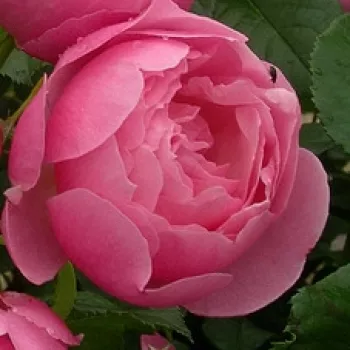
Medium-large, double, ball to pompon-shaped clusters with 26–39 petals; cluster-flowering habit and good self-cleaning, with spent petals dropping naturally to maintain garden neatness. |
| Colour data and phenology |
Raspberry-pink buds open to rich pink centres (RHS 65C/62C), then fade through medium pink to soft powder pink; paler outer petal margins give a pastel halo effect as blooms age. |
| Fragrance and aroma |
Delicate, mild fragrance of discreet character; primarily valued for visual impact rather than scent, suitable where strong perfume is not desired near doors, windows or seating areas. |
| Hip characteristics |
Occasional small spherical orange-red hips, around 6–10 mm in diameter, may form in autumn, giving modest additional ornamental interest without creating heavy self-seeding issues. |
| Resistance and winter hardiness |
Rated H7, hardy to around –29 to –32 °C (USDA 4b); good resistance to powdery mildew, black spot and rust, though regular watering is needed in prolonged heat and drought. |
| Horticultural recommendations |
Suitable for beds, specimens, cut flowers, parks and urban plantings; plant about 50–55 cm apart in groups, allow 90 cm for specimens, and use generous containers of at least 40–50 litres. |
Marie Blanche Paillé offers reliable repeat flowering, strong disease resistance and a compact, long-lived own-root habit that settles in steadily over the years, making it a sound, attractive choice for a relaxed yet refined garden.