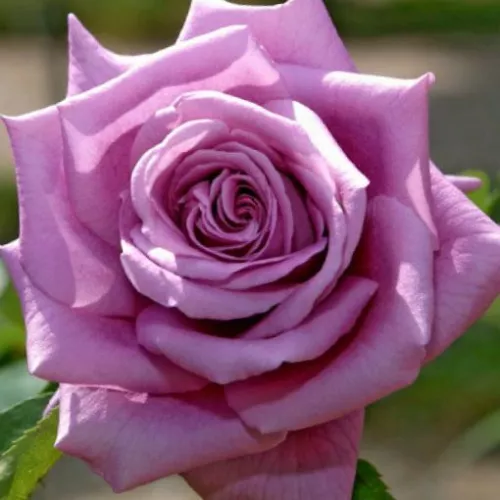
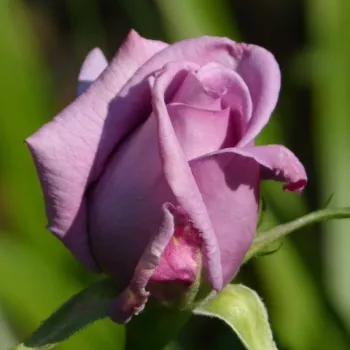
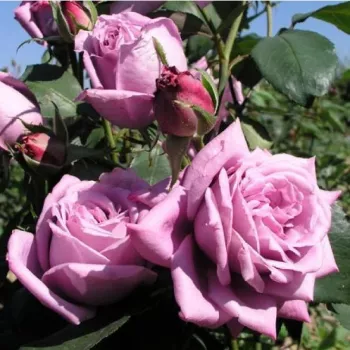
Deep, rich purple base colour with a subtle bluish‑violet iridescence. - hybrid tea rose - very strong, garden-filling scented rose - deeply sweet, violet-honey
– Deep, rich purple blooms with bluish sheen
– Classic high‑centred Hybrid Tea flower form
– Very strong, garden‑filling violet‑honey scent
– Reliable remontant rose with abundant second flush
– Compact, upright bush ideal for beds and cutting
– Special feature: Award‑winning fragrance, honoured in New Zealand (1997).
Unfortunately, we are currently unable to ship to the United Kingdom; we only deliver to countries within the European Union. For more information, please contact us!
5(13091)
Mamy Blue™ – violet-purple hybrid tea rose – Delbard
Fragrance lovers choose Mamy Blue™ for its deeply sweet, violet-honey perfume that drifts across the garden, while the velvety blooms open in rich purple shades that gently soften to lilac-mauve with a cool silvery sheen. This hybrid tea forms an upright, bushy habit ideal for neat front gardens and small beds, giving you classic, high-centred flowers on strong stems for cutting and display. In an own-root form, the plant matures steadily, building a long-lived framework that can regenerate from its own base and stay attractive for many seasons. In the first year it concentrates on roots, the second on stronger shoots, and by the third year it delivers its full ornamental impact with repeated flushes of flowers. Well-suited to typical British gardens that may face cool, damp spells and occasional fungal pressure, it responds best in a sunny, well-drained spot where its colour and perfume can be fully enjoyed.
Mamy Blue™ shows a double, high-centred bloom with 26–39 petals.
Usage options
Target area
Reasoning
Feature rose near the front door
Placed by a path or entrance, the intense violet-honey scent and rich purple flowers create an immediate welcome as you come and go, echoing traditional scented front gardens while remaining compact enough for small urban plots – ideal for fragrance-focused beginners.
Cutting rose for indoor arrangements
The high-centred, exhibition-style blooms sit on sturdy stems, making this variety excellent for cutting; a few stems in a vase easily perfume a room, giving you show-style flowers at home without specialist techniques – perfect for design-conscious home decorators.
Small specimen in a cottage-style border
Used singly in a mixed border, its upright, bushy habit and glossy foliage provide a vertical accent, while the shifting purple-to-lilac tones blend beautifully with soft perennials and climbers for a romantic cottage effect – appealing to cottage-garden enthusiasts.
Matched pair to frame steps or a path
Planting a pair on either side of a path or steps produces a symmetrical, tidy look in a modest space; as the plant settles, flowering becomes more reliable year after year, giving you a long-lived focal point – reassuring for busy, style-oriented homeowners.
Rose bed with classic hybrid teas
In a dedicated rose bed, its repeat-flowering habit and defined structure allow you to combine it with other hybrid teas at the recommended spacing, creating a formal yet manageable layout that is easy to prune and refresh annually – suitable for methodical planners.
Large patio container (minimum 40–50 litres)
Grown in a generous container with good drainage, this rose performs well on a patio or terrace, where you can enjoy its perfume at seating height and control soil quality more easily in wetter spells and humid conditions – ideal for balcony and courtyard gardeners.
Front-garden accent in clay or chalk soils
In typical British front gardens with heavier clay or chalky soils, planting into improved, well-drained pockets or a slightly raised bed helps it establish and flower reliably, keeping maintenance practical while preserving visual impact – useful for time-poor householders.
Long-term own-root planting for family gardens
As an own-root plant, it gradually builds a stable bush that can regrow from its own wood after hard pruning or weather damage, so the same plant can serve as a scented highlight in the garden for many seasons – reassuring for long-term-minded gardeners.
Styling ideas
Cottage Scent Corner – Place Mamy Blue™ with clematis and soft pink perennials near a bench to create a richly perfumed, romantic nook – ideal for cottage-style admirers who enjoy evening garden moments.
Classic Entrance Pair – Flank a front path with two plants underplanted with low Ajuga reptans to frame the doorway with colour and scent – suited to homeowners wanting smart kerb appeal with minimal complexity.
Patio Perfume Pot – Grow one plant in a 40–50 litre container beside outdoor seating so its fragrance and colour can be appreciated up close – perfect for balcony and terrace users with limited ground space.
Hybrid Tea Showcase – Combine Mamy Blue™ with other hybrid teas in a simple rectangular bed, keeping colours to lilacs, creams and deep reds for a formal yet easy-to-manage collection – attractive to organised hobby growers.
Vertical Accent Mix – Use its upright habit among airy grasses and low shrubs, with Parthenocissus on a nearby wall to echo the purple tones – appealing to design-led gardeners seeking structure without complex planting schemes.
Technical cultivar profile
Parameter
Data
Name and registration
Hybrid tea rose, registered as DELblue, marketed as Mamy Blue™ Grands Parfums DELblue; recognised exhibition name Mamy Blue in the hybrid tea group for cut and garden use.
Origin and breeding
Bred by Georges Delbard, France, from complex hybrid tea parentage including Holstein, Bayadère, Prélude and Saint-Exupéry; breeding completed 1983, registered 1984, introduced commercially 1991.
Awards and recognition
Holds a New Zealand Fragrance Award (1997), recognising its particularly strong, garden-filling scent; valued by exhibitors and collectors who prioritise perfume alongside distinctive purple-toned flower colour.
Growth and structural characteristics
Upright, bushy shrub reaching around 75–105 cm in height and 50–70 cm spread, with moderately dense, glossy dark green foliage and moderate prickliness; flowers are solitary and not strongly self-cleaning.
Flower morphology
Large, double blooms with 26–39 petals, high-centred and pointed in classic hybrid tea form; flowers are usually borne singly on stems, with remontant flowering and an abundant second flush in suitable conditions.
Colour data and phenology
Deep crimson-purple with bluish veil when fully open, shifting to lilac-pink with silvery, bluish shimmer; colour may lighten in strong sun; ARS code m, RHS 77A outer, 79B inner, described overall as purple-lilac.
Fragrance and aroma
Very strong, garden-filling perfume with a deeply sweet violet-honey character; primarily an ornamental variety with double flowers that partly obscure stamens, so pollinator value is limited despite intense scent.
Hip characteristics
Produces hips only occasionally; when present they are small, spherical, around 10–14 mm, and orange-red, offering modest late-season interest without significantly affecting the plant’s ornamental flowering use.
Resistance and winter hardiness
Hardy to approximately –23 to –21 °C (RHS H7, USDA 6a, Swedish zone 3); disease resistance moderate to powdery mildew and black spot but very susceptible to rust, so regular protection and good hygiene are advised.
Horticultural recommendations
Best in full sun with fertile, well-drained soil; water consistently in dry spells and deadhead to encourage repeat bloom; recommended spacing 50–90 cm depending on use, with 2.8–3.2 plants/m² in group plantings.
Mamy Blue™ brings richly scented purple blooms, reliable cutting stems and a long-lived own-root habit to front gardens and patios, making it a thoughtful choice if you value colour, perfume and staying power over many seasons.
Meaning of Cultivar Name:
The name 'Mamy Blue' is a playful designation referring to the 1970s hit of the same name, where 'Mamy' denotes the grandmother and 'Blue' evokes the bluish‑purple flower colour.
Pollinator Attraction:
Its strongly double flower form and reduced accessibility of the stamens mean it attracts pollinators poorly.
Pollinator-Friendly Rating:
The double flowers partially cover the stamens, so its pollinator-friendliness is limited; it is primarily an ornamental variety.
Our product is a rose grown with pharmaROSA®’s unique cultivation technology!
2-litre, own-root, potted rose.
With a shoot system appropriate to the season.
With a root system that thoroughly permeates the growing medium.
Quality compliant with the requirements of the E.N.A. (European Nurserystock Association).
Supplied in unique packaging that prevents damage.
Can be planted during frost-free periods.
True-to-variety rose bush with a unique identifier.
The pharmaROSA® own-root potted rose is a well-rooted plant that supports reliable establishment when planted and cared for properly, so it can be planted whenever the soil is not frozen.
Crop overview: several varieties and growth stages in a short crop section.Shoot system: intensive growth of fresh basal shoots on a young plant.Root system: demonstration of a vigorous root system permeating the growing medium, by removing the pot.Balance: mature plant with root system and shoots in harmony with each other.
Information about the videos
The video series is not a “seasonal showcase”; it illustrates the essence of pharmaROSA® own-root cultivation in a tangible way: how the plant is built up, what the root system is like and how the shoot system regenerates. The recordings were therefore made at different times and with plants at various stages of development, so mixed foliage levels and differing stages of growth may appear in the videos. They are not a ‘sample’ of the batch dispatched, but a visual explanation of how the technology works. The current condition of the rose available to order — typical for the given period and similar to what you can expect to receive in the parcel — is shown in the upper part of the product page.
Pages for private customers Garden roses for the family garden, with minimal care → ORIGINAL® Premium garden roses – instant impact, a truly showpiece garden → EXTRA® Pages for professionals and private customers Roses for public spaces – large areas, sustainable maintenance → NATURAL® Roses for projects – hedge and row planting, fast implementation → RAPID® For professional partners only Production – propagation material for garden roses, wholesale → NEONATAL®
Company details
PharmaRosa Ltd. Company registration number: 01-09-717479 VAT number: 13075314-2-43 Plant health registration no.: HU130721 Bank account (IBAN): HU85117631891388688400000000 BIC (SWIFT): OTPVHUHB Bank name: OTP Bank Nyrt.