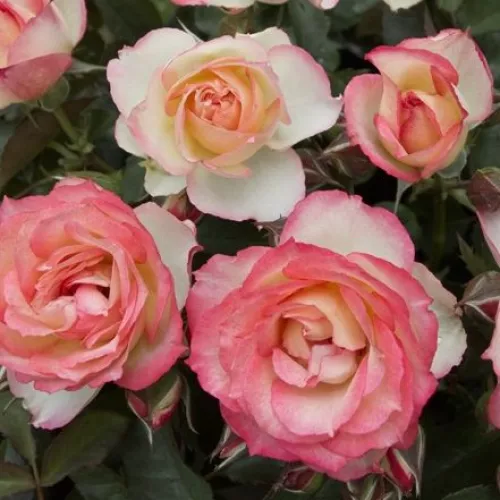
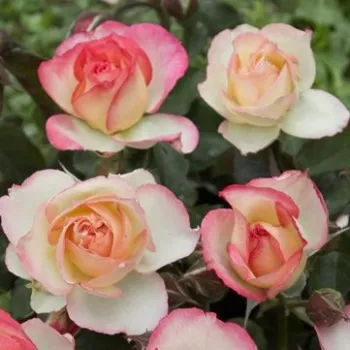
Cream-coloured ivory base with a slight pink edge. - bedding floribunda rose - mild, subtly scented rose - rosy character
– Soft cream‑pink blooms with pastel edges.
– Compact, bushy habit for neat bedding.
– Good heat and drought tolerance in summer.
– Winter hardy to approx. −21 °C in gardens.
– Mild, classic rosy fragrance for close seating.
– Special feature: Forms occasional bright red decorative hips late in the season.
Unfortunately, we are currently unable to ship to the United Kingdom; we only deliver to countries within the European Union. For more information, please contact us!
4(6095)
LAKE COMO® – cream-pink bedding floribunda rose – Barni
With its softly cream-pink blooms and compact, bushy growth, LAKE COMO® is an easy-care floribunda that quickly brings a classic cottage-garden feel to front gardens and small beds. Delivered as a well-rooted own-root plant in a 2-litre pot, it settles in reliably and develops a stable, long-lived framework that copes well with typical British winters and summer heat provided you give reasonable watering. Over time it forms a low, rounded hedge-like presence, ideal for edging paths or anchoring a mixed border without dominating the space. Its remontant nature gives dependable waves of flowers through the season, while the glossy dark foliage stays attractive between flushes. In heavy soils it appreciates planting where water can drain away steadily, helping it manage our changeable rain and wind more comfortably. Mild rosy fragrance, moderate maintenance needs and flexible use in beds or large containers (from 40–50 litres) make it a reassuring choice for beginners and time-pressed gardeners alike, maturing from root-building to full ornamental charm over its first few years for lasting garden impact.
Lake Como® in freshly opened bloom, with cream petals softly edged in pink.
Lake Como® shows a double, cup-shaped bloom form.
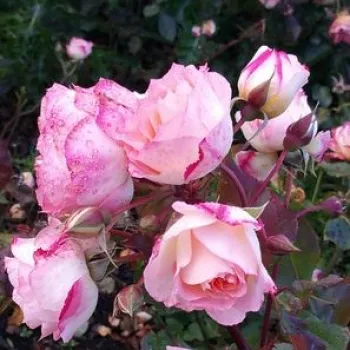
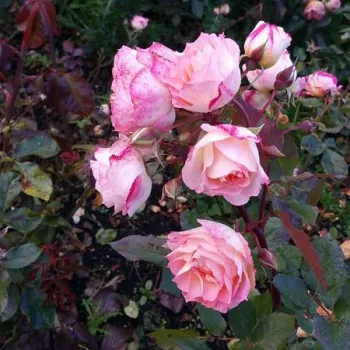
Lake Como® rose in closed bud stage, with a pale ivory base and delicate pink edging.
Lake Como® bedding floribunda in full bloom
Usage options
Target area
Reasoning
Front garden focal bed near the entrance
Its compact 70–95 cm height and bushy habit create a neat, welcoming presence that fits well beside paths or drives without overwhelming the space, giving reliable colour through repeated flowering in a tidy, easy-to-read layout for the typical UK front garden, ideal for the style-focused homeowner.
Low rose hedge along paths or driveways
Regular spacing at around 35–40 cm forms a coherent, low hedge that visually guides visitors while remaining easy to look after; the dense foliage and floribunda clusters knit together into a soft barrier that works particularly well where you want structure without formal clipping, suited to the relaxed-cottage-garden gardener.
Small mixed border in a family back garden
The cream-pink tones blend effortlessly with perennials and low shrubs, while the moderate disease resistance and simple pruning needs reduce ongoing work; its own-root form builds a stable base that regrows well after harder pruning if children or pets knock stems, reassuring for the busy family gardener.
Raised bed or improved soil on heavy clay
Planting into a raised or well-drained bed lets its roots establish cleanly even on difficult clay, while its moderate maintenance demands keep the task list short; once settled, it responds well to consistent but straightforward care in regions with persistent rainfall and periodic wind, encouraging the cautious beginner.
40–50 litre terrace or courtyard container
In a generously sized container with regular watering, its bushy, upright habit and repeat flowering give a long season of interest on patios or small courtyards; the plant remains manageable in scale and simple to deadhead, a good choice where ground planting is limited for the balcony-and-patio owner.
Small groups of 3–5 plants in ornamental beds
Planted in drifts, the uniform habit and harmonious colour create an instant, coherent picture that fills a bed quickly without complex planning; repeat flowering means that even modest-sized groups offer a continuous, cohesive display, helpful for the time-poor but design-conscious gardener.
Low-maintenance cottage-style compositions
Its soft colouring, cup-shaped blooms and modest fragrance pair beautifully with traditional cottage companions while its moderate care needs avoid the intensive regimes of show roses; the own-root base supports long-term shape and recovery, giving confidence to the cottage-style-aspiring novice.
Urban and suburban family gardens
The moderate height, good heat tolerance and remontant flowering suit warmer, more sheltered town plots, and the flexible pruning options let you keep it compact or slightly fuller as space allows; over successive seasons it becomes a quietly reliable feature for the busy urban gardener.
Styling ideas
Cottage-Drift – Plant 3–5 LAKE COMO® together with low catmint and dwarf silvermound to form a soft, repeat-flowering drift – ideal for beginners wanting relaxed, classic charm.
Pathway-Edge – Line a front path with evenly spaced plants for a low hedge of cream-pink cups that stays neat with simple annual trimming – perfect for homeowners seeking tidy structure with minimal effort.
Courtyard-Pot – Grow a single plant in a 40–50 litre container with trailing thyme or lobelia to soften the rim, relying on its bushy habit and remontant flowering – suited to balcony and terrace gardeners with limited ground.
Family-Border – Anchor a small mixed border by pairing it with compact honeysuckle and low grasses, using its dense foliage and steady flowering as the visual constant – good for family gardens needing robust, forgiving planting.
Soft-Screen – Stagger plants in two offset rows to form a low, semi-transparent screen that defines play areas without feeling harsh, supported by its manageable height and long-term framework – ideal for parents planning simple, durable layouts.
Technical cultivar profile
Parameter
Data
Name and registration
Floribunda bed rose with the registered cultivar name BAR 7752, marketed as LAKE COMO® Bedding rose BAR 7752, commemorating Lake Como and classified as a shrub-type floribunda.
Origin and breeding
Bred by Enrico Barni in Pistoia, Italy, with parentage not recorded; introduced by Rose Barni in 2016, representing a modern Italian floribunda aimed at ornamental bedding and landscape use.
Growth and structural characteristics
Compact bushy shrub reaching about 70–95 cm high and 50–75 cm spread, with dense, glossy dark green foliage and moderate prickliness, forming a rounded, well-branching framework suitable for beds and low hedges.
Flower morphology
Double, cup-shaped clusters of medium-sized flowers (approximately 4–7 cm), with around 26–39 petals; floribunda-type trusses provide generous flowering and the plant remontantly produces a notably abundant second flush.
Colour data and phenology
Cream-ivory base with soft pink edging (RHS 155D outer, 62C inner), opening light and deepening at the margins before fading to pale dewy tones; colour retention is moderate and the shrub gives repeated flushes all season.
Fragrance and aroma
Mild, pleasantly rosy fragrance with a subtle character rather than strong perfume; chiefly grown for visual effect, yet close planting near paths or seating still allows appreciation of its gentle aromatic presence.
Hip characteristics
Occasionally develops small, spherical bright red hips about 8–12 mm in diameter, adding modest late-season interest if flowers are not deadheaded, though hip formation is not a dominant ornamental feature.
Resistance and winter hardiness
Moderate resistance to black spot, powdery mildew and rust, benefiting from basic preventive care; hardy approximately to −21 to −18 °C (RHS H7, USDA 6b, Swedish zone 3), coping well with typical central UK winters.
Horticultural recommendations
Prefers sunny sites with reasonably drained soil, watering in extended dry spells; plant 35–65 cm apart depending on use, with 5.7–6.5 plants per m² for bedding, and maintain through occasional pruning and disease checks.
LAKE COMO® offers softly coloured repeat flowering, a compact, versatile habit and a durable own-root framework that matures gracefully over time, making it a sound, dependable choice for understated structure and colour in everyday gardens.
Detailed product attributes
Product Identification Data
Product Name:
LAKE COMO® – cream-pink bedding floribunda rose - Barni
Product Type:
pharmaROSA® ORIGINAL - 2-litre own-root potted rose
Closed Bud:
Pale ivory base with a delicate powder‑pink edging at the outer tip.
Newly Opened Flower:
The petals are a light cream colour with a soft pink tint at the edges.
Full Bloom:
The surface is cream-coloured, ivory-hued, with the edges of the petals a more pronounced pastel pink.
Before Fading:
The creamy colour fades, and the pink edging softens to a pale dewy tone.
Colour Fading Description:
During opening the cream–ivory ground moderately lightens; the pink at the margin intensifies at full bloom, then fades to a pale dewy colour before the bloom fades.
Pollinator Attraction:
Double (26–39 petals) flowers only moderately attract pollinators, as the fully double form and reduced accessibility of the stamens limit nectar and pollen access, and flower form (single/semi‑double/double) and stamen accessibility therefore directly af
Pollinator-Friendly Rating:
Its double flowers typically enclose the stamens, so it is primarily an ornamental variety.
Our product is a rose grown with pharmaROSA®’s unique cultivation technology!
2-litre, own-root, potted rose.
With a shoot system appropriate to the season.
With a root system that thoroughly permeates the growing medium.
Quality compliant with the requirements of the E.N.A. (European Nurserystock Association).
Supplied in unique packaging that prevents damage.
Can be planted during frost-free periods.
True-to-variety rose bush with a unique identifier.
The pharmaROSA® own-root potted rose is a well-rooted plant that supports reliable establishment when planted and cared for properly, so it can be planted whenever the soil is not frozen.
Crop overview: several varieties and growth stages in a short crop section.Shoot system: intensive growth of fresh basal shoots on a young plant.Root system: demonstration of a vigorous root system permeating the growing medium, by removing the pot.Balance: mature plant with root system and shoots in harmony with each other.
Information about the videos
The video series is not a “seasonal showcase”; it illustrates the essence of pharmaROSA® own-root cultivation in a tangible way: how the plant is built up, what the root system is like and how the shoot system regenerates. The recordings were therefore made at different times and with plants at various stages of development, so mixed foliage levels and differing stages of growth may appear in the videos. They are not a ‘sample’ of the batch dispatched, but a visual explanation of how the technology works. The current condition of the rose available to order — typical for the given period and similar to what you can expect to receive in the parcel — is shown in the upper part of the product page.
Pages for private customers Garden roses for the family garden, with minimal care → ORIGINAL® Premium garden roses – instant impact, a truly showpiece garden → EXTRA® Pages for professionals and private customers Roses for public spaces – large areas, sustainable maintenance → NATURAL® Roses for projects – hedge and row planting, fast implementation → RAPID® For professional partners only Production – propagation material for garden roses, wholesale → NEONATAL®
Company details
PharmaRosa Ltd. Company registration number: 01-09-717479 VAT number: 13075314-2-43 Plant health registration no.: HU130721 Bank account (IBAN): HU85117631891388688400000000 BIC (SWIFT): OTPVHUHB Bank name: OTP Bank Nyrt.