KNIRPS® – deep pink groundcover rose – KORverlandus
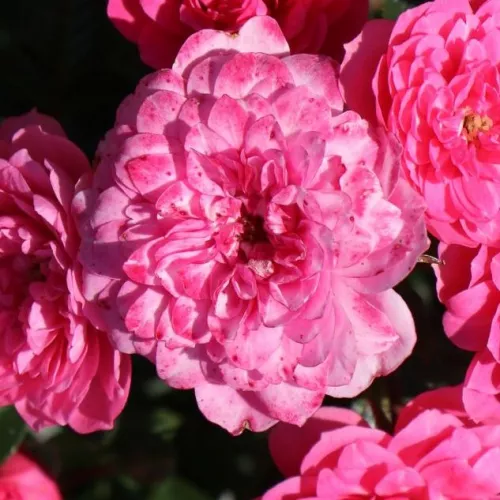
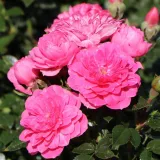
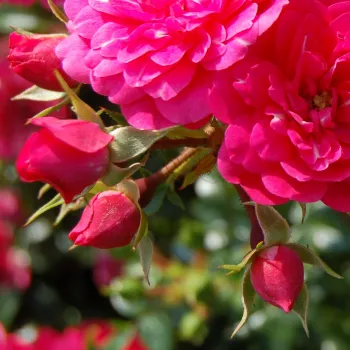
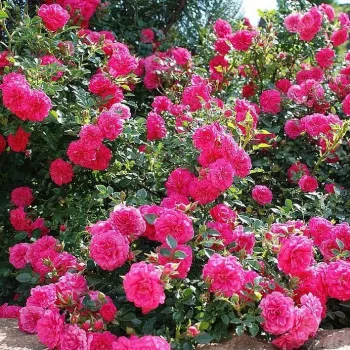
Compact and naturally spreading, KNIRPS® forms a low, even carpet of colour that suits front gardens and around-the-house beds where you want tidy structure without fuss. Its dense, glossy foliage and abundant, very double deep-pink clusters create a continuous display from early summer well into autumn, while most spent blooms drop cleanly for an effortlessly neat look. Bred by Kordes with ADR-level resilience, it stands up well to typical British humidity and rain, coping reliably with exposed plots and brisk coastal breezes. On its own roots it develops steadily into a long-lived, balanced shrub, anchoring itself well and needing only light pruning to keep its low outline. Over time it adapts to your soil and care routine, rewarding even beginners with a stable planting and dependable flowering. In a generously sized container or raised bed it gives a refined ground-hugging presence near seating areas or doorways, ideal where space is tight but you still want a classic cottage-garden accent.
Usage options
| Target area |
Reasoning |
| Front garden groundcover |
The naturally low, compact habit creates a neat, deep-pink carpet along drives and front paths, softening hard edges without blocking windows or sight-lines, ideal for those wanting order and colour with minimal shaping – perfect for busy homeowners |
| Edging for beds and borders |
With a spreading width of 40–70 cm and modest height, KNIRPS® makes a reliable edging that hides bare soil, reduces visible weeds, and frames taller perennials and shrubs in classic cottage-style plantings – ideal for aesthetic-focused beginners |
| Low-maintenance flowering banks and slopes |
Its dense, branching structure knits together into a stabilising mat over gentle banks, reducing mowing and helping to hold soil while providing season-long colour on exposed, windy sites where other small shrubs can struggle – suited to practical family gardeners |
| Urban and high-traffic beds |
Selected for resilience, this variety performs particularly well in busy urban planting strips and car-park borders, maintaining glossy foliage and repeat flowering despite reflected heat and intermittent care, keeping spaces presentable – a smart choice for city homeowners |
| Small-group planting in family gardens |
Planting 3–5 roses at 40–70 cm spacing produces a unified, cushion-like mass of blooms that looks considered without complex design, delivering strong impact in modest beds while staying easy to prune and refresh – ideal for first-time rose planters |
| Containers and large tubs |
Its shallow, spreading habit works well in large 40–50 litre containers or troughs, where good drainage helps it cope with wet spells and you gain flexible placement around patios, entrances, and seating areas for long-season colour – great for small-patio gardeners |
| Low, flowering hedge or border strip |
At 30–40 cm spacing it forms an informal, knee-high line of deep-pink flowers and dense foliage, perfect for soft boundaries along paths or separating lawn from beds without the hard look of clipped box or dwarf conifers – appealing to lovers of soft cottage style |
| Easy-care mixed cottage planting |
Combining KNIRPS® with perennials like Echinacea and bluebeard creates layered texture and long colour, while its repeat flowering and self-cleaning blooms minimise deadheading and fit a relaxed, “plant it and it works” approach – ideal for time-poor hobby gardeners |
Styling ideas
- PAVED-EDGE CARPET – Line a front path with a repeating band of KNIRPS® to spill slightly over paving, giving a soft pink fringe that needs little trimming – for structured yet low-effort front gardens.
- COTTAGE FOOTLIGHTS – Place KNIRPS® at the front of a mixed border with foxgloves and mock orange, providing a low “footlight” of pink beneath taller, romantic blooms – for lovers of classic cottage charm.
- URBAN WINDOW APRON – Underplant ground-floor windows with a continuous strip, keeping foliage below the sill while filling the view with flowers – for city terraces and townhouses wanting discreet colour.
- PATIO COLOUR BOWLS – Set three plants into a 50-litre half-barrel with free-draining compost, pairing with trailing thyme for scented edges and an easy-care, long-season feature – for balcony and courtyard gardeners.
- SLOPE SOFTENER – Use loose drifts across a gentle bank to reduce mowing and bind the soil, backed with ornamental grasses for movement and contrast – for practical owners improving awkward corners.
Technical cultivar profile
| Parameter |
Data |
| Name and registration |
Groundcover shrub rose, registered as KORverlandus, marketed as Knirps® Groundcover KORverlandus; the name alludes to its dwarf, child-like, very low and compact habit. |
| Origin and breeding |
Bred by Wilhelm, Tim-Hermann and Margarita Kordes (Germany); W. Kordes’ Söhne introduction from 1997, with breeding completed in 1987 and distributed internationally as a groundcover rose. |
| Awards and recognition |
ADR certified in 2004 for health and garden performance; Gold Medal Baden-Baden, Silver Medal Australian National Rose Trials (Adelaide, 1999), and Certificate of Merit at Orléans in 2001. |
| Growth and structural characteristics |
Low, spreading groundcover shrub reaching about 25–45 cm in height and 40–70 cm in spread, with dense, glossy mid-green foliage and moderate prickles; forms an even, carpet-like mound over time. |
| Flower morphology |
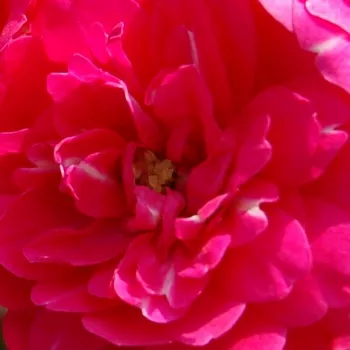
Small, very double, flat blooms with more than 40 petals, borne in clusters; flowers repeatedly with abundant first and second flushes, maintaining good coverage of the plant in season. |
| Colour data and phenology |
Intense deep-pink flowers, opening bright then maturing to rich pink before fading to soft pastel tones; colour holds better in cooler conditions and can fade more rapidly in strong, hot sunshine. |
| Fragrance and aroma |
Fragrance is very weak and discreet, essentially neutral in the garden; primarily grown for colour impact and groundcover effect rather than scent or pollinator value, as stamens are concealed. |
| Hip characteristics |
Hip set is light due to very double flowers; where present, hips are small, globular, about 6–10 mm across, orange-red in colour and of minor ornamental significance compared with the persistent bloom display. |
| Resistance and winter hardiness |
Excellent disease resistance, including high tolerance to powdery mildew, black spot and rust; hardy to approximately −29 to −26 °C (RHS H7, USDA 5a), suitable for exposed and colder UK garden sites. |
| Horticultural recommendations |
Best in sunny positions with reasonable drainage; spacing 30–70 cm depending on use, with 6–7 plants per m² for full cover; low maintenance, needing only light annual pruning and occasional deadheading. |
KNIRPS® Groundcover KORverlandus offers compact, low-maintenance groundcover, excellent disease resistance and adaptable own-root longevity, making it a thoughtful choice if you seek reliable, easy colour for a modest family garden.