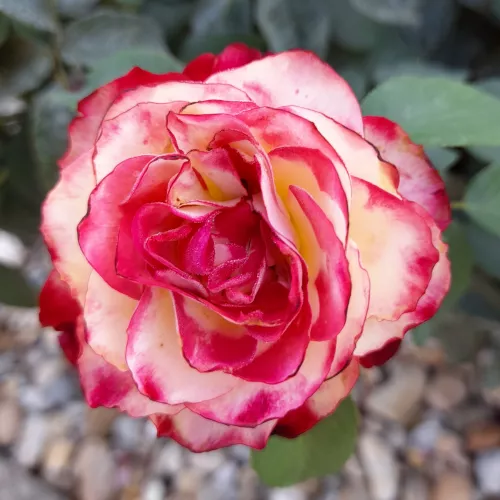
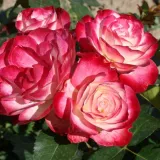
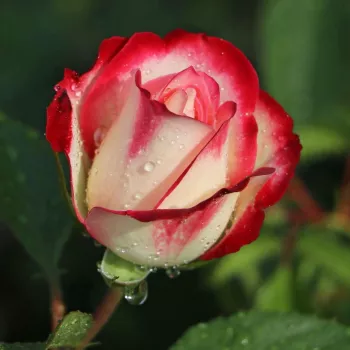
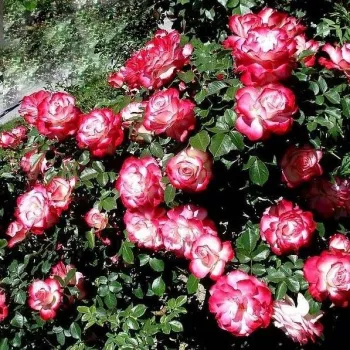
Cream-white base colour with a thin, vivid carmine-red edging. - floribunda bedding rose - mild, restrained-scented rose - fresh, fruity character
– Striking cream-white blooms edged vivid carmine-red.
– Abundant cluster-flowering for long summer display.
– Good heat and drought tolerance in sunny beds.
– Compact, bushy habit suits beds and containers.
– Mild, fresh fruity fragrance for close planting.
– Special feature: Internationally acclaimed, multi‑medal AARS winner rose.
Horticultural experience – Thoughtful planning
pharmaROSA® ORIGINAL 2-litre own-root potted rose
21,20 £
Unfortunately, we are currently unable to ship to the United Kingdom; we only deliver to countries within the European Union. For more information, please contact us!
3.5(5795)
JUBILE DU PRINCE DE MONACO® – cream-red bedding floribunda rose - Meilland
Colour holds centre stage with JUBILE DU PRINCE DE MONACO®, its generous clusters of cream-white blooms edged in vivid cherry-red giving a cottage feel to any front garden or small border. The neat, bushy shrub habit stays compact and tidy, ideal where space is limited but you still want real impact from the kerb or patio. Regular dead-heading keeps the plant in strong flower throughout the season, as it remontantly produces new buds again and again in generous clusters. As an own-root rose in a 2-litre pot, it is easy to plant and settles securely, gradually forming a balanced, long-lived stand that recovers well after pruning or winter. Once planted into well-prepared soil with good drainage, it anchors reliably even in wind-exposed sites near the house, suiting typical British family plots. Think in terms of a gentle arc – Year 1 building roots, Year 2 strong shoots, Year 3 full ornamental value – and you can watch it grow into the character of your garden.
Freshly opened bloom of Jubile Du Prince De Monaco® with cream-white petals and vivid scarlet edging.
Usage options
Target area
Reasoning
Front garden feature shrub
The compact, bushy habit forms a tidy mound, ideal beside a path or in a small front bed where you want structure without an overbearing rose. Its own-root longevity means the shrub matures steadily into a stable, ornamental presence for beginners.
Bedding rose in small groups
Plant in groups of 3–5 at the recommended spacing to create a dense, low bedding effect. The floribunda-style clusters produce a mass of colour with minimal shaping, so the bed remains coherent and attractive in a typical family garden for busy-owners.
Border edging in mixed cottage-style planting
The cherry-edged cream flowers blend easily with perennials and cottage-garden favourites, softening border edges without demanding complex pruning. Own-root growth ensures the shape fills out gradually, suiting evolving, informal schemes for style-seekers.
Patio container (large tub)
Grown in a sturdy 40–50 litre container, the bushy framework and self-cleaning habit give a long season of colour near doors or seating areas. Provided you water and feed regularly, it provides reliable flowering with simple seasonal pruning for urban-gardeners.
Small family back garden focal point
Used as a single specimen in a modest bed, its repeat-flowering clusters draw the eye from early summer onwards. Own-root resilience allows for periodic harder pruning if children’s play or re-designs damage shoots, helping it bounce back for families.
Low hedge or path lining
Planted in a row at closer spacing, the bushy growth links individual plants into a low hedge, giving rhythm along drives or front paths. Over a few seasons, the own-root plants knit into a continuous, long-lived line that suits straightforward trimming for homeowners.
Colour accent in sunny raised beds
In sunny raised beds or improved soil, good drainage helps this variety establish strongly and support its abundant flower clusters; this reduces stress and keeps the plant looking its best with basic care for clay-gardeners.
Formal bed within urban or park-style layouts
Its compact dimensions and regular growth make spacing and patterning simple in more formal designs. Once the own-root plants have settled, the stand remains structurally consistent for many years with seasonal feeding and pruning, rewarding thoughtful planners.
Styling ideas
COTTAGE RIBBON – Edge a small front border with a short run of JUBILE DU PRINCE DE MONACO® interplanted with low-growing heuchera for foliage contrast – ideal for cottage-style enthusiasts.
DOORSTEP WELCOME – Place one plant in a 40–50 litre terracotta pot by the front door, underplanting with trailing ivy for a neat, long-season welcome – perfect for busy homeowners.
CHERRY BED – Create a compact bedding block of 5 roses with Gaillardia x grandiflora weaving between for warm-toned summer colour – suited to small garden experimenters.
FAMILY FOCAL – Use a single specimen in a circular bed in the lawn, ringed with dwarf lavender for scent and structure – attractive for families wanting an easy focal point.
URBAN BORDER – In a narrow city border, alternate this rose with Knautia macedonica 'Red Knight' to mix formal clusters with airy blooms – appealing to space-conscious town gardeners.
Technical cultivar profile
Parameter
Data
Name and registration
JUBILE DU PRINCE DE MONACO® bedding floribunda rose; shrub group, bed rose; registered as MEIsponge, ARS exhibition name Cherry Parfait™, cultivar authenticity verified for this product.
Origin and breeding
Bred by Alain A. Meilland (France) in 2000 from 'Meichoiju' × ('Meidanu' × 'Maeman'); introduced after 2002 by Meilland International and Conard-Pyle / Star® Roses in several markets.
Awards and recognition
Highly decorated floribunda: multiple medals from Saverne, Madrid, Buenos Aires, Baden-Baden and Genova between 2000–2001, plus an Orléans certificate in 2002 and AARS winner status in the USA.
Growth and structural characteristics
Bushy shrub 65–95 cm high and 60–95 cm wide, with dense, matt medium-green foliage and moderate prickles; forms a compact, stable framework well suited to bedding and small garden schemes.
Flower morphology
Double, cup-shaped blooms with 26–39 petals, usually in cluster-flowered inflorescences; large flowers around 7–10 cm across, remontant with abundant second and subsequent flushes in season.
Colour data and phenology
Cream-white base with vivid carmine-red edging (ARS WBl; RHS 155D, 53A); colour holds well, only slightly lightening in strong sun, maintaining a clear cherry-edged effect through full bloom and fading.
Fragrance and aroma
Mild, fresh, fruity scent suited to close viewing rather than long-distance perfume; double blooms partially conceal stamens, making it primarily an ornamental variety rather than pollinator focused.
Hip characteristics
Occasional small, spherical red hips, 8–12 mm diameter; visually discreet but adding a modest seasonal detail in late season when present, without significantly affecting the plant’s flowering display.
Resistance and winter hardiness
Winter hardy to about −21 to −18 °C (RHS H7, USDA 6b, Swedish zone 3); very susceptible to major rose diseases, so systematic protection and attentive hygiene are essential in humid seasons.
Horticultural recommendations
Best in full sun with fertile, well-drained soil; spacing 50–90 cm depending on use, 3.2–3.7 plants/m² in mass plantings. Needs regular watering, feeding and active disease control for reliable performance.
JUBILE DU PRINCE DE MONACO® offers compact bushy growth, abundant cluster-flowering and enduring colour on an own-root plant that settles for the long term, making it a thoughtful choice if you enjoy planning a lasting garden picture.
Detailed product attributes
Product Identification Data
Product Name:
JUBILE DU PRINCE DE MONACO® – cream-red bedding floribunda rose - Meilland
Product Type:
pharmaROSA® ORIGINAL - 2-litre own-root potted rose
Competition and Show Awards:
Saverne – Certificate (FR) (2000); Madrid – Silver Medal, Rose de Madrid (ES) (2000); Buenos Aires – Gold Medal (AR) (2000); Baden‑Baden – Prix des Casinos (DE) (2000); Genova – Bronze Medal (IT) (2001); Orléans – Certificate (FR) (2002); AARS winner (USA
Pollinator Attraction:
Because it is double-flowered (fully double), with its stamens largely inaccessible, this variety is less attractive to pollinating insects.
Pollinator-Friendly Rating:
Its double flowers partially conceal the stamens; primarily an ornamental variety.
Maintenance Requirement:
Maintenance requirement high; highly susceptible to major rose diseases, therefore regular plant protection and frequent intervention are required.
Primary Uses:
flower bed, park, urban green space, container, cut flower
Our product is a rose grown with pharmaROSA®’s unique cultivation technology!
2-litre, own-root, potted rose.
With a shoot system appropriate to the season.
With a root system that thoroughly permeates the growing medium.
Quality compliant with the requirements of the E.N.A. (European Nurserystock Association).
Supplied in unique packaging that prevents damage.
Can be planted during frost-free periods.
True-to-variety rose bush with a unique identifier.
The pharmaROSA® own-root potted rose is a well-rooted plant that supports reliable establishment when planted and cared for properly, so it can be planted whenever the soil is not frozen.
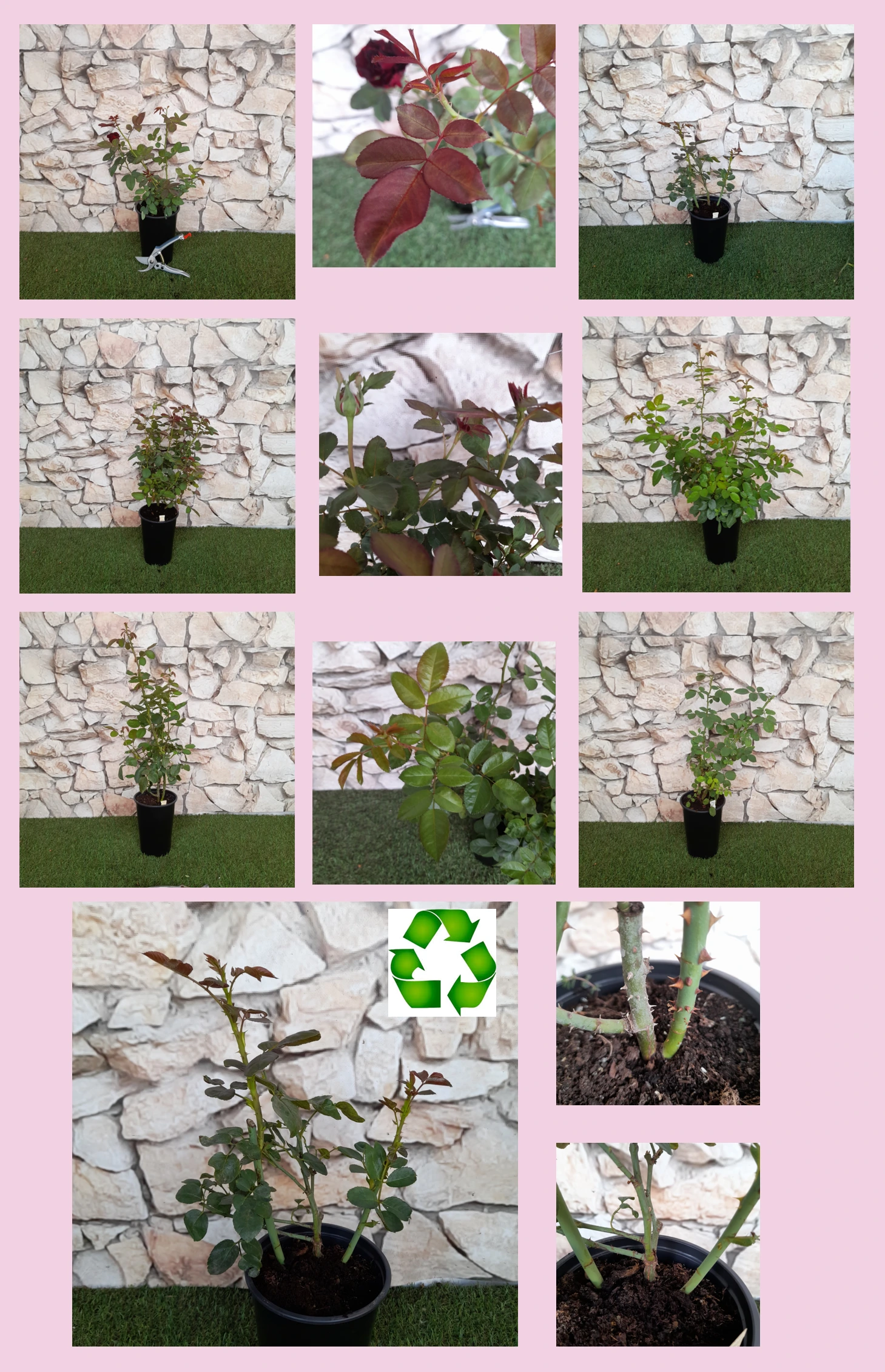
Crop overview: several varieties and growth stages in a short crop section.Shoot system: intensive growth of fresh basal shoots on a young plant.Root system: demonstration of a vigorous root system permeating the growing medium, by removing the pot.Balance: mature plant with root system and shoots in harmony with each other.
Information about the videos
The video series is not a “seasonal showcase”; it illustrates the essence of pharmaROSA® own-root cultivation in a tangible way: how the plant is built up, what the root system is like and how the shoot system regenerates. The recordings were therefore made at different times and with plants at various stages of development, so mixed foliage levels and differing stages of growth may appear in the videos. They are not a ‘sample’ of the batch dispatched, but a visual explanation of how the technology works. The current condition of the rose available to order — typical for the given period and similar to what you can expect to receive in the parcel — is shown in the upper part of the product page.
Pages for private customers Garden roses for the family garden, with minimal care → ORIGINAL® Premium garden roses – instant impact, a truly showpiece garden → EXTRA® Pages for professionals and private customers Roses for public spaces – large areas, sustainable maintenance → NATURAL® Roses for projects – hedge and row planting, fast implementation → RAPID® For professional partners only Production – propagation material for garden roses, wholesale → NEONATAL®
Company details
PharmaRosa Ltd. Company registration number: 01-09-717479 VAT number: 13075314-2-43 Plant health registration no.: HU130721 Bank account (IBAN): HU85117631891388688400000000 BIC (SWIFT): OTPVHUHB Bank name: OTP Bank Nyrt.