ISKRA™ – scarlet-red climbing rose – Meilland
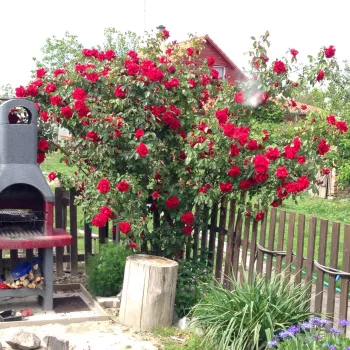
Scarlet petals of ISKRA™ bring a vivid cottage-garden accent to pergolas, house walls and fences, creating a quick vertical screen even in exposed areas with frequent wind and rain where good support and anchoring really matter; once planted, this own-root climber steadily builds a long-lived framework, its semi-double clusters opening in a bright, spark-like flush once each summer, then setting neat orange-red hips that extend the display into autumn; with moderate care and simple pruning, you can let it clothe arches or pergolas without intricate training, while its adaptable root system settles gradually – year one focusing on roots, year two on strong shoots, and by year three delivering full ornamental impact for relaxed, low-fuss garden pleasure.
Usage options
| Target area | Reasoning |
|---|
| House-front pergola or arch |
Ideal where you want a bold, once-a-year summer display over an entrance or path: its scarlet flowers appear in generous clusters, then the structure stays neat and green, needing only light annual pruning – especially rewarding for beginners. |
| Wall or fence greening |
Clothes bare walls and long fences with a season-long green curtain and a single, impressive flush of colour; moderate vigour makes it easier to keep within bounds than very vigorous ramblers, suiting small to medium family plots and busy-owners. |
| Cottage-style mixed border backdrop |
Provides vertical colour behind perennials like bearded iris and hardy herbs, echoing classic British cottage gardens with a manageable, medium-height climber that does not overwhelm neighbouring plants, appealing to cottage-garden enthusiasts. |
| Family seating or play area edge |
Can be trained up and over an arbour or along the boundary of a seating or play area, giving a sense of enclosure and summer spectacle while remaining readable and easy to prune, well suited to practical, aesthetics-minded families. |
| Small group planting on shared support |
Planting two or three plants to cover a larger arch or wide pergola post gives faster coverage and a more dramatic flowering wave, while the once-blooming habit keeps maintenance simple for gardeners who prefer straightforward solutions. |
| Seasonal wildlife and rose-hip interest |
Semi-double flowers offer moderate pollinator value, followed by neat orange-red hips that add autumn structure and seasonal colour, particularly attractive where you wish to support light wildlife activity alongside ornamental value for nature-lovers. |
| Coastal or wind-exposed gardens |
The flexible canes and medium-dense foliage cope well on sturdy supports in breezy, damp positions, giving reliable cover and colour even where wind and rain regularly test garden planting, reassuring for exposed-site gardeners. |
| Large container on terrace (with support) |
Can be grown in a substantial 40–50 litre container with a trellis or obelisk, providing height and colour on patios or balconies where ground planting is limited, a strong option for space-conscious urban owners. |
Styling ideas
- Cottage Arch – Train ISKRA™ over a timber arch with bearded iris and catmint at the base for a soft, traditional welcome – ideal for cottage-style romantics.
- Scarlet Screen – Use along a simple wire-strung fence to form a living partition that flowers once, then stays quietly green – perfect for privacy-seeking families.
- Pergola Walk – Plant at the posts of a short pergola run, pairing with lavender and low grasses for a calm, low-maintenance walkway – good for busy homeowners.
- Hip Focus – Let the canes scramble along a rustic fence with autumn grasses and seedheads to highlight the orange-red hips – suited to wildlife-friendly gardeners.
- Patio Column – Grow in a 50-litre pot with a slim obelisk, underplanted with hardy herbs for colour and scent by the back door – appealing to urban balcony users.
Technical cultivar profile
| Parameter | Data |
|---|
| Name and registration |
Climbing rose, Hybrid Wichurana rambler; registered as MEIhaiti, traded as ISKRA™ Rambling rose MEIhaiti, also exhibited under the name Sparkling Scarlet. |
| Origin and breeding |
Bred by Marie-Louise Meilland, Meilland International SA; breeding completed c.1969 in Germany and introduced commercially around 1971 through Meilland International (France). |
| Growth and structural characteristics |
Medium-vigorous, creeping climber reaching about 240–360 cm high and 150–260 cm spread, with moderately dense, slightly glossy bronze-green foliage and a moderately thorny framework. |
| Flower morphology |
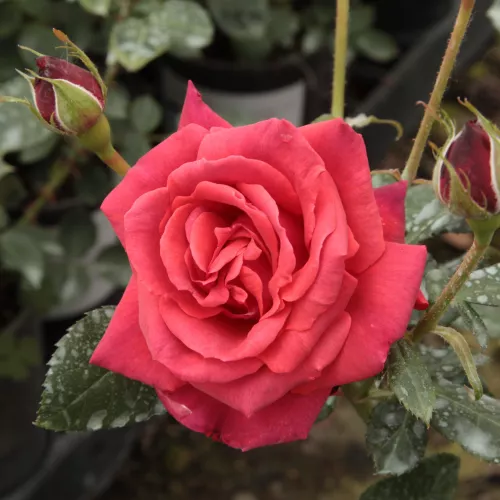
Semi-double, cupped flowers with a medium high-centred form, borne in clusters; around 13–25 petals per bloom, medium-sized at approximately 1.5–2.75 inches in diameter. |
| Colour data and phenology |
Bright scarlet-red blooms with a slight orange tone; RHS 46B outer, 46A inner; once-flowering, with colour gradually softening to coral-red shades before petals fall cleanly. |
| Fragrance and aroma |
Very weak, delicately rosy scent that remains unobtrusive near doors and windows; fragrance is present but light, adding gentle character without dominating surrounding planting. |
| Hip characteristics |
Moderately abundant spherical hips, around 16–24 mm across, ripening to an orange-red colour that extends ornamental value well beyond flowering into late season. |
| Resistance and winter hardiness |
Medium overall disease resistance; good black-spot resistance with moderate susceptibility to mildew and rust; reliably hardy to about -15 to -12 °C, aligning with RHS H6 and USDA 7b. |
| Horticultural recommendations |
Best in sunny positions on pergolas, fences, walls or arbours; plant 140–220 cm apart depending on effect; moderate maintenance with occasional pest and disease checks as needed. |
ISKRA™ – scarlet-red climbing rose – Meilland offers vibrant seasonal colour, reliable wall and pergola coverage, and durable own-root growth; a considered choice if you want a long-lived, low-fuss climber for your garden.