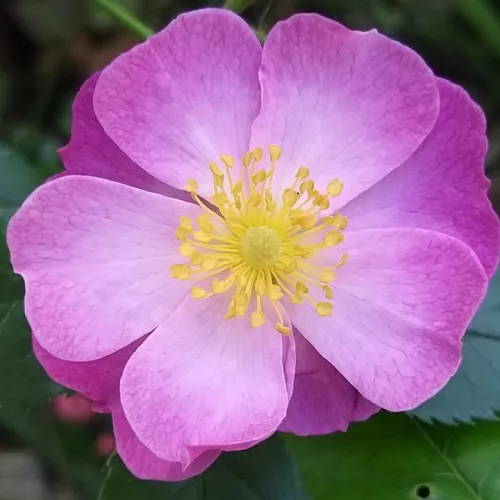
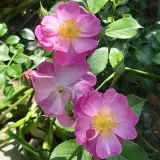
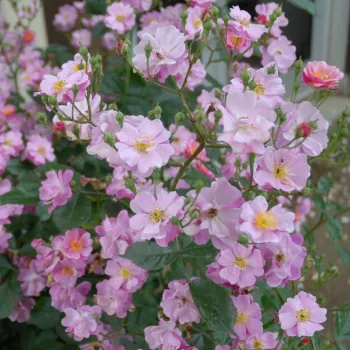
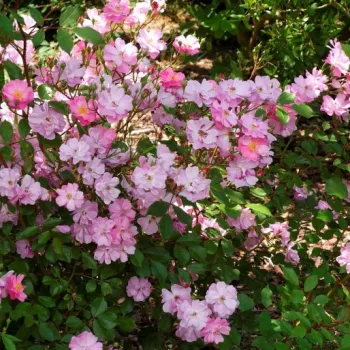
Delicate mallow-pink shade that fades to a soft lilac tone. - park rose - very weak, barely perceptible scented rose - fragrance description not available
– Soft mauve-pink clouds of dainty blooms
– Long, abundant repeat flowering season
– Spreading shrub ideal for borders and parks
– Hardy to H7, reliable in colder climates
– ADR award for proven garden performance
– Special feature: Bright red hips add vivid autumn colour.
Unfortunately, we are currently unable to ship to the United Kingdom; we only deliver to countries within the European Union. For more information, please contact us!
3.5(5763)
INTERLAV – mauve-pink park rose - Ilsink
This classic shrub rose brings a soft, cottage-garden lavender haze of colour to small and medium family gardens, forming a broad, gently spreading shrub that fills space without demanding complicated care. Its semi-double, self-cleaning flowers fall cleanly after each flush, helping you keep beds tidy with minimal deadheading, while the plant’s dependable remontant habit keeps the border in near-continuous bloom through the season. Bred for robust park use and ADR-recognised, it offers reassuring reliability in typical British conditions, even where you need better anchoring and drainage on heavier soils exposed to prevailing winds. Own-root growth ensures long-term stability and natural regeneration, so the bush matures into a balanced form that fits effortlessly into classic front-garden and cottage-style schemes. In its first year it concentrates on roots, the second on stronger shoots, and by the third season it delivers its full ornamental value as a flowering, low-maintenance feature you can simply plant and enjoy over many years.
Freshly opened Lavender Dream bloom in mauve-pink tones.
Interlav in full bloom, showing pastel mauve-pink flowers.
Usage options
Target area
Reasoning
Front garden focal shrub
Forms a broad, spreading shrub that quickly gives presence without becoming overpowering, ideal beside a path or bay window where you want soft mauve-pink colour and an informal cottage look with minimal training – reassuring for the beginner.
Low-maintenance mixed border
Good self-cleaning means most spent blooms drop away naturally, helping the border stay neat between visits, while remontant flowering weaves gentle colour through perennials and grasses so you can reduce deadheading and simply enjoy the show – welcome for the busy.
Lightly shaded side garden
Tolerates partial shade, so it copes well on east- or west-facing sides of the house where sun hours are limited, still flowering reliably and holding a healthy canopy of foliage, making awkward side strips feel finished and cared-for – helpful to the practical.
Groundcover and bank planting
The naturally spreading habit and dense foliage lend themselves to soft groundcover on banks or along fences, helping to suppress weeds and stabilise soil, while the mass of small blooms creates a gentle colour wash rather than formal structure – ideal for the relaxed.
Urban front garden with exposure
Selected for robust park use and ADR-recognised, it copes well with typical town conditions, including wind and fluctuating moisture, making it reliable for exposed front gardens where you need a tough, forgiving rose that still looks romantic – reassuring for the urban.
Pollinator-friendly cottage planting
Open, semi-double flowers with accessible stamens give bees and other insects easy foraging, so you gain movement and life around the front path while still keeping the delicate, old-fashioned flower style that suits cottage plantings – enjoyable for the wildlife-lover.
Decorative hip interest in autumn
After flowering, clusters of small, bright red hips appear, adding late-season colour and a naturalistic feel, especially effective when paired with grasses or seedheads, extending the value of the planting well beyond summer bloom – attractive to the collector.
Long-term structural planting
As an own-root shrub it develops a durable framework that regenerates well from the base, so if winter, pruning or weather set it back, it regrows from its own wood, supporting a long service life in family gardens with simple, flexible pruning – ideal for the planner.
Styling ideas
Cottage-curve – Plant as a loose, spreading anchor at the outer curve of a front path, underplant with catmint and parsley for a soft, informal cottage look – for romantically minded homeowners.
Pastel-ribbon – Use several plants in a gentle sweep along a low fence, weaving through low grasses for a pastel, cloud-like edge that stays attractive with little shaping – for time-poor garden owners.
Shaded-edge – Place in light shade on the east side of a house with hardy geraniums to brighten tricky strips where many roses struggle – for practical problem-solvers.
Wildlife-drift – Combine with pollinator-friendly perennials in soft lilac and white, letting its open blooms and hips add seasonal interest within a relaxed planting – for wildlife-conscious families.
Autumn-echo – Pair its bright red hips with tawny ornamental grasses and seedheads to carry colour into autumn without extra work – for design-focused beginners.
Technical cultivar profile
Characteristic
Data
Name and registration
INTerlav, shrub rose group, park type; current trade name Interlav – mauve-pink park rose – Ilsink; ARS exhibition name Lavender Dream; registration year 1984.
Origin and breeding
Bred by G. Peter Ilsink, Interplant Roses, Netherlands, from the cross ‘Yesterday’ × ‘Nastarana’; introduced and registered in 1984 for landscape and park use.
Awards and recognition
Holds ADR recognition from 1987, indicating tested garden performance in independent trials, with reliable ornamental value and serviceable disease resistance under real garden conditions.
Growth and structural characteristics
Vigorous, broad, spreading shrub reaching about 120–190 cm in height and 120–200 cm spread, with dense, light green matt foliage and moderate prickliness, suitable for specimen or group planting.
Flower morphology
Bears many small, semi-double, flat flowers in clustered inflorescences, typically 13–25 petals, remontant with abundant second and later flushes; good natural self-cleaning of spent blooms.
Colour data and phenology
Mauve-pink to delicate mallow-pink blooms, buds mid-pink with mauve tinge, opening to pastel lavender-pink, fading to pinkish-lilac; colour lightens in sun, giving a soft, pastel effect over time.
Fragrance and aroma
Fragrance recorded as very weak and barely perceptible, so it is best chosen for visual effect and garden structure rather than scent-focused plantings or areas where strong perfume is a priority.
Hip characteristics
Frequently produces small, spherical, bright red hips about 6–10 mm across, carried in clusters, offering decorative value for autumn and early winter arrangements and wildlife-friendly plantings.
Resistance and winter hardiness
Hardy to about −26 to −23 °C (RHS H7, Swedish zone 4, USDA 5b); moderate drought and disease tolerance, with resistance to powdery mildew and moderate susceptibility to black spot and rust.
Horticultural recommendations
Suited to beds, edging, parks, groundcover and urban green spaces; allow 90–165 cm spacing; thrives in well-drained soil, and larger containers from 40–50 litres upward for long-term pot culture.
INTERLAV offers soft pastel flowering, self-cleaning clusters and durable own-root growth for long-lived, low-maintenance planting; consider it where you want an easy shrub rose that quietly earns its place over time.
Detailed product attributes
Product Identification Data
Product Name:
INTERLAV – mauve-pink park rose - Ilsink
Product Type:
pharmaROSA® ORIGINAL - 2-litre own-root potted rose
Pollinator Attraction:
Its open, semi‑double flower form with accessible stamens and strong fragrance make it highly attractive to pollinating insects.
Our product is a rose grown with pharmaROSA®’s unique cultivation technology!
2-litre, own-root, potted rose.
With a shoot system appropriate to the season.
With a root system that thoroughly permeates the growing medium.
Quality compliant with the requirements of the E.N.A. (European Nurserystock Association).
Supplied in unique packaging that prevents damage.
Can be planted during frost-free periods.
True-to-variety rose bush with a unique identifier.
The pharmaROSA® own-root potted rose is a well-rooted plant that supports reliable establishment when planted and cared for properly, so it can be planted whenever the soil is not frozen.
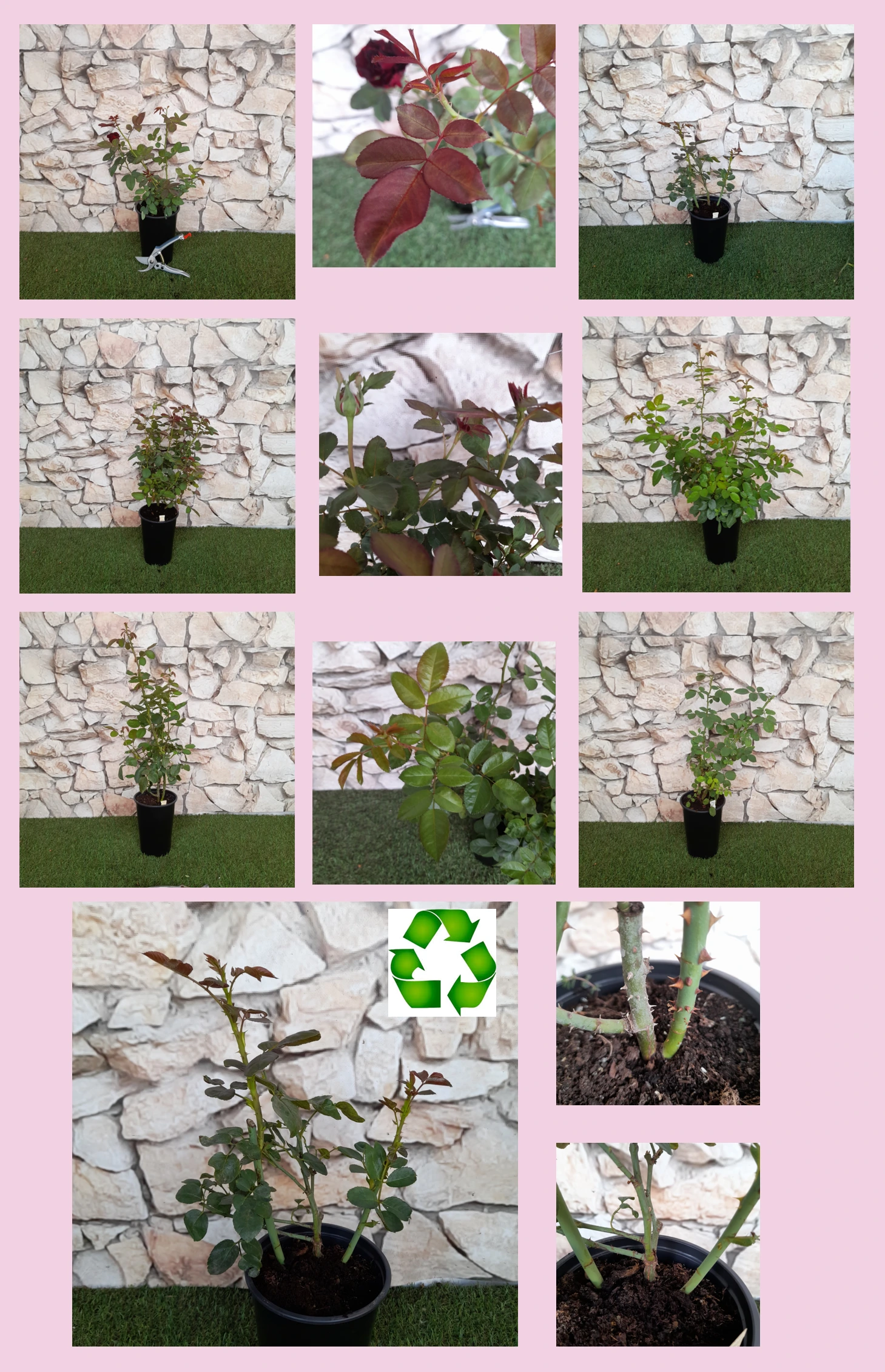
Crop overview: several varieties and growth stages in a short crop section.Shoot system: intensive growth of fresh basal shoots on a young plant.Root system: demonstration of a vigorous root system permeating the growing medium, by removing the pot.Balance: mature plant with root system and shoots in harmony with each other.
Information about the videos
The video series is not a “seasonal showcase”; it illustrates the essence of pharmaROSA® own-root cultivation in a tangible way: how the plant is built up, what the root system is like and how the shoot system regenerates. The recordings were therefore made at different times and with plants at various stages of development, so mixed foliage levels and differing stages of growth may appear in the videos. They are not a ‘sample’ of the batch dispatched, but a visual explanation of how the technology works. The current condition of the rose available to order — typical for the given period and similar to what you can expect to receive in the parcel — is shown in the upper part of the product page.
Pages for private customers Garden roses for the family garden, with minimal care → ORIGINAL® Premium garden roses – instant impact, a truly showpiece garden → EXTRA® Pages for professionals and private customers Roses for public spaces – large areas, sustainable maintenance → NATURAL® Roses for projects – hedge and row planting, fast implementation → RAPID® For professional partners only Production – propagation material for garden roses, wholesale → NEONATAL®
Company details
PharmaRosa Ltd. Company registration number: 01-09-717479 VAT number: 13075314-2-43 Plant health registration no.: HU130721 Bank account (IBAN): HU85117631891388688400000000 BIC (SWIFT): OTPVHUHB Bank name: OTP Bank Nyrt.