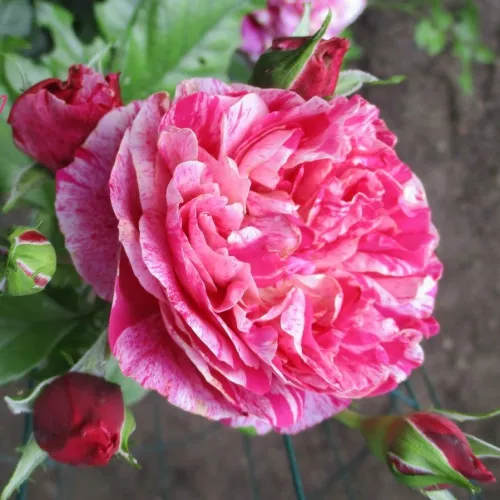
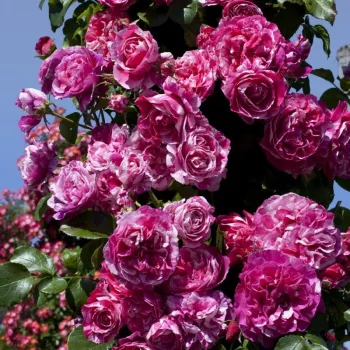
Raspberry — on a pink ground irregular cream‑white stripes and speckles run across. - climbing rose, climbing rose - very weak, barely noticeable scented rose - fresh, apple-like character
– Striking raspberry‑pink blooms with cream‑white stripes.
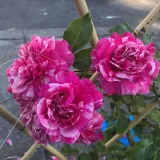
– Very double, cupped flowers in generous clusters.
– Vigorous climber for walls, fences and arches.
– Glossy, dark green foliage with sparse thorns.
– Proven garden merit: Hradec Králové 1st prize.
– Special feature: Premium gold cultivar quality rating for reliable, decorative performance.
Secure ordering – Characterful choice
pharmaROSA® ORIGINAL 2-litre own-root potted rose
21,20 £
Unfortunately, we are currently unable to ship to the United Kingdom; we only deliver to countries within the European Union. For more information, please contact us!
5(8312)
INES SASTRE® – pink-white climbing rose – Meilland
With its striking raspberry and cream stripes, INES SASTRE® creates a romantic vertical accent that is easy to manage in the average British garden. This own-root pharmaROSA® ORIGINAL climber settles in reliably, forming a long-lived framework that responds well to simple, seasonal training rather than complex pruning. Plant against a wall, fence or arch where you can enjoy the very double, cupped blooms at eye level, and where occasional deadheading keeps the display orderly. In normal UK conditions it copes well provided soil is not waterlogged, even in areas with frequent rain and wind where good drainage and support help it stay healthy. Over time, the plant builds a dense, glossy canopy with relatively few thorns, making tying-in and shaping more comfortable. Year by year, the own-root habit underpins a stable, well-anchored structure that recovers cleanly from winter and light mishaps for dependable longevity. Given average care and periodic watering in longer dry spells, this climbing rose rewards you with season-long, remontant flowering and a quietly confident presence on your house or garden boundary. Especially suited to beginners wanting a classic cottage backdrop that simply looks finished.
Freshly opened flower of Ines Sastre® with raspberry-pink petals and creamy white striping.
Ines Sastre® showing very double flowers and a full centre.
Usage options
Target area
Reasoning
House wall or sunny fence
Ideal for training along a warm wall or south-facing fence, where its medium maintenance needs are easy to meet and the striped flowers make a strong feature from limited ground space. A good choice for beginners.
Archway or pergola approach
Its creeping, tieable growth and repeat flowering allow you to clothe an arch or pergola with layered blooms, building a long-lived framework that improves year on year without complex pruning demands for busy-owners.
Small front-garden focal point
Used as a specimen on a single post or pillar, the compact spread and dense, glossy foliage create an orderly look that suits neat front gardens, giving strong visual impact from just one or two plants for style-conscious.
Informal cottage-style boundary
Along a low fence or boundary, its striped flowers mix well with perennials while the own-root base forms a durable line of growth that is easy to refresh by cutting back older stems when needed, suiting cottage-lovers.
Raised bed on heavier soils
Well suited to raised beds where improved drainage supports healthy roots in heavier clays, giving a more resilient plant that copes better with typical British rain and wind patterns for clay-gardeners.
Large patio container (40–60 litres)
In a substantial container, regular watering and feeding encourage strong, repeat flowering while the own-root habit offers good long-term stability so the plant can remain in place for years, ideal for balcony-owners.
Family seating area backdrop
Placed behind a seating area, the very double blossoms and almost thorn-sparse shoots make it easier to manage and safer around children, creating a soft, colourful screen with modest routine care for families.
Cut-flower and decorative corner
Clustered, exhibition-standard blooms on long stems lend themselves to cutting, while remontant flowering ensures repeated flushes over the season, maintaining a productive decorative corner for home-arrangers.
Styling ideas
COTTAGE STRIPE – Train INES SASTRE® on a rustic arch with bee balm and obedient plant beneath to echo its pink-white tones – ideal for romantic front gardens.
FORMAL FRAME – Grow it flat against a painted garden wall with clipped evergreen honeysuckle at the base to keep a tidy, architectural outline – suited to design-conscious households.
PATIO GALLERY – In a 50–60 litre container with soft grasses, let the striped blooms provide the colour focus by a seating area – perfect for small urban terraces.
FRONT DOOR WELCOME – Twin plants on either side of an entrance, tied to narrow trellises, create a symmetrical, low-maintenance welcome – good for busy homeowners.
FAMILY BACKDROP – Use it along a fence behind a lawn, partnered with easy perennials, to make a gentle, flowered screen that needs only seasonal tying-in – great for relaxed family spaces.
Technical cultivar profile
Parameter
Data
Name and registration
Climbing rose from the Romantica® collection; registered as MEIteratol, marketed as INES SASTRE® Romantica® MEIteratol and Raspberry Cream Twirl in exhibition circles.
Origin and breeding
Bred by Alain Antoine Meilland (France) from ‘Meinoiral’ × (‘Meihestries’ × ‘Meidomonac’), introduced in 2012 by Meilland International and Star Roses and Plants.
Awards and recognition
Recognised at Hradec Králové International Rose Competition in the Czech Republic, where it achieved first prize in 2012, confirming strong ornamental and garden performance.
Growth and structural characteristics
Creeping, tieable climber reaching about 180–280 cm high and 90–160 cm wide, with dense, glossy dark green foliage and comparatively sparse prickles for easier handling.
Flower morphology
Very double, cupped blooms with more than 40 petals, extra-large in size, carried in clusters of three to five per stem, remontant with an especially abundant second flush.
Colour data and phenology
Vivid raspberry-pink buds with cream-white streaks open to striped pink-white flowers; colours soften as blooms age, with moderate retention and blurred striping towards full bloom.
Fragrance and aroma
Very light fragrance with a fresh, apple-like character, generally unobtrusive near seating areas and suitable where strong scent is not required or could be overwhelming.
Hip characteristics
Hip set is usually low due to very double flowers, but occasional small spherical red hips, around 6–10 mm diameter, may form and add modest late-season decorative interest.
Resistance and winter hardiness
Hardy to approximately –26 to –23 °C (RHS H7, USDA 5b), with medium disease resistance; tolerates summer heat but benefits from regular watering during extended dry spells.
Horticultural recommendations
Best in full sun with support on walls, fences or arches; plant 140–225 cm apart, allow moderate space, and deadhead plus tie in young canes periodically to renew flowering.
INES SASTRE® offers eye-catching striped blooms, manageable climbing growth and long-lived own-root reliability, making it a thoughtful choice when you want a dependable vertical rose feature.
Detailed product attributes
Product Identification Data
Product Name:
INES SASTRE® – pink-white climbing rose - Meilland
Product Type:
pharmaROSA® ORIGINAL - 2-litre own-root potted rose
Flower Colour Description:
Raspberry — on a pink ground irregular cream‑white stripes and speckles run across.
Closed Bud:
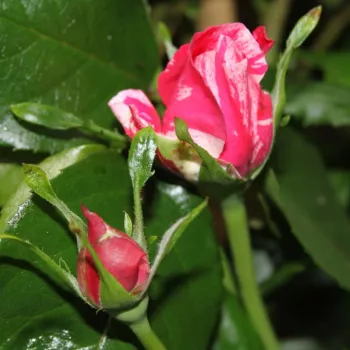
Deep raspberry-red ground colour, variegated with thin off-white streaks.
Newly Opened Flower:
Vivid raspberry-pink petals with bold, high-contrast creamy-white striping.
Full Bloom:
The shade of the inner petals is lighter, and the white streaks blend into a rosy white.
Before Fading:
The raspberry-pink gradually fades to a pale pink and the white stripes become blurred.
Colour Fading Description:
During opening, the vivid raspberry pink gradually lightens to a pale pink, while the cream‑white stripes turn rose‑white and become blurred.
Pollinator Attraction:
Its heavily double flower form means the stamens are largely inaccessible, so it is of low attractiveness to pollinating insects.
Pollinator-Friendly Rating:
Its very double flowers conceal the stamens, making it primarily an ornamental variety.
Heat and Drought Tolerance Description:
According to the descriptions, it tolerates heat well but requires regular watering during prolonged dry conditions.
Our product is a rose grown with pharmaROSA®’s unique cultivation technology!
2-litre, own-root, potted rose.
With a shoot system appropriate to the season.
With a root system that thoroughly permeates the growing medium.
Quality compliant with the requirements of the E.N.A. (European Nurserystock Association).
Supplied in unique packaging that prevents damage.
Can be planted during frost-free periods.
True-to-variety rose bush with a unique identifier.
The pharmaROSA® own-root potted rose is a well-rooted plant that supports reliable establishment when planted and cared for properly, so it can be planted whenever the soil is not frozen.
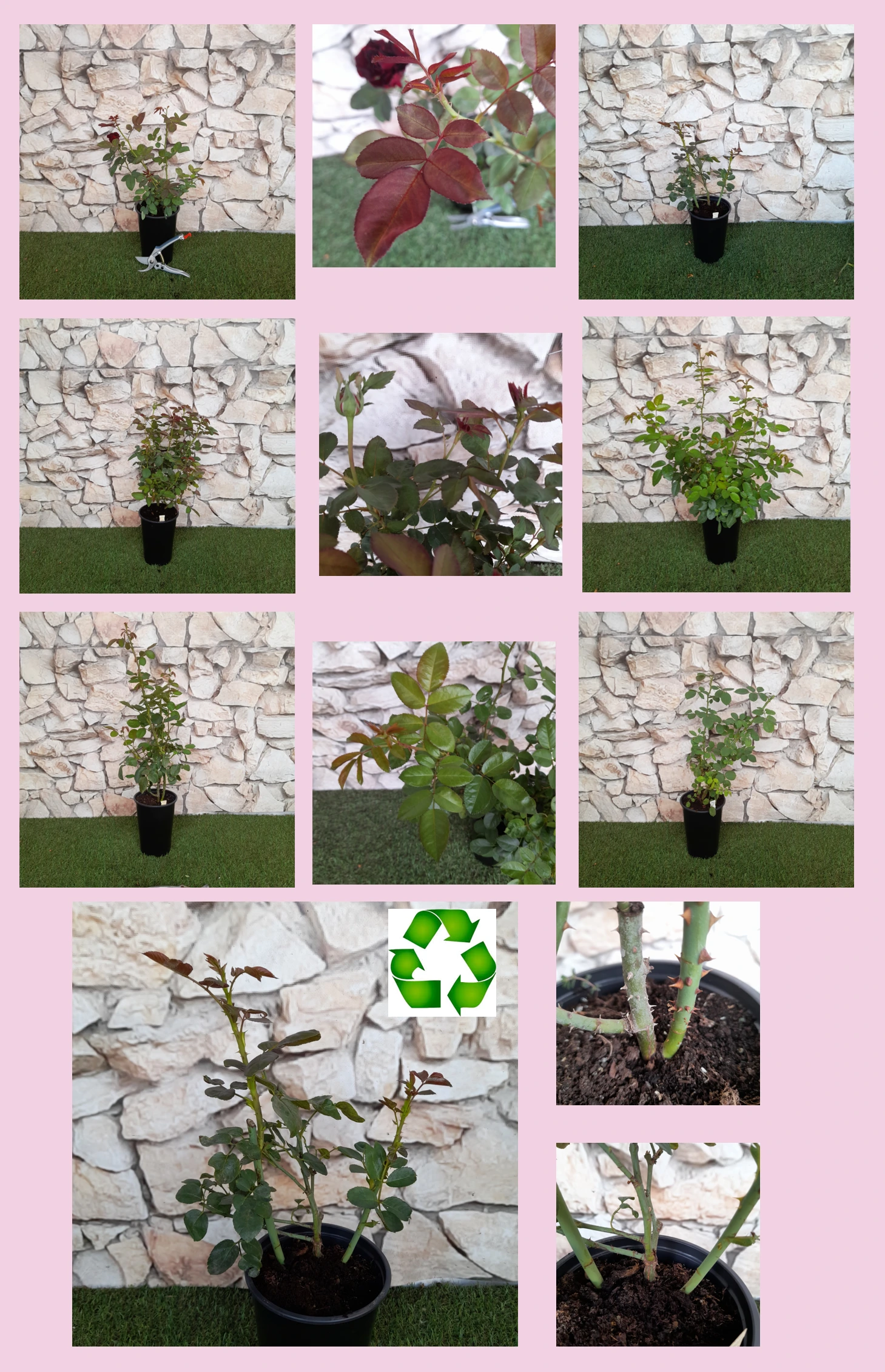
Crop overview: several varieties and growth stages in a short crop section.Shoot system: intensive growth of fresh basal shoots on a young plant.Root system: demonstration of a vigorous root system permeating the growing medium, by removing the pot.Balance: mature plant with root system and shoots in harmony with each other.
Information about the videos
The video series is not a “seasonal showcase”; it illustrates the essence of pharmaROSA® own-root cultivation in a tangible way: how the plant is built up, what the root system is like and how the shoot system regenerates. The recordings were therefore made at different times and with plants at various stages of development, so mixed foliage levels and differing stages of growth may appear in the videos. They are not a ‘sample’ of the batch dispatched, but a visual explanation of how the technology works. The current condition of the rose available to order — typical for the given period and similar to what you can expect to receive in the parcel — is shown in the upper part of the product page.
Pages for private customers Garden roses for the family garden, with minimal care → ORIGINAL® Premium garden roses – instant impact, a truly showpiece garden → EXTRA® Pages for professionals and private customers Roses for public spaces – large areas, sustainable maintenance → NATURAL® Roses for projects – hedge and row planting, fast implementation → RAPID® For professional partners only Production – propagation material for garden roses, wholesale → NEONATAL®
Company details
PharmaRosa Ltd. Company registration number: 01-09-717479 VAT number: 13075314-2-43 Plant health registration no.: HU130721 Bank account (IBAN): HU85117631891388688400000000 BIC (SWIFT): OTPVHUHB Bank name: OTP Bank Nyrt.