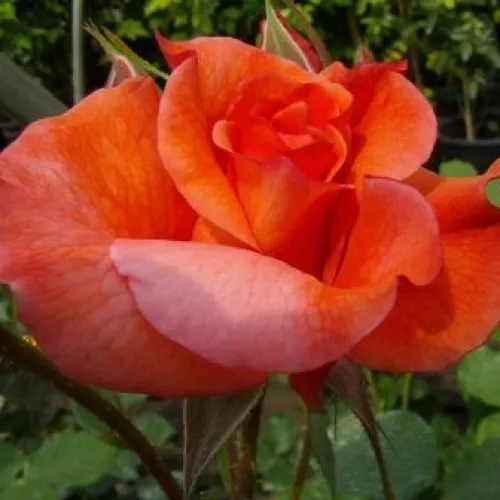
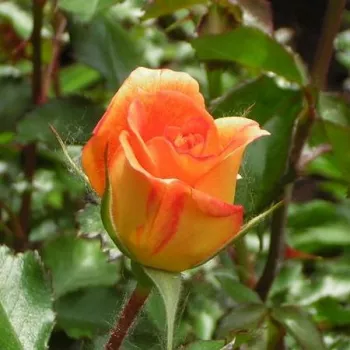
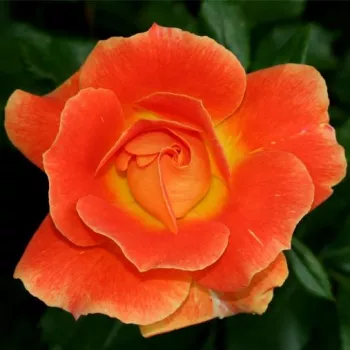
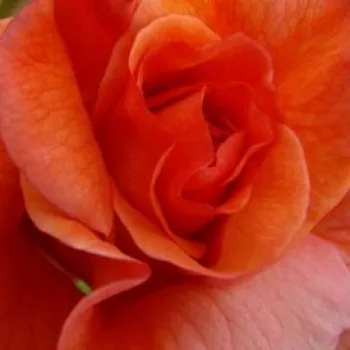
The petals' base colour is light lemon yellow, enlivened by irregular orange brushstrokes. - park rose - mild, restrained-scented rose - fresh, fruity character
– Striking hand-painted yellow-orange blooms.
– Strong repeat flowering for long display.
– Compact, upright shrub for beds and hedges.
– Hardy to RHS H7 for colder gardens.
– Semi-double blooms support garden wildlife.
– Special feature: Award-winning shrub rose, 1er Prix – Bagatelle (Paris).
Supports local wildlife – Long-term garden plan
pharmaROSA® ORIGINAL 2-litre own-root potted rose
18,70 £
Unfortunately, we are currently unable to ship to the United Kingdom; we only deliver to countries within the European Union. For more information, please contact us!
5(8697)
Gypsy Dancer – yellow-orange park rose – DICquiet
Colour and character define Gypsy Dancer, a compact shrub rose that brings a hand-painted effect to everyday gardens with its lively yellow petals brushed in orange. The semi-double, cup-shaped blooms appear in clusters over glossy, dark green foliage, creating a neat, upright habit that suits small borders and front gardens. Strongly remontant, it flowers in generous waves through the season, giving reliable colour even in changeable UK summers. As an own-root shrub it builds a stable, long-lived stand that regenerates well from the base, needing only straightforward routine care. In year one it concentrates on roots, in year two on framework and shoots, and by year three it shows its full ornamental value. Moderate disease resistance and simple pruning keep maintenance manageable for busy gardeners, while its semi-double flowers and red autumn hips gently support local wildlife. Suited to typical British conditions, it copes well with exposed spots where strong winds drive rain across the garden.
Gypsy Dancer shows semi-double, cup-shaped yellow-orange flowers in clusters.
Gypsy Dancer shows its yellow-orange, brushstroke-like bloom.
Usage options
Target area
Reasoning
Small front-garden bed by the path
The compact, upright shrub form and 85–135 cm height give a tidy, welcoming presence without overpowering a narrow front border. Repeating yellow-orange flowers in clusters keep the entrance bright with minimal shaping or staking – ideal for the style-conscious beginner.
Mixed cottage-style border
The vivid, hand-painted petal effect reads beautifully among perennials and grasses, echoing classic cottage gardens while staying controlled in size. Its own-root longevity allows it to settle and improve year on year within a long-term planting – reassuring for the long-horizon planner.
Low informal hedge along a drive
Planted at 50–60 cm intervals, Gypsy Dancer forms a low, flowering line with dense foliage that looks cared-for with only basic clipping. Sturdy, well-anchored growth copes with drive-by wind and rain exposure, making it practical for busy homeowners.
Season-long colour spot near a terrace or seating area
Strongly remontant flowering ensures repeated colour flushes where you sit and relax, with only moderate deadheading needed to keep the display fresh. The mild, fruity scent adds a gentle backdrop without dominating small spaces – a good match for relaxed gardeners.
Wildlife-friendly family garden corner
Semi-double flowers give moderate access to nectar, and the red spherical hips extend interest into autumn while providing a subtle resource for birds. Its manageable size keeps play areas and sightlines clear, suiting nature-aware families.
Feature shrub in a small rose grouping
Own-root growth ensures a stable bush that recovers well if pruned harder, supporting simple long-term shaping without graft worries. Planted with 1–4 other shrubs, it creates a bold colour focus that matures steadily for the patient collector.
Large container on patio or balcony
In a 40–50 litre pot with good drainage, its moderate height and upright habit stay proportionate, while repeat flowering keeps the container lively through summer. Straightforward feeding and watering routines make it suitable for time-pressed urbanites.
Small bed in exposed or coastal-influenced gardens
The dense foliage and firm framework stand up well where wind drives rain across the plot, especially if soil drainage is improved. Moderate disease resistance and simple pruning keep care realistic for those in challenging spots – practical for coastal gardeners.
Styling ideas
Cottage Echo – Combine Gypsy Dancer with fragrant alyssum and soft pink geraniums for a relaxed, low border that recalls traditional cottage fronts – for romantically inclined homeowners.
Sunlit Ribbon – Plant a loose hedge with alternating clumps of ornamental alliums to pick up the yellow-orange tones and add height punctuation – for those refining a front drive.
Patio Focus – Use a single shrub in a 50 litre terracotta pot, underplanted with trailing thyme, to create a simple, repeat-flowering focal point – for balcony and patio gardeners.
Wild Corner – Mix with cypress spurge ‘Fens Ruby’ and ornamental grasses so hips and pollinator-friendly blooms read as a gentle wildlife strip – for nature-conscious families.
Colour Rhythm – Group three shrubs in a small bed with blue catmint and white campanulas to set off the hand-painted petals in a balanced palette – for design-focused beginners.
Technical cultivar profile
Parameter
Data
Name and registration
Gypsy Dancer – park shrub rose, ARS exhibition name Gypsy Dancer, registered as DICquiet, shrub and floribunda group, commercial type park rose for garden and show use.
Origin and breeding
Bred by Patrick Dickson (Dickson Roses, Newtownards, Northern Ireland), from DICmagic × MACmanly (‘Sweet Magic’ × ‘Little Artist’), introduced 1994 in the UK and USA, bred in 1992.
Awards and recognition
1er Prix at the Bagatelle international rose competition, Paris 1992, plus Shrub class winner at Rhode Island Rose Society Show 2000 and Fort Worth Rose Society Show 2001.
Growth and structural characteristics
Upright shrub 85–135 cm high, 60–90 cm spread, dense dark green glossy foliage, moderate prickles, moderate self-cleaning so occasional deadheading improves display, suited to beds and low hedges.
Flower morphology
Semi-double, cup-shaped blooms with 13–25 petals, medium-sized at 1.5–2.75 inches, carried mainly in clusters, strongly remontant with an abundant second flush and further repeat through the season.
Colour data and phenology
Light lemon yellow base enlivened by irregular orange brushstrokes, ARS yb, RHS 14B outer and 24B inner, colour lightens slightly in strong sun and remains more vivid in cooler weather.
Fragrance and aroma
Mild, fresh, fruity fragrance that does not overpower sitting areas; not primarily a scent rose, but offers a gentle aromatic note alongside its visual effect in borders and containers.
Hip characteristics
Produces red, spherical hips 9–15 mm across in moderate numbers, extending ornamental interest into autumn and offering a subtle wildlife resource without heavy self-seeding issues.
Resistance and winter hardiness
Hardy to around –21 to –18 °C (RHS H7, USDA 6b, Swedish zone 3); moderate tolerance of heat and drought with regular watering, and moderate resistance to powdery mildew, black spot and rust.
Horticultural recommendations
Best in full sun with well-drained soil; plant 50–60 cm apart for hedges or mass effect, 100 cm as specimen, 2.8–3.2 plants/m², with medium maintenance and occasional plant protection as needed.
Gypsy Dancer combines compact, upright growth, repeat yellow-orange flowering and wildlife interest with the long-term stability of an own-root shrub, making it a considered choice for easy-going family gardens.
Detailed product attributes
Product Identification Data
Product Name:
GYPSY DANCER – yellow-orange park rose - Dickson
Product Type:
pharmaROSA® ORIGINAL - 2-litre own-root potted rose
Competition and Show Awards:
1er Prix – Bagatelle (Paris) international rose competition (1992); Shrub class winner – Rhode Island Rose Society Show (2000); Shrub class winner – Fort Worth Rose Society Show (2001)
Pollinator Attraction:
Semi-double, 13–25-petalled flowers moderately attract pollinators, as the semi-double form and reduced accessibility of the stamens limit their appeal.
Our product is a rose grown with pharmaROSA®’s unique cultivation technology!
2-litre, own-root, potted rose.
With a shoot system appropriate to the season.
With a root system that thoroughly permeates the growing medium.
Quality compliant with the requirements of the E.N.A. (European Nurserystock Association).
Supplied in unique packaging that prevents damage.
Can be planted during frost-free periods.
True-to-variety rose bush with a unique identifier.
The pharmaROSA® own-root potted rose is a well-rooted plant that supports reliable establishment when planted and cared for properly, so it can be planted whenever the soil is not frozen.
Crop overview: several varieties and growth stages in a short crop section.Shoot system: intensive growth of fresh basal shoots on a young plant.Root system: demonstration of a vigorous root system permeating the growing medium, by removing the pot.Balance: mature plant with root system and shoots in harmony with each other.
Information about the videos
The video series is not a “seasonal showcase”; it illustrates the essence of pharmaROSA® own-root cultivation in a tangible way: how the plant is built up, what the root system is like and how the shoot system regenerates. The recordings were therefore made at different times and with plants at various stages of development, so mixed foliage levels and differing stages of growth may appear in the videos. They are not a ‘sample’ of the batch dispatched, but a visual explanation of how the technology works. The current condition of the rose available to order — typical for the given period and similar to what you can expect to receive in the parcel — is shown in the upper part of the product page.
Pages for private customers Garden roses for the family garden, with minimal care → ORIGINAL® Premium garden roses – instant impact, a truly showpiece garden → EXTRA® Pages for professionals and private customers Roses for public spaces – large areas, sustainable maintenance → NATURAL® Roses for projects – hedge and row planting, fast implementation → RAPID® For professional partners only Production – propagation material for garden roses, wholesale → NEONATAL®
Company details
PharmaRosa Ltd. Company registration number: 01-09-717479 VAT number: 13075314-2-43 Plant health registration no.: HU130721 Bank account (IBAN): HU85117631891388688400000000 BIC (SWIFT): OTPVHUHB Bank name: OTP Bank Nyrt.