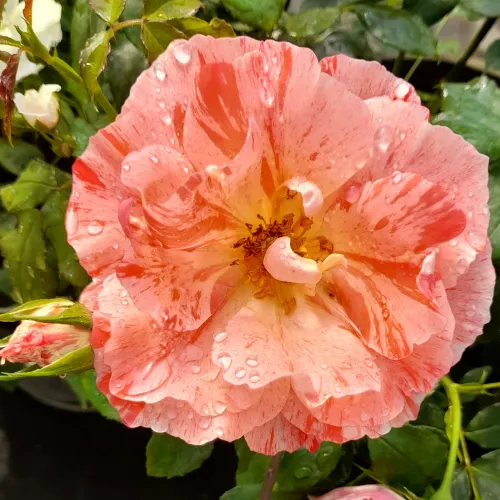
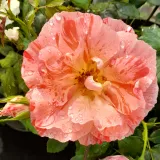
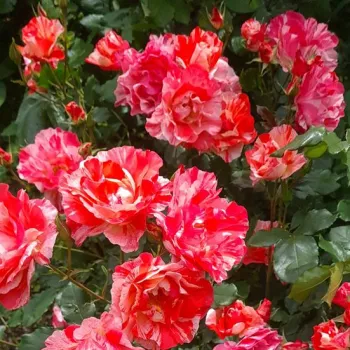
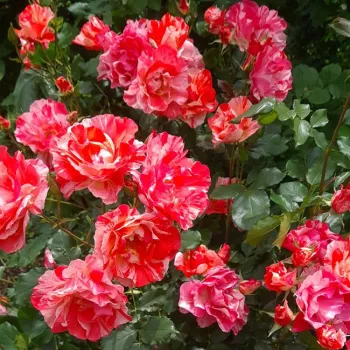
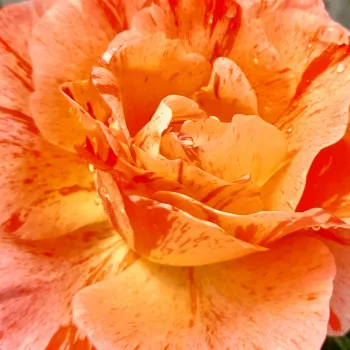
Salmon-pink base colour richly variegated with delicate white and pale pink streaks. - bedding floribunda rose - mild, restrained-scented rose - fresh, fruity-rosy character
– Distinctive salmon-pink blooms with painterly streaks.
– Compact, bushy habit ideal for bedding schemes.
– Reliable repeat flowering with abundant second flush.
– Hardy shrub tolerating cold down to RHS H7.
– Mild, fresh fruity-rosy fragrance for close-up enjoyment.
– Special feature: Award-winning variety, honoured at Monza with People’s Choice and Silver Medal.
Low maintenance – Eco-friendly garden design
pharmaROSA® ORIGINAL 2-litre own-root potted rose
18,70 £
Unfortunately, we are currently unable to ship to the United Kingdom; we only deliver to countries within the European Union. For more information, please contact us!
3(3545)
DELstror – salmon-pink bedding floribunda rose – Delbard & Delbard
Salmon blooms with painterly streaks give DELstror an instantly recognisable focus in a cottage or front garden, forming a bushy, medium-height border shrub that flowers reliably through the season with a generous second flush. Semi-double clusters open in repeated waves, needing only light deadheading to keep the display tidy, while the mild fresh-fruity fragrance adds a gentle note around paths and seating areas. As an own-root plant it settles in securely, building a durable framework that supports a long, balanced lifespan and recovers well after pruning. It adapts steadily to local soil and weather, coping well where gardens are exposed to frequent rain and wind near the coast, and suits mixed beds, small groups or larger drifts in ordinary family plots. Over its first three years it concentrates on roots, then shoots, before reaching full ornamental value for dependable colour, relaxed maintenance and long-term impact.
Closed bud of Delstror with salmon-pink petals and creamy-white shading.
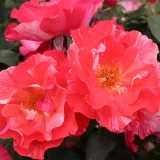
Grimaldi floribunda rose in full bloom
Delstror foliage, shiny in the light
Cup-shaped, semi-double blooms of DELSTROR (Grimaldi).
Usage options
Target area
Reasoning
Front garden feature group (3–5 plants)
Clustered salmon-pink, streaked flowers create an eye-catching focus from the pavement while the bushy, medium-height habit fills space without overwhelming smaller gardens. Repeat blooming keeps the bed active across summer with only occasional deadheading needed for a neat look, ideal for time-pressed beginners.
Cottage-style mixed border
The semi-double, painterly blooms blend beautifully with traditional perennials and grasses, providing a soft, informal structure that still looks composed. Own-root growth forms a stable base that responds well to varied pruning styles, allowing the rose to mature gracefully in long-term border schemes for style-conscious homeowners.
Low flowering hedge along paths or drives
The bushy, medium-density foliage and 90–115 cm height make a coherent low hedge that frames paths without blocking views. Regular, remontant flowering brings colour rhythm through the season, and own-root resilience helps the line recover evenly after harder trims, reassuring cautious gardeners.
Small bed next to patio or seating area
Its compact spread and moderate height make it easy to place close to seating, where the fresh, mild fragrance can be appreciated without being overpowering. The semi-double flowers offer partial value for pollinators while still looking refined, suiting relaxed spaces used by nature-aware families.
Container planting in large pots (40–50 litres)
In a sufficiently large container the bushy structure stays balanced and manageable, giving season-long colour on terraces and paved front gardens. Own-root vigour supports regrowth after occasional repotting or pruning, keeping the plant reliable even for those with limited planting space or no borders, supporting urban gardeners.
Part-shaded town garden corner
Tolerance of partial shade lets it flower well where sun is limited by neighbouring houses or walls. The streaked salmon and cream blooms lighten darker corners without needing specialist care, and the own-root framework adapts steadily to local conditions, fitting busy professionals.
Small town or coastal gardens
This variety performs well where space is tight and conditions can be breezy, its bushy shape and sturdy stems coping with borders that face regular rain and wind on exposed sites. Once established, moderate self-cleaning and simple pruning keep it manageable, appealing to practical owners.
Informal park-style or community planting
Reliable repeat flowering and mid-height structure work well in shared spaces where impact is expected without complex upkeep. The own-root habit supports a long service life and easier regeneration after heavier pruning, making it a sound choice for low-input, mixed plantings maintained by community volunteers.
Styling ideas
Painterly drift – Plant 5–7 bushes in a loose curve, underplanting with Geranium macrorrhizum to hide bare stems and extend colour – ideal for relaxed cottage-style front gardens.
Salmon focus – Use three DELstror in a triangle in a small lawn bed, edged with low Sedum spurium to contrast foliage and texture – suited to homeowners wanting a compact yet striking feature.
Soft hedge – Create a low informal hedge at 60 cm spacing, weaving in Liriope muscari at the feet for year-round ground cover – perfect for defining paths in family gardens.
Courtyard pot – Grow one plant in a 40–50 litre terracotta container with trailing thyme at the rim for fragrance and softness – a good option for urban patios and balconies.
Border rhythm – Alternate DELstror with clumps of ornamental grasses to break up the rose clusters and echo the streaked petals – appealing to beginners seeking an easy, modern cottage look.
Technical cultivar profile
Parameter
Data
Name and registration
Floribunda bed rose, registered as DELstror, marketed as Delstror Les Roses de peintres DELstror; exhibition name Grimaldi, marking 700 years of Monaco’s Grimaldi dynasty.
Origin and breeding
Bred by Georges and Guy Delbard in France around 1990, parentage unknown; introduced by Pépinières et Roseraies Georges Delbard in 2001 in France and 2002 in the United Kingdom.
Awards and recognition
Recognised at Monza trials with the People’s Choice Award in 1998 and Silver Medals in 1998 and 1999, confirming strong public appeal and ornamental performance under show conditions.
Growth and structural characteristics
Bushy, medium-height shrub, 90–115 cm tall and 95–125 cm wide, with moderately thorny stems and dark green, medium-density foliage providing a solid structure for bedding or low hedging.
Flower morphology
Semi-double, medium-sized cup-shaped flowers in clusters, typically 13–25 petals, remontant with a particularly plentiful second flush, offering good visual effect through the main season.
Colour data and phenology
Salmon-pink base with delicate white and pale pink streaks; RHS 36C outer and 155D inner, colours lighten in strong sun, giving a soft, painterly effect as the blooms mature and fade.
Fragrance and aroma
Mild, restrained scent with a fresh, fruity-rosy character; noticeable close-up around paths or seating but not overpowering, making it suitable for high-traffic family spaces and smaller gardens.
Hip characteristics
Rose hips may form sporadically, usually small at 0–8 mm diameter and not a dominant ornamental feature; this lends the variety more to floral than autumnal display in most settings.
Resistance and winter hardiness
Hardy to around −21 to −18 °C (RHS H7, USDA 6b, Swedish Zone 3) with moderate heat tolerance; disease resistance moderate to mildew and black spot, but very sensitive to rust.
Horticultural recommendations
Best in well-drained beds or large containers; monitor foliage regularly and treat promptly for rust, watering consistently in dry spells to support repeat flowering and sustained ornamental value.
DELstror offers painterly salmon-pink repeat flowering, a compact bushy habit and adaptable own-root durability for long-term borders and containers, making it a thoughtful choice for those planning a dependable family garden rose.
Foliage:
The variety has medium-density foliage; the surface texture of the leaves cannot be clearly classified and their colour is a dark green shade.
Pollinator Attraction:
Double-flowered varieties (as opposed to simple or semi-double forms) are less attractive to pollinators because the densely filled petals hide or restrict access to the stamens and nectar.
Maintenance Requirement:
Maintenance requirement high; due to poor disease resistance it requires regular inspections and frequent plant protection measures.
Primary Uses:
flower bed, group, container, hedge, cut flower, park
Our product is a rose grown with pharmaROSA®’s unique cultivation technology!
2-litre, own-root, potted rose.
With a shoot system appropriate to the season.
With a root system that thoroughly permeates the growing medium.
Quality compliant with the requirements of the E.N.A. (European Nurserystock Association).
Supplied in unique packaging that prevents damage.
Can be planted during frost-free periods.
True-to-variety rose bush with a unique identifier.
The pharmaROSA® own-root potted rose is a well-rooted plant that supports reliable establishment when planted and cared for properly, so it can be planted whenever the soil is not frozen.
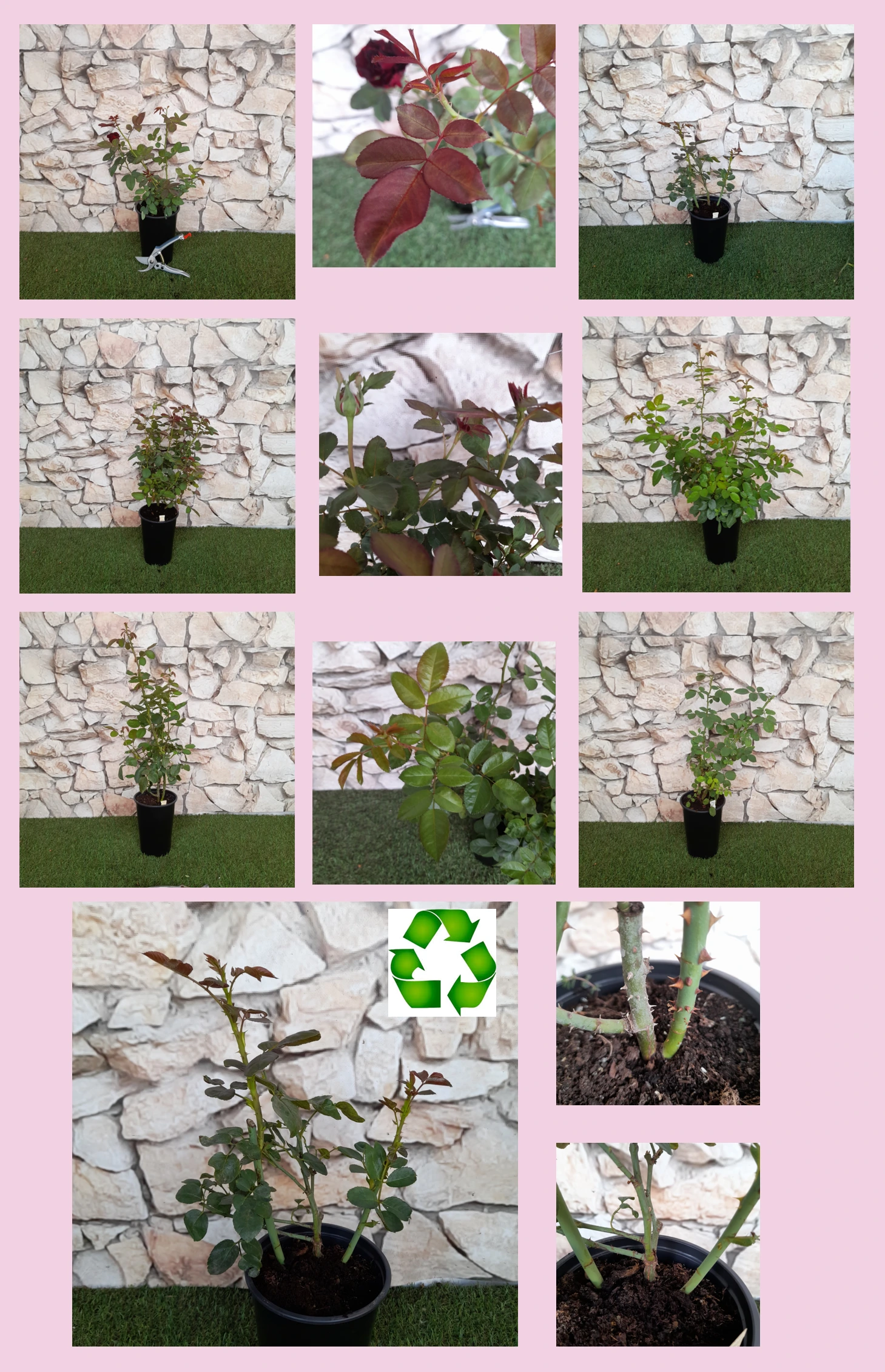
Crop overview: several varieties and growth stages in a short crop section.Shoot system: intensive growth of fresh basal shoots on a young plant.Root system: demonstration of a vigorous root system permeating the growing medium, by removing the pot.Balance: mature plant with root system and shoots in harmony with each other.
Information about the videos
The video series is not a “seasonal showcase”; it illustrates the essence of pharmaROSA® own-root cultivation in a tangible way: how the plant is built up, what the root system is like and how the shoot system regenerates. The recordings were therefore made at different times and with plants at various stages of development, so mixed foliage levels and differing stages of growth may appear in the videos. They are not a ‘sample’ of the batch dispatched, but a visual explanation of how the technology works. The current condition of the rose available to order — typical for the given period and similar to what you can expect to receive in the parcel — is shown in the upper part of the product page.
Pages for private customers Garden roses for the family garden, with minimal care → ORIGINAL® Premium garden roses – instant impact, a truly showpiece garden → EXTRA® Pages for professionals and private customers Roses for public spaces – large areas, sustainable maintenance → NATURAL® Roses for projects – hedge and row planting, fast implementation → RAPID® For professional partners only Production – propagation material for garden roses, wholesale → NEONATAL®
Company details
PharmaRosa Ltd. Company registration number: 01-09-717479 VAT number: 13075314-2-43 Plant health registration no.: HU130721 Bank account (IBAN): HU85117631891388688400000000 BIC (SWIFT): OTPVHUHB Bank name: OTP Bank Nyrt.