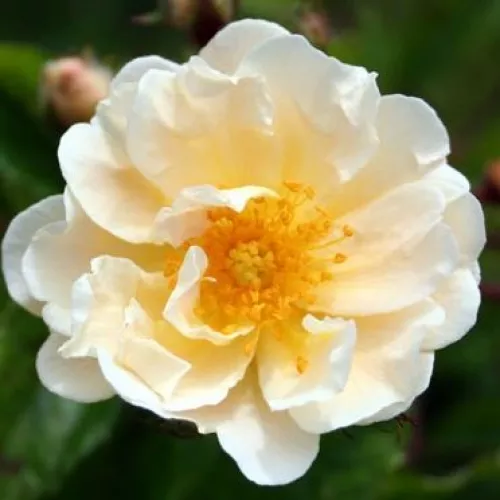
Initially deep golden yellow, fading to a buttery yellow in sunlight. - historical, old garden rose - strong, well-scented rose - fresh, fruity character
– Strong, fresh fruity fragrance in bloom.
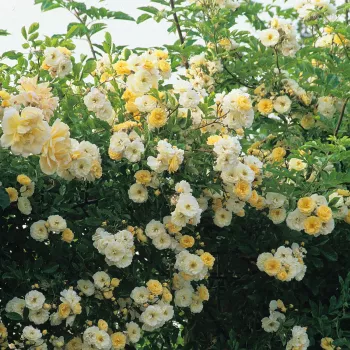
– Abundant small clusters of lemon-yellow flowers.
– Vigorous climber for arches, fences and walls.
– Barely thorny canes, easier to handle.
– Excellent disease resistance, low maintenance.
– Special feature: Historic 1907 rambler with decorative red hips.
Consistent quality – Value-based choice
pharmaROSA® ORIGINAL 2-litre own-root potted rose
18,20 £
Unfortunately, we are currently unable to ship to the United Kingdom; we only deliver to countries within the European Union. For more information, please contact us!
4(6239)
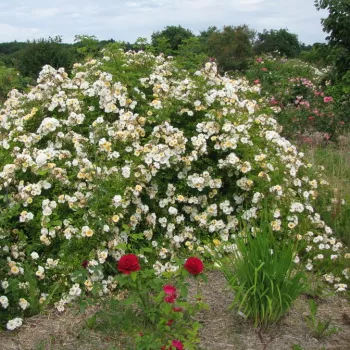
Goldfinch – yellow historic rambler rose for easy cottage charm
historiceasy-carevigoroushealthyfragrantpollinatorsthornlesslong-lived Goldfinch is a century-old rambler that brings soft, lemon-yellow clusters and a fresh, fruity scent to pergolas, arches and cottage-style front gardens. Once established, it asks for very little: its good disease resistance and self-cleaning blooms keep the plant looking tidy with minimal attention, and its barely thorny stems make everyday handling more comfortable around family paths and play areas. Own-root plants settle in steadily and can give reliable structure for decades, while well-anchored growth copes confidently with exposed, windier British spots. In its first year it concentrates on roots, in the second on shoots, and by the third it reaches its full ornamental presence.
Goldfinch rose in close-up, showing its strong, fresh fruity fragrance.
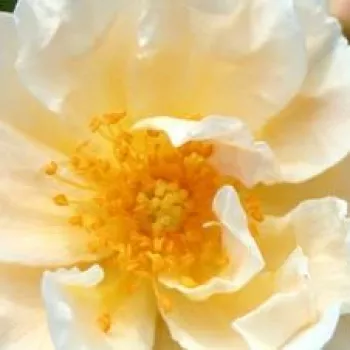
Goldfinch showing colour changes across opening stages.
Usage options
Target area
Reasoning
Pergolas and garden arches
Goldfinch’s vigorous climbing habit quickly clothes pergolas and arches with cascading clusters of small, cupped blooms in early summer, creating a soft yellow tunnel effect that suits cottage-style entrances and seating areas, especially for the beginner
Low-maintenance front gardens
Once established, this rose needs only basic watering in dry spells and a light annual tidy, while its self-cleaning flowers and good disease resistance help keep the plant presentable without regular deadheading or spraying, ideal for the busy homeowner
Long-term structure along fences and walls
The own-root, long-lived character of Goldfinch makes it a dependable choice for training along boundaries, gradually forming a stable framework of stems that can be renewed from the base over time for a consistent display, reassuring for the planner
Family paths and play-adjacent areas
With its barely thorny shoots, Goldfinch is more comfortable to work around than many ramblers, reducing snagging on clothes and making seasonal tying-in or light pruning less daunting in narrower spaces used regularly by the family
Healthy cottage-style mixed borders
Its resistant foliage stays attractive in typical British humidity, allowing Goldfinch to blend reliably with perennials and shrubs without frequent treatments, supporting a relaxed, informal garden style that still looks well kept for the style-conscious
Pollinator-friendly wildlife corners
Semi-double, open blooms with accessible stamens provide useful forage for bees and other insects, especially when trained through wildlife-friendly shrubs, adding seasonal interest while supporting garden biodiversity valued by the nature-lover
Lightly shaded side gardens
Its tolerance of partial shade allows planting on east- or north-facing aspects where many roses struggle, helping to green up narrower side passages or shaded boundaries that still benefit from a soft yellow flush, encouraging the practical
Exposed and breezier plots
Goldfinch forms a well-anchored framework when tied to supports, coping well with typical British breezes and coastal winds while maintaining foliage quality, bringing reassurance in open sites for the coastal
Styling ideas
Cottage Archway – Train Goldfinch over a metal or wooden arch, underplanting with hardy geraniums and nepeta for a soft, romantic entrance – ideal for lovers of classic cottage gardens
Soft Screen – Use along a wire fence with lavender and Echinacea purpurea in front to form a scented, low-maintenance boundary – suited to busy families wanting easy structure
Wildlife Walkway – Weave stems through mixed shrubs and tall verbena to create a lightly managed, pollinator-friendly corridor – perfect for nature-focused gardeners
Shaded Side Retreat – Plant in a narrow side garden with ferns and hostas below, using its partial-shade tolerance to add height and colour – good for urban homeowners with limited sun
Gentle Pergola – Cover a seating pergola where fewer thorns are appreciated, pairing with climbers like clematis for layered flowering – attractive to those prioritising comfort and relaxation
Technical cultivar profile
Parameter
Data
Name and registration
Goldfinch – historical Hybrid Multiflora rambler, part of the Historic rose collection; registered cultivar name and current trade name Goldfinch, unregistered with formal registries but widely recognised.
Origin and breeding
Bred by George Paul Jr. at Paul & Son, Cheshunt Nurseries, United Kingdom; introduced 1907 via Hazlewood Bros. in Australia; parentage ‘Hélène’ × unknown seedling typical of early multiflora ramblers.
Growth and structural characteristics
Vigorous climbing rambler reaching 320–500 cm in height with a 180–280 cm spread; moderately dense, glossy dark green foliage on largely smooth, barely thorny stems suited to training on structures.
Flower morphology
Semi-double, cupped to flat-opening blooms, 0.5–1.5 inches across, borne in many-flowered clusters; 13–25 petals, non-remontant with a single but abundant early-summer flush that self-cleans well.
Colour data and phenology
Initially deep golden yellow with lemon tones, coded RHS 11C outer and 4D inner; colour fades in sun through buttery and pastel creamy yellow to near white by the end of flowering, giving a soft, nostalgic effect.
Fragrance and aroma
Strong, fresh, fruity fragrance characteristic of old ramblers; scent is noticeable in still air around arches and pergolas, adding atmospheric value to seating and entrance areas when in full early-summer bloom.
Hip characteristics
Produces moderately formed spherical red hips, around 6–9 mm in diameter; hips extend visual interest into autumn and can contribute modestly to wildlife value in less heavily pruned plantings.
Resistance and winter hardiness
Rated resistant to powdery mildew, black spot and rust; RHS hardiness H6, tolerating approximately –15 to –12 °C; suitable for much of the UK with moderate heat tolerance and irrigation needed in long droughts.
Horticultural recommendations
Best trained on pergolas, arches, fences or walls with 120–220 cm spacing; prefers well-drained soil and regular watering in dry periods; own-root habit favours long-term stability and rejuvenation pruning when required.
Goldfinch offers an easy-care, healthy, strongly fragrant display on long-lived own-root plants that settle in reliably over time, making it a thoughtful choice if you seek enduring cottage charm with modest effort.
Detailed product attributes
Product Identification Data
Product Name:
GOLDFINCH – yellow historic old garden rose - Paul
Product Type:
pharmaROSA® ORIGINAL - 2-litre own-root potted rose
Our product is a rose grown with pharmaROSA®’s unique cultivation technology!
2-litre, own-root, potted rose.
With a shoot system appropriate to the season.
With a root system that thoroughly permeates the growing medium.
Quality compliant with the requirements of the E.N.A. (European Nurserystock Association).
Supplied in unique packaging that prevents damage.
Can be planted during frost-free periods.
True-to-variety rose bush with a unique identifier.
The pharmaROSA® own-root potted rose is a well-rooted plant that supports reliable establishment when planted and cared for properly, so it can be planted whenever the soil is not frozen.
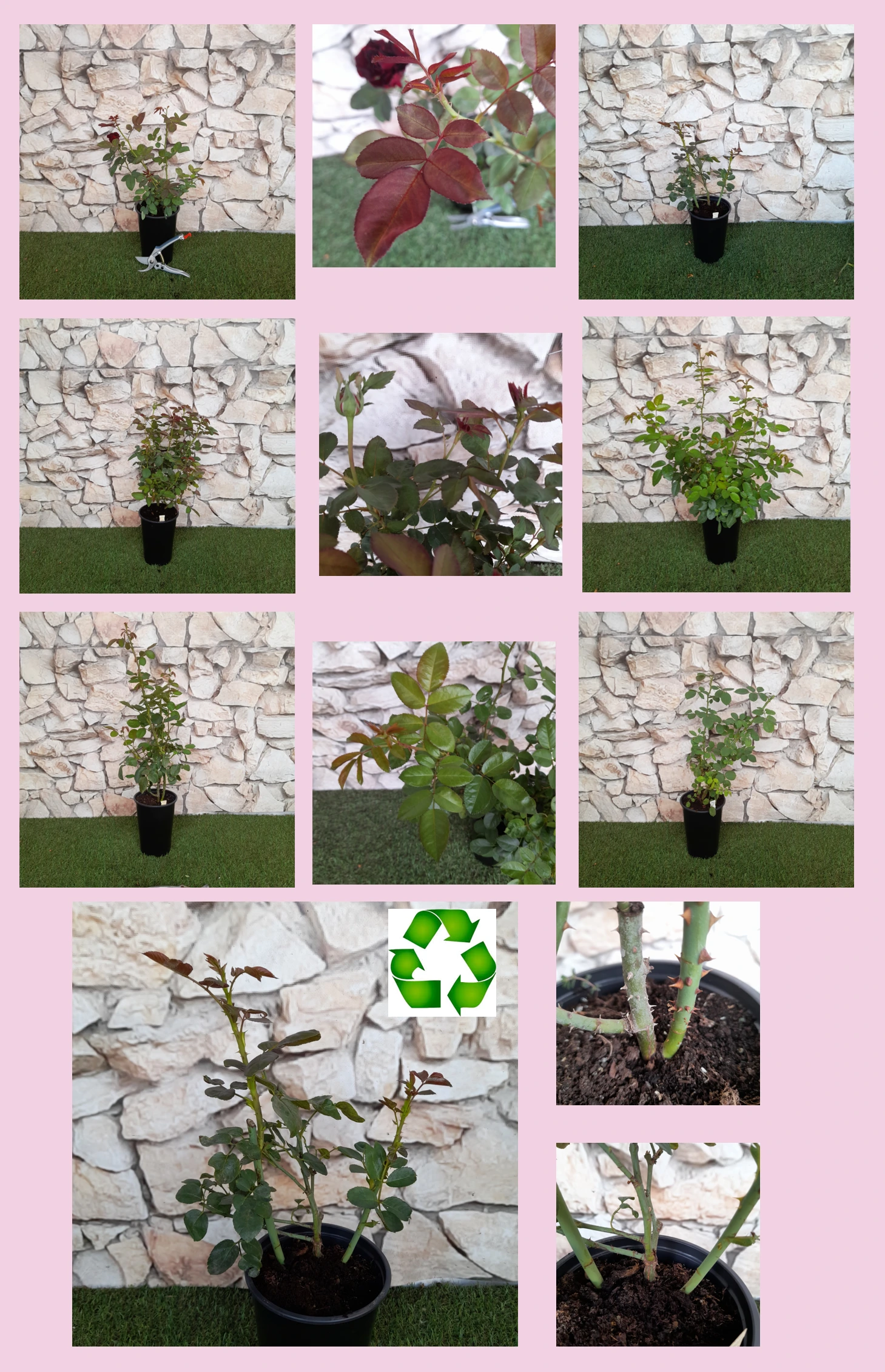
Crop overview: several varieties and growth stages in a short crop section.Shoot system: intensive growth of fresh basal shoots on a young plant.Root system: demonstration of a vigorous root system permeating the growing medium, by removing the pot.Balance: mature plant with root system and shoots in harmony with each other.
Information about the videos
The video series is not a “seasonal showcase”; it illustrates the essence of pharmaROSA® own-root cultivation in a tangible way: how the plant is built up, what the root system is like and how the shoot system regenerates. The recordings were therefore made at different times and with plants at various stages of development, so mixed foliage levels and differing stages of growth may appear in the videos. They are not a ‘sample’ of the batch dispatched, but a visual explanation of how the technology works. The current condition of the rose available to order — typical for the given period and similar to what you can expect to receive in the parcel — is shown in the upper part of the product page.
Pages for private customers Garden roses for the family garden, with minimal care → ORIGINAL® Premium garden roses – instant impact, a truly showpiece garden → EXTRA® Pages for professionals and private customers Roses for public spaces – large areas, sustainable maintenance → NATURAL® Roses for projects – hedge and row planting, fast implementation → RAPID® For professional partners only Production – propagation material for garden roses, wholesale → NEONATAL®
Company details
PharmaRosa Ltd. Company registration number: 01-09-717479 VAT number: 13075314-2-43 Plant health registration no.: HU130721 Bank account (IBAN): HU85117631891388688400000000 BIC (SWIFT): OTPVHUHB Bank name: OTP Bank Nyrt.