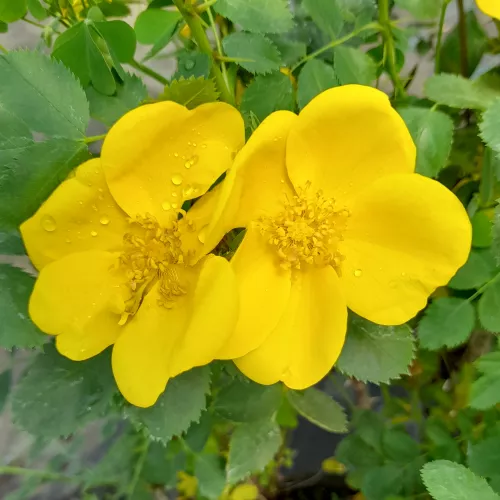
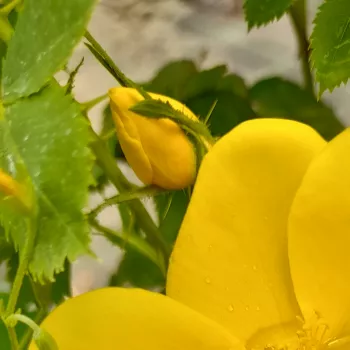
FOETIDA – yellow wild rose
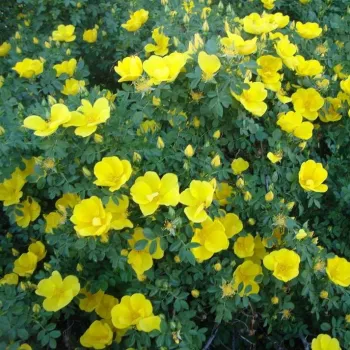
Golden blooms on this classic wild rose bring a quietly dramatic focal point to modest British plots, thriving even in exposed gardens where wind and rain are regular visitors, while its robust, erect-arching habit forms a natural, informal backdrop in beds and borders. Once-established hardy growth shrugs off winter cold and summer heat with little input beyond watering in dry spells, allowing you to enjoy its botanical character without complicated care routines. As an own-root plant it settles in steadily, forming a stable, long-lived shrub that regenerates well if cut back, so your investment in this historic species pays off year after year. In the first seasons the focus is on roots, then strong new shoots, and by the third year the shrub shows its full ornamental value, with arching stems scattered with lustrous yellow flowers. Its once-a-year spring flush creates a memorable moment in the garden calendar and then steps back, leaving dark green foliage to structure borders through summer, fitting neatly into low-maintenance cottage and family-garden schemes.
Usage options
| Target area | Reasoning |
|---|
| Front-garden focal shrub |
Planted near the house or along a front path, this rose forms a tall, eye-catching shrub with a broad golden flush in late spring, then settles into dark green structure that needs little more than light shaping, suiting busy beginners |
| Informal flowering hedge |
At 90 cm spacing it knits into a loose, semi-transparent screen, combining height, arching branches and moderate prickles for a gently protective boundary that stays ornamental with minimal pruning, ideal for family gardens |
| Mixed cottage-style border |
Its once-a-season golden display and wild character pair well with perennials and grasses, bringing contrast in form and colour while remaining easy to manage and not demanding complex rose care, appealing to cottage enthusiasts |
| Low-intervention park or landscape strip |
Excellent where the goal is large-scale impact with very little attention: drought and disease resistance, own-root longevity and reliable structure make it a sound choice for public-facing planting maintained by urban homeowners |
| Feature rose in clay or chalky soils |
Once established it copes well with typical British conditions, including heavier or chalky ground if drainage is considered, anchoring firmly and giving tall, stable growth that rewards basic care from casual gardeners |
| Seasonal highlight in family gardens |
Its concentrated bloom period creates a clear “rose moment” each year, after which it behaves as a tough green shrub, so families can enjoy drama in spring without needing to deadhead or coax repeat flowers, suiting time-poor parents |
| Naturalistic and wildlife-style planting |
The wild look, arching form and occasional hips integrate well into looser, meadow-edge or orchard-style schemes, providing height and seasonal colour while remaining structurally reliable and undemanding for hobby gardeners |
| Long-term own-root specimen |
As an own-root shrub it ages gracefully, recovering better from hard pruning or weather damage and maintaining its botanical character over many years, making it a reassuring choice for gardeners planning a lasting feature, including beginners |
Styling ideas
- Cottage Accent – Place FOETIDA at the back of a small border with white sweet alyssum and pastel foxgloves for a relaxed cottage feel that still stays tidy – ideal for aesthetics-led beginners
- Sunny Screen – Use a loose row along a front boundary, underplanted with low grasses and verbena, to form a soft, informal screen that needs little more than an annual tidy – perfect for busy suburban owners
- Golden Feature – Make a single shrub the centrepiece of a small lawn island, with simple spring bulbs beneath, for a striking once-a-year display that requires minimal ongoing work – good for low-maintenance seekers
- Botanical Mix – Combine with other species roses and hardy perennials in a naturalistic strip to showcase its wild character and robust health while keeping maintenance straightforward – suited to curious improvers
- Family Backdrop – Plant behind a seating area or play space to create a tall, green backdrop with a short, spectacular bloom period, avoiding constant pruning or deadheading – reassuring for new homeowners
Technical cultivar profile
| Property | Data |
|---|
| Name and registration |
Wild yellow species rose marketed as FOETIDA – yellow wild rose; trade and exhibition name Rosa foetida within the Botanical rose collection, classed as a botanical/historical wild rose type. |
| Origin and breeding |
Wild species originating from the Caucasus–Iran region, in cultivation in Europe since 1583; breeder and breeding year uncertain, reflecting its long-standing historical status in gardens. |
| Growth and structural characteristics |
Erect to arching, bushy habit reaching around 160–240 cm tall and 120–190 cm wide; moderately dense dark green foliage, moderately thorny stems, generally forming a strong, self-supporting shrub. |
| Flower morphology |
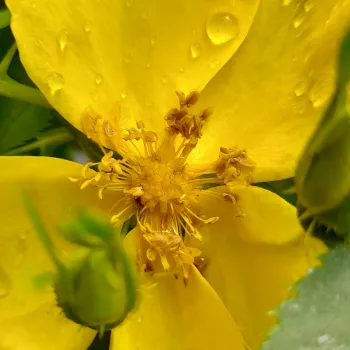
Medium-sized, flat, single flowers with 5–12 petals, usually borne singly; non-remontant, giving one main flowering period, with good self-cleaning as petals fall naturally and hips can then develop. |
| Colour data and phenology |
Intense deep yellow buds open to lustrous golden-yellow blooms that gradually fade to a softer straw yellow with creamy tones; colour fade is faster in hot weather but remains warm and attractive overall. |
| Fragrance and aroma |
Distinctly spicy, medium-strength fragrance, noticeable at close range and characteristic of the species; foliage and overall plant scent are part of its traditional appeal for lovers of botanical roses. |
| Hip characteristics |
Occasional spherical red hips, around 10–14 mm in diameter, may appear following flowering; overall hip set is limited but can add a subtle seasonal feature in late summer to early autumn. |
| Resistance and winter hardiness |
Very hardy, tolerating approximately −40 to −37 °C (RHS H7, USDA 3a); good resistance to powdery mildew, black spot and rust, and copes well with heat and moderate drought once established. |
| Horticultural recommendations |
Best in full sun; plant 90–165 cm apart depending on hedge or specimen use; suits low-intervention maintenance with only periodic pruning to control size and maintain a clear, arching framework. |
FOETIDA – yellow wild rose offers striking golden spring colour, exceptional hardiness and low-maintenance shrub structure on a long-lived own-root plant, making it a thoughtful choice for gardeners planning a reliable, characterful feature.