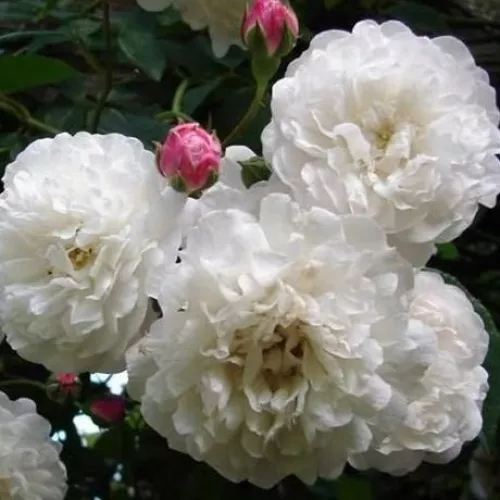
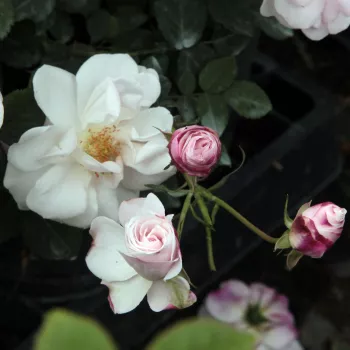
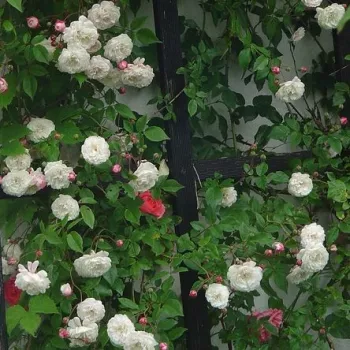
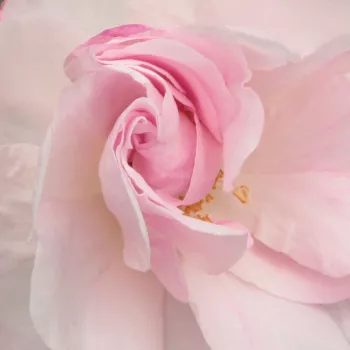
FÉLICITÉ ET PERPÉTUE – white historic rambler rose (climbing/trailing) - Jacques
Historic yet reassuringly reliable, Félicité et Perpétue is a classic rambler for effortless vertical structure in family gardens, clothing walls, pergolas and old trees in soft off-white clusters. Its dense, mid-green, glossy foliage forms a long-lived framework that needs little intervention beyond the simplest pruning, while its excellent disease resistance means low chemical input and fewer worries in humid summers and exposed, breezy sites where persistent rain and wind test lesser roses. Once established, the vigorous growth copes well with heat and moderate drought, staying dependable even in heavier garden soils with sensible drainage. As an own-root plant it develops a stable, regenerating framework that matures steadily over the years, giving you a heritage feature that quietly earns its place season after season.
Usage options
| Target area | Reasoning |
|---|
| Front garden focal wall |
Ideal for covering a plain house wall or garage side, creating a soft, romantic curtain of creamy-white clusters in early summer with minimal ongoing care thanks to its naturally low maintenance needs and strong disease resistance, suiting the time-poor enthusiast beginner |
| Pergola or arbour for seating area |
Its vigorous, climbing habit and dense foliage quickly form a leafy canopy over a bench or garden path, giving seasonal privacy and shade; once tied in during the first years, it largely manages itself with occasional thinning, perfect for the relaxed cottage-garden lover homeowner |
| Training into mature trees |
The long, flexible, sparsely thorned shoots can be guided into the lower branches of an existing tree, where they weave naturally to create a romantic, “old garden” look without complex pruning regimes, appealing to creative gardeners seeking a dreamy atmosphere stylist |
| Boundary screen or informal hedge |
Planted at wider intervals along a fence, it provides a tall, leafy screen that is easy to maintain: simple tying-in and light annual pruning keep it tidy, while the persistent framework ensures lasting structure and privacy for practical yet aesthetic-minded garden owners families |
| Low-maintenance heritage feature bed |
Works beautifully as a stand-alone specimen trained on sturdy supports, where its award-winning garden performance and historic character add depth and story to a small ornamental area that the gardener wants to enjoy rather than constantly tend, suiting thoughtful plant collectors enthusiasts |
| Cottage-style mix with perennials and grasses |
The small, globular clusters of soft off-white blooms harmonise effortlessly with pastel lupins, low heucheras and airy grasses, giving a layered, textural cottage effect while the plant’s resilience to common rose diseases keeps the whole composition looking fresh for style-conscious yet busy urbanites |
| Challenging sites with exposed weather |
Performs reliably in breezier, rain-washed gardens where its strong disease resistance and tolerance of moderate drought reduce the need for spraying and constant watering, giving peace of mind in areas where frequent wind and rain would otherwise test a rambling rose, making it reassuring for coastal and country gardeners |
| Long-term structural planting project |
Best for gardeners planning several years ahead: it establishes roots in the first seasons, builds substantial framework and then offers its full ornamental display, creating a permanent vertical element that only needs simple yearly attention, attractive to planners of evolving family gardens |
Styling ideas
- COTTAGE FRONT ARCH – Train over a simple metal arch at the garden gate with underplanting of low heucheras to soften the base, ideal for those wanting a welcoming, low-effort cottage entrance – homeowners
- ROMANTIC TREE VEIL – Allow stems to climb into an existing small tree, underplanted with lupins for early-summer colour echoes, for gardeners seeking an old-park feel without intricate pruning – dreamers
- PERGOLA RETREAT – Cover a timber pergola beside a terrace, combining with potted grasses such as Panicum for movement and texture, perfect for families creating a shaded outdoor room – relaxers
- HISTORIC FEATURE CORNER – Use as a specimen on a sturdy obelisk with simple, low-maintenance groundcover around the base, suited to those who enjoy heritage varieties but prefer straightforward care – traditionalists
- BOUNDARY SOFTENER – Plant along a fence and allow the long canes to weave through, mixing with informal perennials in front to blur the edges, appealing to small-garden owners aiming for privacy with charm – neighbours
Technical cultivar profile
| Parameter | Data |
|---|
| Name and registration |
Félicité et Perpétue is a historic hybrid Sempervirens rambler; trade name as listed, unregistered cultivar, classed as a heritage climbing or creeping rose for ornamental garden use. |
| Origin and breeding |
Bred by Antoine Jacques in France, around 1827–1828, at the Château de Neuilly gardens, from Rosa sempervirens crossed with a Noisette rose, reflecting early nineteenth-century breeding artistry. |
| Awards and recognition |
Holds the Royal Horticultural Society Award of Garden Merit (1993) and has been shown successfully as a Dowager Queen, confirming its proven performance and reliability under garden conditions. |
| Growth and structural characteristics |
Strong climbing rambler reaching 5–8 m high with 3–5 m spread, forming dense, mid-green, glossy foliage on sparsely thorned canes; self-cleaning is moderate, occasional deadheading enhances appearance. |
| Flower morphology |
Produces small, 0.5–1.5 inch, very double, globular pompon blooms in tight clusters; petal count exceeds 40, with a single, abundant main flush rather than repeat flowering through the season. |
| Colour data and phenology |
Buds open pale pink-cream to creamy white with faint pink sheen, maturing to clean off-white; colour holds well in sun with limited fading, creating a soft, uniform display at full bloom. |
| Fragrance and aroma |
Fragrance is very weak, with a subtle classic rose character only lightly perceptible; flower form hides stamens, making it primarily ornamental rather than a significant pollinator resource. |
| Hip characteristics |
Occasionally produces small, spherical orange-red hips around 8–12 mm across, which can add a discreet ornamental interest in late season without being a dominant feature. |
| Resistance and winter hardiness |
Shows high resistance to powdery mildew, black spot and rust; hardy to about –21 to –18 °C (RHS H7, USDA 6b, Swedish Zone 3), coping well with heat and moderate drought once established. |
| Horticultural recommendations |
Best on walls, pergolas, arbours or into trees, spaced generously; plant in well-drained soil, in ground or large containers above 40–50 litres, with light annual pruning to manage size and remove spent growth. |
Félicité et Perpétue offers easy-care height, long-lived structural cover and reliable health in an own-root form that settles in for decades, making it a wise choice if you want a classic rambler that simply works.