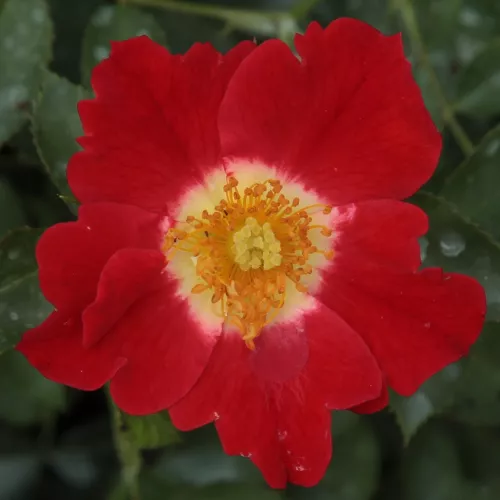
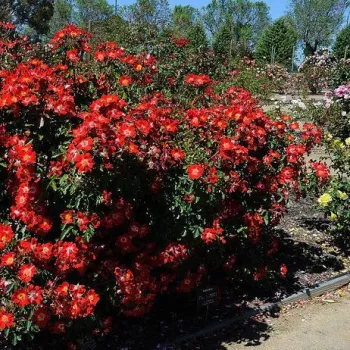
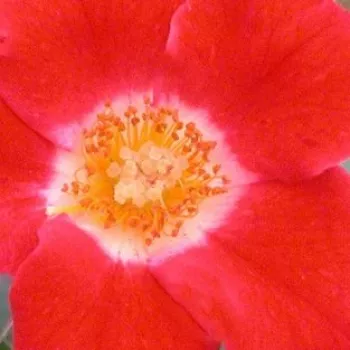
Vibrant scarlet-red petals with a contrasting cream-white eye. - floribunda bedding rose - very weak, barely perceptible scented rose - scent description not available
– Vivid scarlet blooms with cream-white eye.
– Long, abundant repeat flowering display.
– Bushy, slightly spreading shrub habit.
– Good hardiness, suited to colder regions.
– Pollinator-friendly single, open flowers.
– Special feature: Multiple international show awards, including Baden-Baden Gold medal (1976).
Thinking about the garden’s future – Open to feedback
pharmaROSA® ORIGINAL 2-litre own-root potted rose
17,60 £
Unfortunately, we are currently unable to ship to the United Kingdom; we only deliver to countries within the European Union. For more information, please contact us!
3.5(5895)
Tapis Persan – hand-painted scarlet-red floribunda rose
Vivid clusters of small, open blooms make Tapis Persan a practical choice for low‑maintenance beds and borders, bringing a classic cottage feel in a compact, easy‑to‑manage form that copes well with breezy, rain‑washed British weather in exposed gardens. Its colour pattern of scarlet‑red petals with a cream‑white eye stands out from spring to autumn, while the clusters of single flowers invite bees into family spaces without overwhelming fragrance. With a bushy yet tidy habit, this floribunda works beautifully in traditional front gardens, narrow side beds or informal cottage mixes where you want reliable display without complex pruning. Planted as a half‑ to one‑year‑old own‑root rose, it settles gradually, building roots in the first year, stronger shoots in the second, and full garden impact by the third, giving you a resilient, regenerating shrub that can be gently shaped to suit your border layout and long‑term plans.
Flat, single red blooms with a cream-white eye
Tapis Persan with exposed stamens in the flower centre
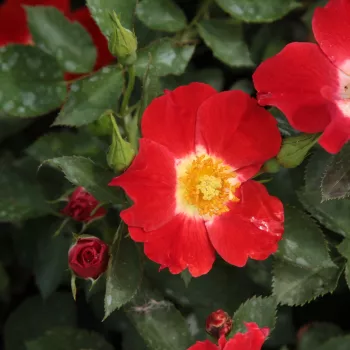
Dark green foliage of Tapis Persan
Tapis Persan floribunda rose in close-up, showing its very weak fragrance.
Usage options
Target area
Reasoning
Front garden bed along a path
The bushy, slightly spreading habit forms a well‑defined line without becoming overpowering, ideal for edging a path or drive in a typical family front garden. Its remontant flowering keeps colour near the house where it is most visible for beginners.
Mixed cottage-style border
Clusters of small, flat, single blooms thread vivid scarlet and cream through looser cottage plantings, pairing easily with perennials and grasses. The distinctive bicolour effect adds pattern rather than bulk, suiting layered borders for aesthetes.
Small group planting (3–5 plants) as a focal patch
Planted in a triangular or loose drift, it creates a “carpet” of repeating red‑and‑cream flowers, giving strong visual impact from a modest footprint. The recommended spacing helps maintain air movement and simple upkeep for homeowners.
Low informal hedge or boundary marker
The moderate height and good lateral spread allow a gently undulating hedge line at 50–55 cm spacing. Recurrent flowering softens fences or front boundaries while remaining easy to trim back to shape in late winter for planners.
Urban garden with partial shade
Its suitability for partial shade means it will still perform where taller buildings or fences limit sun. Positioning in an airy spot reduces humidity issues, and simple deadheading supports repeat bloom for busy-urbanites.
Pollinator-friendly family play area edge
The open, single flowers with accessible stamens attract bees and other beneficial insects, adding life and movement around lawns or play spaces. With very light scent and modest thorns, it suits wildlife-conscious yet practical families.
Large container on patio or balcony
In a 40–50 litre container, its bushy shape and repeat clusters give a long season of colour close to seating areas. Own‑root resilience means the shrub can be refreshed by pruning and top‑dressing rather than frequent replacement for renters.
Weather-exposed coastal or open-site planting
The compact flowers and firm petals cope well with wind and regular rain, maintaining a tidy appearance where more delicate roses can ball or shatter, supporting dependable colour even in unsheltered British plots for pragmatists.
Styling ideas
Cottage Carpet – Combine with soft pink asters and pale echinacea for a loose cottage border where its vivid bicolour clusters create a tapestry effect – ideal for romantically minded front‑garden owners.
Scarlet Ribbon – Plant a single row along a path, repeating at 50–55 cm, to draw the eye to your front door with a low, informal hedge – suited to those seeking simple, high‑impact structure.
Pollinator Drift – Weave through a mixed bed with other single‑flowered perennials to build a bee‑friendly strip that offers colour and movement with minimal care – perfect for wildlife‑focused families.
Patio Feature – Grow one specimen in a 40–50 litre terracotta pot, underplanting with low herbs to soften the base and enjoy repeat flowering at eye level – appealing to balcony and courtyard gardeners.
Graphic Contrast – Set against dark evergreen shrubs or yew, using groups of three plants, to emphasise the cream eye and scarlet petals as living “exclamation points” – attractive for design‑conscious homeowners.
Technical cultivar profile
Parameter
Data
Name and registration
Floribunda shrub rose; registered as MACeye and traded as Tapis Persan, also known in exhibition circles as Eye Paint, with stable naming verified for garden use.
Origin and breeding
Bred by Samuel Darragh McGredy IV from ‘MACyeleye’ × ‘Picasso’, registered in 1976 and introduced after 1976 by McGredy Roses International from New Zealand breeding lines.
Awards and recognition
Gold medal at Baden‑Baden and merit certificate in New Zealand Experimental Garden in 1976, plus Belfast awards for best cluster‑flowered rose and merit diploma in 1978.
Growth and structural characteristics
Bushy, slightly spreading shrub to around 120–180 cm high and 65–95 cm wide, with moderately dense dark green foliage and moderate prickliness, forming a substantial yet manageable garden presence.
Flower morphology
Single, flat flowers with 5–12 petals, produced in clusters on a floribunda framework; small blooms around 0.5–1.5 inches open repeatedly through the season with abundant second flush.
Colour data and phenology
Scarlet‑red (RHS 46A) petals with a cream‑white eye (RHS 11C), deep red in bud, lightening as blooms age while generally retaining a pale centre, creating strong contrast even towards petal drop.
Fragrance and aroma
Fragrance is very weak and barely perceptible, prioritising visual effect and pollinator access over scent, making it suitable near seating where strong perfume might be unwelcome or overwhelming.
Hip characteristics
Moderate production of small, egg‑shaped hips 11–15 mm in diameter, typically in RHS 33B tones, adding discreet late‑season interest without significantly affecting the plant’s floribunda habit.
Resistance and winter hardiness
Rated to approximately −21 to −18 °C (RHS H7, USDA 6b, Swedish zone 3); medium overall disease resistance with good tolerance to powdery mildew and rust and moderate black spot susceptibility.
Horticultural recommendations
Suited to beds, borders, hedging, parks and large containers; prefers well‑ventilated sites, regular watering in dry spells, and some deadheading to support continuous flowering and tidy presentation.
Tapis Persan Hand-painted roses MACeye offers vivid repeat flowering, pollinator-friendly single blooms and a durable own-root shrub structure, making it a thoughtful long-term choice for easy-care British gardens.
Detailed product attributes
Product Identification Data
Product Name:
TAPIS PERSAN – red bedding floribunda rose - McGredy
Product Type:
pharmaROSA® ORIGINAL - 2-litre own-root potted rose
Competition and Show Awards:
Baden-Baden – Gold medal (1976); New Zealand Experimental Garden – Merit certificate (1976); Belfast – Best cluster-flowered rose (1978); Belfast – Merit diploma (1978)
Foliage:
The variety has moderately dense foliage. The surface characteristics of the leaves are not clearly classifiable. Their colour is a dark green shade.
Maintenance Requirement:
Maintenance requirement moderate; thrives in a well‑ventilated position, but in enclosed, humid urban courtyards expect plant protection against pests and diseases.
Primary Uses:
flowerbed, border, park, urban green space, container, cut flower, specimen, hedge
Comments
Strengths:
Thinking about the garden’s future – Open to feedback
Our product is a rose grown with pharmaROSA®’s unique cultivation technology!
2-litre, own-root, potted rose.
With a shoot system appropriate to the season.
With a root system that thoroughly permeates the growing medium.
Quality compliant with the requirements of the E.N.A. (European Nurserystock Association).
Supplied in unique packaging that prevents damage.
Can be planted during frost-free periods.
True-to-variety rose bush with a unique identifier.
The pharmaROSA® own-root potted rose is a well-rooted plant that supports reliable establishment when planted and cared for properly, so it can be planted whenever the soil is not frozen.
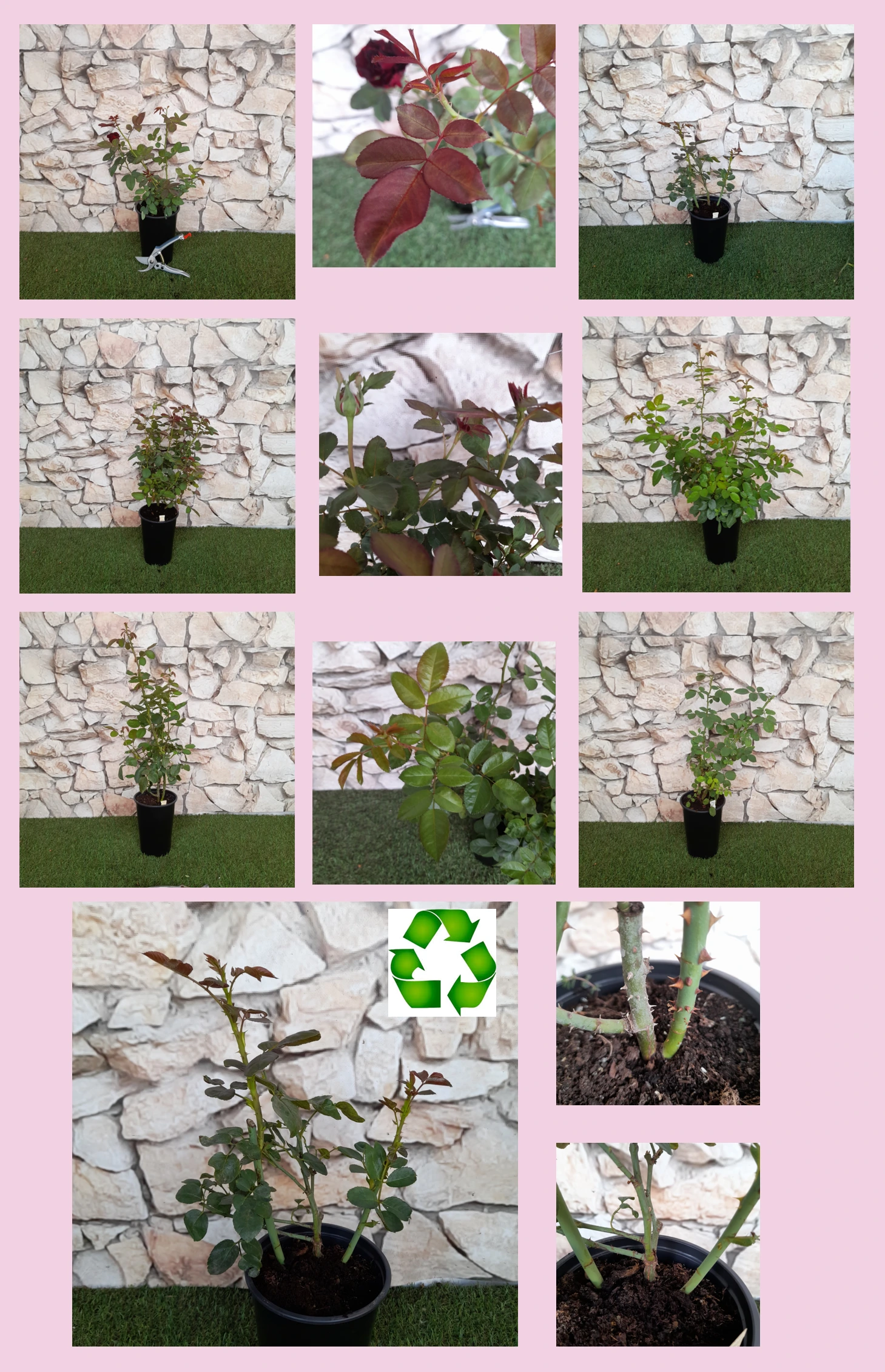
Crop overview: several varieties and growth stages in a short crop section.Shoot system: intensive growth of fresh basal shoots on a young plant.Root system: demonstration of a vigorous root system permeating the growing medium, by removing the pot.Balance: mature plant with root system and shoots in harmony with each other.
Information about the videos
The video series is not a “seasonal showcase”; it illustrates the essence of pharmaROSA® own-root cultivation in a tangible way: how the plant is built up, what the root system is like and how the shoot system regenerates. The recordings were therefore made at different times and with plants at various stages of development, so mixed foliage levels and differing stages of growth may appear in the videos. They are not a ‘sample’ of the batch dispatched, but a visual explanation of how the technology works. The current condition of the rose available to order — typical for the given period and similar to what you can expect to receive in the parcel — is shown in the upper part of the product page.
Pages for private customers Garden roses for the family garden, with minimal care → ORIGINAL® Premium garden roses – instant impact, a truly showpiece garden → EXTRA® Pages for professionals and private customers Roses for public spaces – large areas, sustainable maintenance → NATURAL® Roses for projects – hedge and row planting, fast implementation → RAPID® For professional partners only Production – propagation material for garden roses, wholesale → NEONATAL®
Company details
PharmaRosa Ltd. Company registration number: 01-09-717479 VAT number: 13075314-2-43 Plant health registration no.: HU130721 Bank account (IBAN): HU85117631891388688400000000 BIC (SWIFT): OTPVHUHB Bank name: OTP Bank Nyrt.