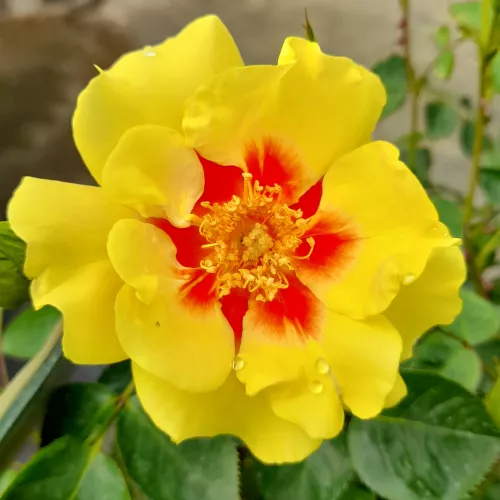
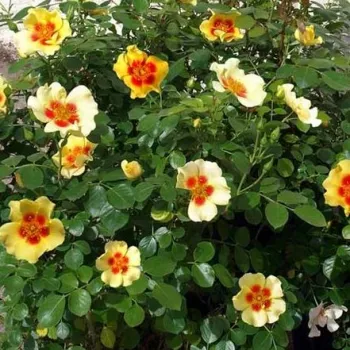
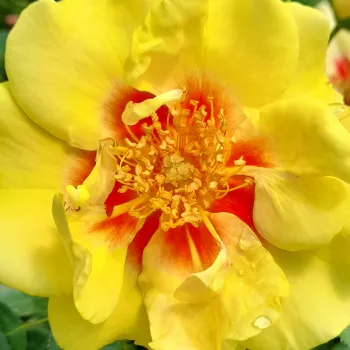
The petals' ground colour is sunshine yellow, with a distinct deep carmine-red eye spot at the centre. - bedding, floribunda, rose - mild, restrained-scented rose - soft, discreet character
– Striking yellow blooms with bold red eye.
– Bushy, dense habit for vibrant bedding.
– Flowers generously with strong repeat flush.
– Excellent winter hardiness to -34 °C.
– Multiple international awards for garden merit.
– Special feature: Especially attractive to pollinators with its open, stamen‑rich flowers.
Shapes and contours – Expert background
pharmaROSA® ORIGINAL 2-litre own-root potted rose
19,30 £
Unfortunately, we are currently unable to ship to the United Kingdom; we only deliver to countries within the European Union. For more information, please contact us!
3(4153)
Eye of the Tiger – yellow bedding floribunda rose – Warner
Colour contrast is the hallmark of Eye of the Tiger, with sunshine-yellow petals and a vivid carmine-red central eye that really stands out in small family gardens and cottage-style front borders. This compact, bushy floribunda forms a dense, rounded shrub with glossy mid-green foliage that keeps beds looking full and tidy without demanding complicated care. Its simple, open blooms are especially attractive to pollinators, bringing movement and life to the garden across a long flowering season. Bred in the UK, it copes reliably with typical British summers, even where breezes and showers are frequent and good drainage is needed on heavier soils. As an own-root plant it establishes steadily, building a durable framework and regenerating well after pruning for a genuinely long lifespan. In its first year it concentrates on roots, in the second on strong new shoots, and by the third year you can enjoy its full impact as a feature in beds, low hedges or containers. Medium maintenance needs mean straightforward care routines, yet its award-winning garden performance rewards both beginners and experienced gardeners looking for reliable colour close to the house.
Freshly opened Eye of the Tiger bloom with bright yellow petals and a crimson-red centre.
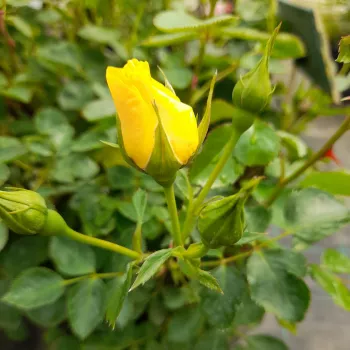
Closed bud of Eye of the Tiger, deep yellow and uniform in tone.
Usage options
Target area
Reasoning
Small front-garden feature bed
The vivid yellow blooms with red eye create instant street-side presence in a compact space, while the rounded, bushy habit keeps the planting looking neat without intricate clipping or staking – ideal for the design-conscious homeowner.
Low flowering hedge along paths or drives
Consistent height and dense foliage make it suitable for informal low hedges that guide visitors while providing season-long colour; the robust structure and own-root resilience give long-term shape with light annual trimming for the busy gardener.
Mixed cottage-style border with perennials
The strong bicolour flowers read clearly among traditional perennials and grasses, and the moderate maintenance needs fit an easy-care cottage mix; self-cleaning helps keep borders fresher between visits for the time-pressed beginner.
Specimen rose in a large container (40–50 litres+)
Its compact, bushy growth and steady repeat flowering suit large patio containers, where a 40–50 litre pot supports root depth and moisture balance, giving colour close to seating areas for the urban balcony or terrace owner.
Pollinator-friendly family play area edge
Single to semi-single flowers with accessible stamens draw bees and other beneficial insects, adding gentle educational interest near lawns or play spaces while remaining visually soft and friendly for families with curious children.
Urban front border with challenging microclimate
UK-bred for garden use, it tolerates exposed, breezier spots and typical urban conditions, responding well where thoughtful soil preparation improves drainage on heavier ground, suiting the practical, space-conscious townsman.
Small group planting (3–5 plants) for colour blocks
Planting in tight groups creates a bold colour carpet, with the yellow-and-red eyes repeating rhythmically; the remontant flushes and manageable upkeep provide reliable impact from a simple scheme for the efficiency-minded planner.
Easy-care rose bed for long-term structure
The own-root form builds a durable framework that responds well to basic pruning and recovers from winter reliably, giving a stable, long-lived display that fits uncomplicated annual routines for long-range oriented garden investors.
Styling ideas
Front-door focus – Plant 3 roses in a shallow arc by the entrance, underplant with low Euonymus fortunei ‘Minimus’ for year-round green edging – ideal for style-aware owners of compact front gardens
Cottage blend – Mix with Gypsophila repens ‘Knuddel’ and soft pink perennials so the bold bicolour flowers pop against airy whites and pastels – suited to lovers of relaxed cottage borders
Pathway ribbon – Create a low hedge along a front path at the recommended spacing, using repeat flowering for a continuous yellow-and-red ribbon – perfect for families wanting tidy structure without formality
Patio statement – Grow a single plant in a 50‑litre terracotta pot with trailing thyme at the base to soften edges and attract bees – a good choice for balcony and courtyard gardeners
Pollinator corner – Group 5 plants with Calamintha nepeta ‘Blue Cloud Strain’ to marry striking colour with movement from insects – for nature-minded households keen on wildlife-friendly planting
Technical cultivar profile
Property
Data
Name and registration
Floribunda bedding rose, Hybrid Hulthemia persica group. Registered as CHEwbullseye, marketed as Eye of the Tiger bedding rose CHEwbullseye; ARS exhibition name Eye of the Tiger.
Origin and breeding
Bred by Christopher Hugh Warner in Newport, Shropshire (UK) in 2006 from ‘Belting Pink’ × ‘Golden Age’; first introduced in 2015 after 2011 registration.
Awards and recognition
RNRS Certificate of Merit St Albans 2014; Gold Standard – Gold Standard Rose Trials 2015; First Prize Lyon Rose Competition 2015; Novelty Award New Zealand 2016; Public Award The Hague.
Growth and structural characteristics
Compact, bushy shrub 85–115 cm tall and wide with dense, glossy mid-green foliage and moderate prickles; forms a rounded, well-branched structure suited to beds, edging and low hedging.
Flower morphology
Single to semi-single, flat clusters of medium-sized blooms (approx. 1.5–2.75 in) with 5–12 petals; remontant with a generous second flush; moderate self-cleaning of spent flowers.
Colour data and phenology
Sunshine-yellow petals with a deep carmine-red central eye (RHS 14A outer, 53A inner); bright yellow in bud, fading to buttery tones as the red eye softens to rose pink while remaining clearly visible.
Fragrance and aroma
Mild, discreet scent that does not dominate nearby seating areas; open flower form leaves stamens visible and accessible, providing good forage for bees and other pollinating insects in season.
Hip characteristics
Occasional small hips, 6–9 mm, globose, orange-red; an unobtrusive feature that may add a light seasonal accent in late summer to autumn without affecting ornamental flowering performance.
Resistance and winter hardiness
Hardy to approximately −34 to −32 °C (RHS H7, USDA 4a, Swedish Zone 5); moderate resistance to powdery mildew, black spot and rust, with routine monitoring and care recommended in humid seasons.
Horticultural recommendations
Best in full sun with well-prepared soil and reliable moisture; medium maintenance with occasional pest and disease control; suitable for beds, edging, containers, specimens and low hedges in family gardens.
Eye of the Tiger offers striking bicolour flowers, a compact, bushy habit and long-lived own-root reliability, making it a thoughtful choice for easy yet rewarding planting in a family garden.
Detailed product attributes
Product Identification Data
Product Name:
EYE OF THE TIGER – yellow bedding floribunda rose - Warner
Product Type:
pharmaROSA® ORIGINAL - 2-litre own-root potted rose
Competition and Show Awards:
RNRS Certificate of Merit – St Albans (2014); Gold Standard – Gold Standard Rose Trials (2015); First Prize – Lyon Rose Competition (2015); Novelty Award – New Zealand National Rose Competition (2016); Public Award – The Hague International Rose Competiti
Pollinator Attraction:
Simple flowers with 5–12 petals attract pollinators well because the simple flower form leaves the stamens accessible, while semi‑double or double forms with extra petals can obscure the stamens and reduce attractiveness to pollinating insects.
Our product is a rose grown with pharmaROSA®’s unique cultivation technology!
2-litre, own-root, potted rose.
With a shoot system appropriate to the season.
With a root system that thoroughly permeates the growing medium.
Quality compliant with the requirements of the E.N.A. (European Nurserystock Association).
Supplied in unique packaging that prevents damage.
Can be planted during frost-free periods.
True-to-variety rose bush with a unique identifier.
The pharmaROSA® own-root potted rose is a well-rooted plant that supports reliable establishment when planted and cared for properly, so it can be planted whenever the soil is not frozen.
Crop overview: several varieties and growth stages in a short crop section.Shoot system: intensive growth of fresh basal shoots on a young plant.Root system: demonstration of a vigorous root system permeating the growing medium, by removing the pot.Balance: mature plant with root system and shoots in harmony with each other.
Information about the videos
The video series is not a “seasonal showcase”; it illustrates the essence of pharmaROSA® own-root cultivation in a tangible way: how the plant is built up, what the root system is like and how the shoot system regenerates. The recordings were therefore made at different times and with plants at various stages of development, so mixed foliage levels and differing stages of growth may appear in the videos. They are not a ‘sample’ of the batch dispatched, but a visual explanation of how the technology works. The current condition of the rose available to order — typical for the given period and similar to what you can expect to receive in the parcel — is shown in the upper part of the product page.
Pages for private customers Garden roses for the family garden, with minimal care → ORIGINAL® Premium garden roses – instant impact, a truly showpiece garden → EXTRA® Pages for professionals and private customers Roses for public spaces – large areas, sustainable maintenance → NATURAL® Roses for projects – hedge and row planting, fast implementation → RAPID® For professional partners only Production – propagation material for garden roses, wholesale → NEONATAL®
Company details
PharmaRosa Ltd. Company registration number: 01-09-717479 VAT number: 13075314-2-43 Plant health registration no.: HU130721 Bank account (IBAN): HU85117631891388688400000000 BIC (SWIFT): OTPVHUHB Bank name: OTP Bank Nyrt.