EUGÉNIE GUINOISSEAU – crimson-red historic moss rose - Guinoisseau-Flon
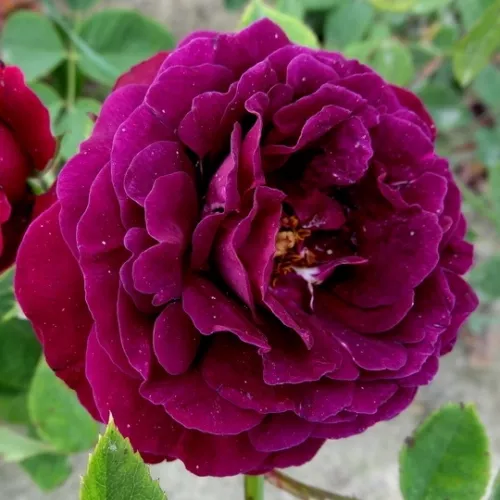
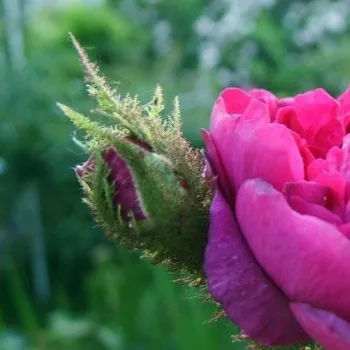
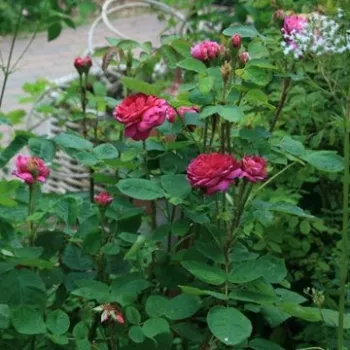
historic charm meets easy-going reliability with Eugénie Guinoisseau, a richly scented moss rose ideal for British family gardens that want period character without demanding care. Its medium maintenance needs suit busy gardeners, provided you give reasonable watering and a mulch to cope with typical damp spells and occasional coastal winds and rain. The upright, well-furnished shrub creates a structure that works beautifully in small front gardens, cottage-style mixes and along paths, where its dark foliage and mossed buds frame repeat crimson flowering through the season. Own-root planting supports long-term longevity, with the shrub settling in gradually and building a stable, resilient presence that responds well to light pruning. Think of it as a gentle arc of development – first consolidating roots, then pushing strong new shoots, then maturing into its full romantic display over a few years – giving you a classic rose that quietly earns its place in the garden border.
Usage options
| Target area |
Reasoning |
| Front garden focal shrub |
The tall, upright habit and dense foliage create an immediate point of interest beside a gate, path or front door, while the crimson, old-fashioned blooms and strong fragrance add classic cottage-garden character with only moderate care for beginners. |
| Loose flowering hedge |
Planted at hedge spacing, the well-branched structure and dark leaves knit into a semi-formal screen that flowers in waves, softening boundaries and giving privacy without needing precise clipping, ideal for those wanting an informal yet tidy edge for the family. |
| Mixed cottage border |
Its heritage look, raspberry-crimson flowers and mossed buds sit perfectly among perennials such as coreopsis, asters and annual lobelia, bringing vertical interest and scent while remaining adaptable to typical mixed-border maintenance for the cottage-garden enthusiast. |
| Feature group of 3 shrubs |
A small group planting lets the shrubs grow together into a generous flowering mass, balancing height and volume so that even a modest lawn corner or side bed gains year-on-year impact with simple winter pruning and feeding for the space-conscious homeowner. |
| Specimen rose in lawn or gravel |
Used as a single specimen at wider spacing, the full height and arching flowering shoots read clearly from all sides, turning even a compact front lawn or gravelled forecourt into a period-style feature with just routine dead wood removal for the design-aware gardener. |
| Traditional rose walk or path edge |
Planted in a line along a path, its scented, double blooms at around head height create a romantic walkway; moderate disease resistance supports a long service life if you allow good air movement and simple seasonal care for the pathway-loving walker. |
| Country-style family back garden |
The combination of height, repeat flowering and a medium maintenance level makes it suitable for family back gardens where you want atmosphere rather than perfection, and where children and adults alike can enjoy colour, scent and structure over many seasons for the busy urbanite. |
| Raised bed or improved heavy soil position |
In areas with heavier clay or exposed sites, a raised bed or improved planting hole allows the own-root shrub to anchor well and adapt over time, helping it cope with typical British moisture and wind patterns while remaining manageable for the practical planner. |
Styling ideas
- Cottage trio – Plant three shrubs in a loose triangle, underplant with catmint and low-growing coreopsis for a soft, billowing look that highlights the rose’s historic character – ideal for romantic front-garden owners.
- Heritage hedge – Use a staggered line along a boundary, mixing with other old roses of similar height to create a flowering screen that feels timeless yet informal – perfect for those wanting privacy with period charm.
- Seasonal tapestry – Combine with asters, salvias and ornamental grasses in a mixed border so the rose provides height, scent and structure while perennials extend colour – suited to design-focused but time-poor gardeners.
- Gateway accent – Position one on either side of a path entrance, with brick edging and lavender at the feet, to frame the approach to your door with scent and colour – great for homeowners upgrading a small front plot.
- Raised-bed feature – In heavier soils, plant in a brick or timber raised bed with good drainage, using low geraniums and lobelia at the front so the rose rises above a neat flowering skirt – useful for practical gardeners on challenging sites.
Technical cultivar profile
| Parameter |
Data |
| Name and registration |
Eugénie Guinoisseau is a historic moss rose traded as Eugénie Guinoisseau – crimson-red historic moss rose – Guinoisseau-Flon; an unregistered heritage cultivar verified for authenticity. |
| Origin and breeding |
Originating in France in 1864, bred by Bertrand Guinoisseau-Flon, with unknown parentage; a classic nineteenth-century moss rose preserved in the heritage rose collection. |
| Growth and structural characteristics |
Upright shrub reaching about 150–220 cm in height and 90–150 cm in spread, densely thorned with dark glossy foliage, forming a well-furnished, structural presence in borders and hedges. |
| Flower morphology |
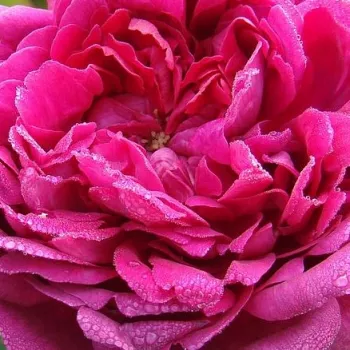
Large, very double, cup-shaped blooms with over 40 petals are carried in clusters; remontant with a lighter second flush, providing generous period-style flowering in early and high summer. |
| Colour data and phenology |
Crimson-red to raspberry tones (RHS 60A–60B) shift through lavender-lilac to a silvery veil as blooms age, giving varied vintage-style colouring from bud stage to fully open flowers. |
| Fragrance and aroma |
Strongly scented rose with a powerful, sweet, berry-like fragrance, giving noticeable scent in still conditions and adding an olfactory focal point near paths, entrances or seating areas. |
| Hip characteristics |
Hip set is generally poor due to the very double flowers, but where produced, hips are small, red, ellipsoidal and mainly of ornamental interest late in the season. |
| Resistance and winter hardiness |
Hardy to approximately −21 to −18 °C (RHS H7, USDA 6b, Swedish Zone 3); disease profile shows good black-spot resistance with moderate susceptibility to powdery mildew and rust. |
| Horticultural recommendations |
Allow about 95–110 cm spacing for hedging or mass planting, wider for specimen use; prefers improved, well-drained soil, with routine feeding and occasional plant protection as needed. |
Eugénie Guinoisseau offers fragrant historic blooms, strong structural presence and adaptable, own-root longevity that settles into your garden with modest care, making it a thoughtful choice if you value enduring, characterful planting.