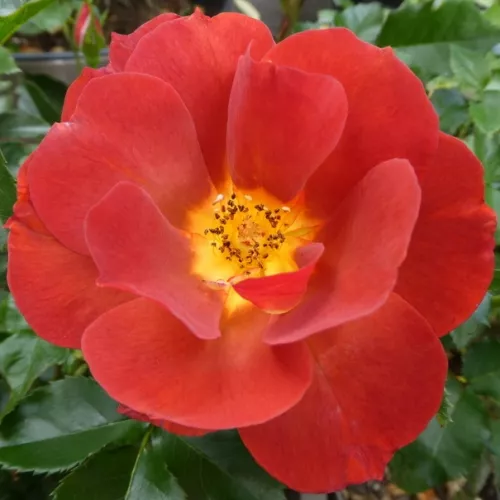
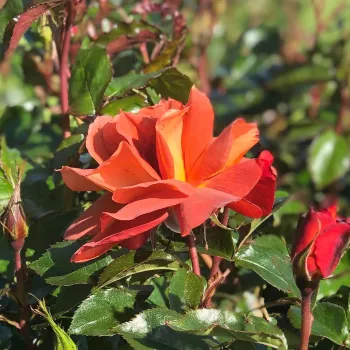
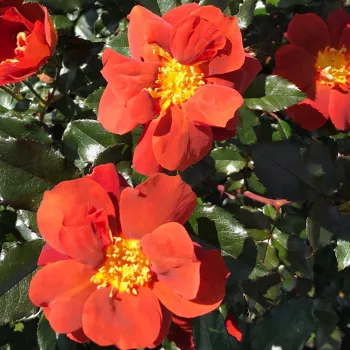
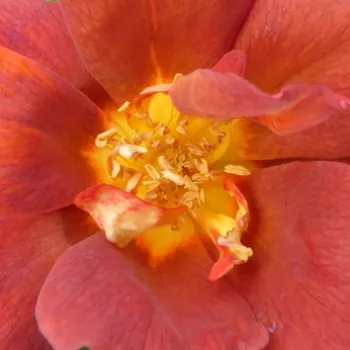
Brick-red, rust-hued petals with a vivid golden-yellow centre. - bedding floribunda rose - moderate-strength, distinctly scented rose - spicy, slightly sweet character
– Unique brick‑red blooms with golden centres.
– Compact, upright shrub for neat bedding.
– Resistant to powdery mildew and black spot.
– Low‑maintenance habit, needs little care.
– Award‑winning rose with multiple merits.
– Special feature: Urban tolerant, thrives in city plantings.
Balanced layout – Biodiversity
pharmaROSA® ORIGINAL 2-litre own-root potted rose
19,30 £
Unfortunately, we are currently unable to ship to the United Kingdom; we only deliver to countries within the European Union. For more information, please contact us!
5(7031)
ESPRESSO – red bedding floribunda rose - Spek
Effortless to grow and remarkably reliable, Espresso is a compact floribunda that brings warm brick-red and golden-yellow blooms to family gardens with minimal work. Its bushy habit and dense, glossy foliage create a neat, low hedge or edging that suits classic British front gardens and tidy cottage-style beds. With strong disease resilience and good urban tolerance, it copes well with exposed, breezier plots and typical suburban conditions, even where wet winters demand improved drainage on heavier soils. A naturally floriferous character ensures generous clusters from early summer, then a rich second flush, so smaller spaces gain long-lasting colour. Own-root planting gives long-term stability, forming a balanced shrub that matures steadily—roots in the first year, richer top growth in the second, then full ornamental value from the third season onward.
Espresso shows flat, semi-double blooms in clusters.
Usage options
Target area
Reasoning
Front garden edging
Low maintenance needs and a compact 60–90 cm height make Espresso ideal for smart, repeat-flowering edging along drives and paths, where you prefer to trim only lightly each spring and leave the rest to the plant – well suited to the busy beginner.
Small bedding schemes
The bushy, upright habit and planting distances from 30–35 cm allow you to build dense, even beds that look “finished” quickly, giving reliable colour in typical small family gardens without complex spacing calculations – perfect for the design-conscious homeowner.
Mixed cottage-style borders
Its warm brick-red and golden-centred flowers blend easily with cottage favourites such as catmint, thyme and ornamental grasses, bringing structure and repeat flowering while still keeping the border relaxed rather than formal – attractive for the cottage-garden lover.
Low flowering hedge
Planted at about 30 cm apart, Espresso knits into a tidy, semi-formal hedge that softens fences and separates spaces without blocking light, staying manageable with a simple once-a-year prune – reassuring for the practical gardener.
Urban and courtyard gardens
Good tolerance of city conditions and moderate heat, plus strong disease resistance, mean this rose performs reliably where air circulation is limited and watering may be irregular, giving dependable flower cover in paved or compact plots – ideal for the urban homeowner.
Feature group by the front door
Groups of three to five plants at 55 cm spacing create a rounded, welcoming focus with season-long clusters of scented flowers, offering a classic, “well-kept” impression with little more than watering and a feed – appealing to the entrance-focused stylist.
Raised beds and improved clay borders
In raised beds or well-drained spots over heavier clay, Espresso roots steadily and forms a sturdy, long-lived shrub, giving you a lasting investment rather than a short-term filler, while coping with breezier, rain-exposed positions – reassuring for the clay-soil gardener.
Large containers on patios
In containers of at least 40–50 litres, its compact size, upright shape and repeat flowering give strong visual impact near seating areas, with only moderate watering and feeding required through the season – convenient for the low-maintenance container grower.
Styling ideas
Brick-Border Harmony – Echo the warm brick-red blooms against traditional brickwork, edging paths with Espresso and low thyme for a smart but soft finish – for homeowners wanting coordinated, classic frontage.
Cottage-Ribbon Row – Thread a sinuous line of Espresso through a cottage border with catmint and hardy geraniums, giving repeating pockets of colour and structure – for relaxed gardeners favouring informal charm.
Front-Door Welcome – Plant three shrubs in a loose triangle by the entrance, underplanted with sedum for texture and easy care, creating a long-flowering welcome point – for those who value kerb appeal with little effort.
Urban-Courtyard Frame – Use Espresso in generous containers to frame a small patio, relying on its disease resistance and neat habit for a clean architectural look – for city gardeners with limited space and time.
Low-Rose Hedge – Run a single or double row along a boundary to form a low, colourful flowering hedge that needs only light annual pruning – for families wanting gentle separation without heavy maintenance.
Technical cultivar profile
Characteristic
Data
Name and registration
Floribunda bedding rose, registered as SPEkbrown, marketed as Espresso; shrub rose / exhibition floribunda category, part of the Bedding rose collection for garden and show use.
Origin and breeding
Bred by Jan Spek Nurseries in Boskoop, Netherlands, around 2013; introduced in 2019 via Jan Spek Rozen B.V., with parentage not publicly disclosed by the breeder.
Awards and recognition
Certificate of Merit at Bagatelle, Paris (2019), Certificate of Merit at Belfast (2019), and Certificate of Merit at The Hague (2020), highlighting its ornamental performance.
Growth and structural characteristics
Compact, upright, bushy shrub reaching about 60–90 cm high and 40–65 cm wide, with dense, glossy medium to dark green foliage and only slight prickliness on the stems.
Flower morphology
Semi-double, flat cluster-flowered blooms of medium size (around 4–7 cm), bearing approximately 13–25 petals, remontant with abundant repeat flushes across the flowering season.
Colour data and phenology
Brick-red to rust-hued flowers with a vivid golden-yellow centre, dark orange-red buds; tones fade towards salmon-coral pink with a creamier centre, ARS code t, RHS 165A–165B.
Fragrance and aroma
Moderate, distinctly spicy fragrance with a slightly sweet character, noticeable on warm days without being overpowering; semi-double form offers limited value for pollinators.
Hip characteristics
Occasional spherical hips, about 8–13 mm diameter, light to bright red in colour; hip set is generally slight and not a dominant feature of the cultivar in typical garden use.
Resistance and winter hardiness
Very good resistance to powdery mildew and black spot, moderate rust resistance; hardy to about −21 to −18 °C (RHS H7, USDA 6b, Swedish Zone 3), with moderate heat tolerance.
Horticultural recommendations
Best in sunny beds or borders, with planting distances from 30–55 cm; ideal for flowerbeds, edging, mixed borders and low hedges, thriving with light pruning and regular watering.
Espresso Bedding rose SPEkbrown offers compact, bushy growth, reliable repeat flowering and strong disease resistance, while its own-root form builds a long-lived, stable shrub; an excellent option to consider for easy, enduring colour.
Detailed product attributes
Product Identification Data
Product Name:
ESPRESSO – red bedding floribunda rose - Spek
Product Type:
pharmaROSA® ORIGINAL - 2-litre own-root potted rose
Competition and Show Awards:
Bagatelle (Paris) – Certificate of Merit (2019); Belfast – Certificate of Merit (2019); The Hague – Certificate of Merit (2020)
Closed Bud:
Dark orange-red, with a deeper tone at the edge.
Newly Opened Flower:
Vivid fiery red–orange petals with a pronounced golden-yellow halo at their base.
Full Bloom:
Uniform intense brick-red appearance, with a strong lemon–gold yellow centre and dark stamens, the edge coral in places.
Before Fading:
The reddish hue lightens, fading to a salmon-coral pink, and the yellow centre becomes creamier.
Colour Fading Description:
As the bloom opens, the dark orange-red–brick-red tones gradually fade to a salmon–coral pink, while the central yellow becomes creamier.
Our product is a rose grown with pharmaROSA®’s unique cultivation technology!
2-litre, own-root, potted rose.
With a shoot system appropriate to the season.
With a root system that thoroughly permeates the growing medium.
Quality compliant with the requirements of the E.N.A. (European Nurserystock Association).
Supplied in unique packaging that prevents damage.
Can be planted during frost-free periods.
True-to-variety rose bush with a unique identifier.
The pharmaROSA® own-root potted rose is a well-rooted plant that supports reliable establishment when planted and cared for properly, so it can be planted whenever the soil is not frozen.
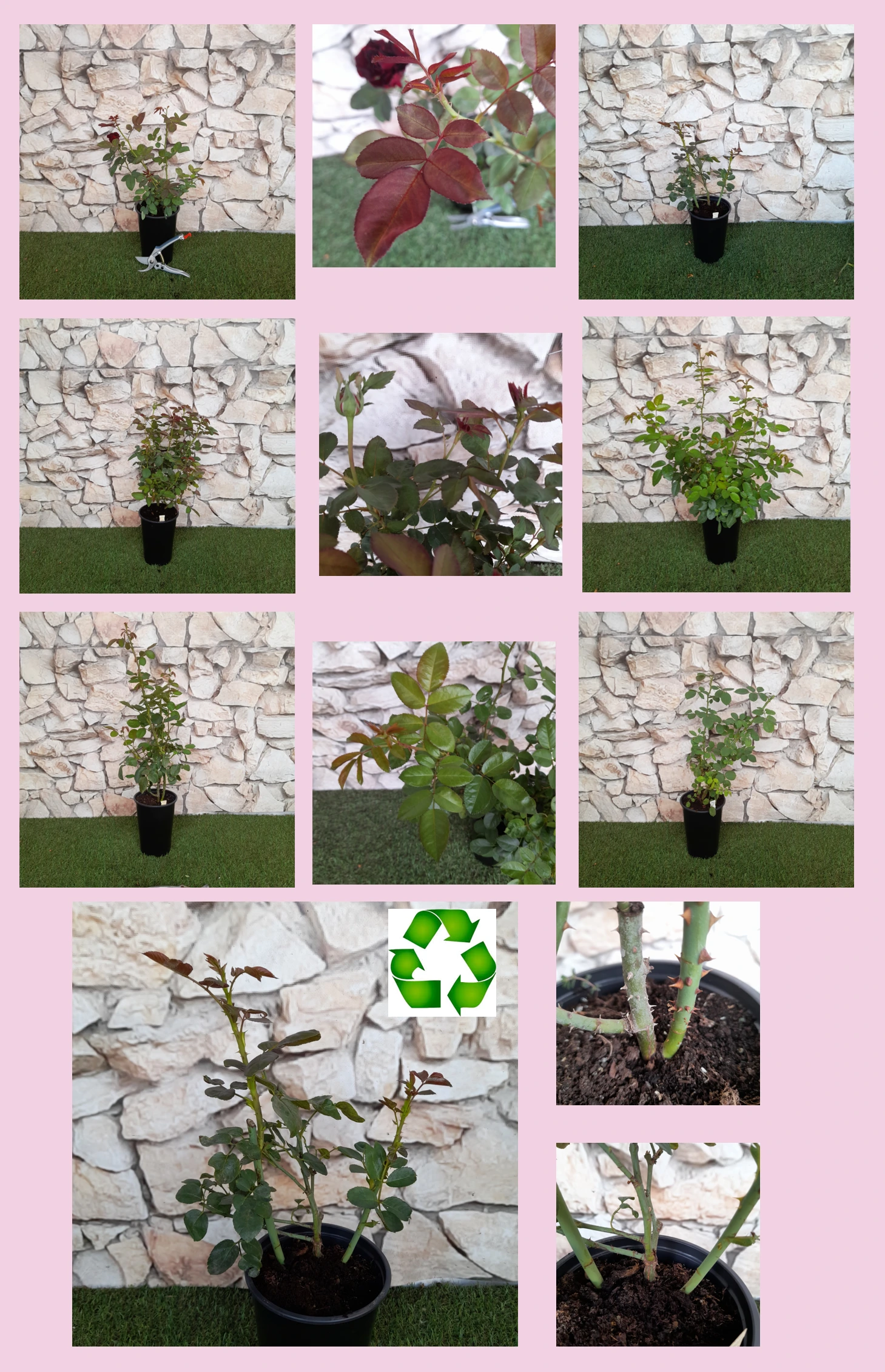
Crop overview: several varieties and growth stages in a short crop section.Shoot system: intensive growth of fresh basal shoots on a young plant.Root system: demonstration of a vigorous root system permeating the growing medium, by removing the pot.Balance: mature plant with root system and shoots in harmony with each other.
Information about the videos
The video series is not a “seasonal showcase”; it illustrates the essence of pharmaROSA® own-root cultivation in a tangible way: how the plant is built up, what the root system is like and how the shoot system regenerates. The recordings were therefore made at different times and with plants at various stages of development, so mixed foliage levels and differing stages of growth may appear in the videos. They are not a ‘sample’ of the batch dispatched, but a visual explanation of how the technology works. The current condition of the rose available to order — typical for the given period and similar to what you can expect to receive in the parcel — is shown in the upper part of the product page.
Pages for private customers Garden roses for the family garden, with minimal care → ORIGINAL® Premium garden roses – instant impact, a truly showpiece garden → EXTRA® Pages for professionals and private customers Roses for public spaces – large areas, sustainable maintenance → NATURAL® Roses for projects – hedge and row planting, fast implementation → RAPID® For professional partners only Production – propagation material for garden roses, wholesale → NEONATAL®
Company details
PharmaRosa Ltd. Company registration number: 01-09-717479 VAT number: 13075314-2-43 Plant health registration no.: HU130721 Bank account (IBAN): HU85117631891388688400000000 BIC (SWIFT): OTPVHUHB Bank name: OTP Bank Nyrt.