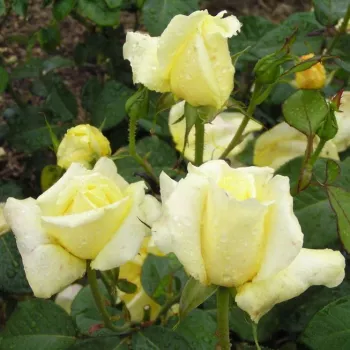
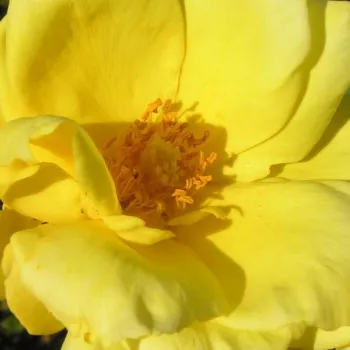
Epi d'Or – yellow hybrid tea rose – Delbard
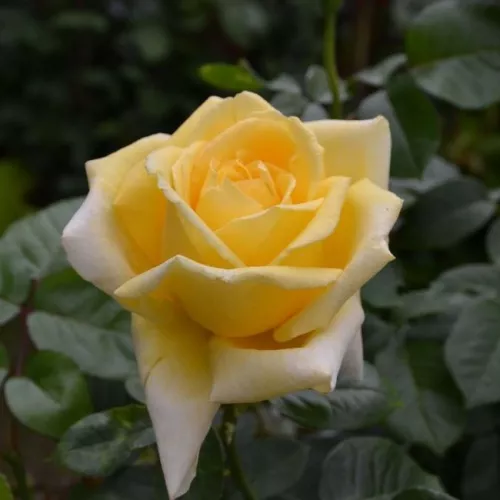
This classic yellow hybrid tea from Delbard offers generous, repeat-flowering blooms on a compact, bushy shrub that suits the average British family garden. Its large, cup-shaped flowers bring a warm, luminous colour accent to front borders and around-the-house beds, while the mild, fruity fragrance adds a refined note without overwhelming smaller spaces. As an own-root plant, it develops steadily into a stable, long-lived rose that regenerates well after pruning and supports a reliably neat shape over many years. Once planted with reasonable drainage and regular watering, it rewards straightforward care with dependable garden performance; you will see roots establishing first, then stronger shoots, and by the third year, its full ornamental value. This makes Epi d'Or an appealing choice for tidy cottage-style schemes where you want a radiant focal point but prefer low-complexity maintenance.
Usage options
| Target area |
Reasoning |
| Front garden feature rose |
The large, luminous yellow hybrid tea blooms create an immediate focal point beside paths, drives or entranceways, yet the compact, bushy habit remains in proportion to smaller front plots. This gives a strong visual welcome with relatively simple pruning and upkeep, ideal for the beginner gardener. |
| Small mixed border in family gardens |
Its moderate height and 50–70 cm spread suit narrow borders where you want defined flower structure without crowding other perennials. The repeat-flowering habit extends seasonal interest, while own-root vigour supports a stable outline in varied soils, suiting the busy home-owner. |
| Classic cottage-style planting with perennials |
Epi d'Or pairs well with soft companions such as lamb’s ear or cranesbill, the warm yellow blooms sitting cleanly above mid-green, matt foliage. This gives a traditional cottage look with a controlled footprint, appealing to the cottage-garden enthusiast. |
| Small group planting for colour impact |
Planted in groups of three to five at 60 cm spacing, the repeated, uniform yellow flowers read as a coherent block of colour. This is effective when viewed from windows or patios, offering high impact from a modest area, appreciated by the aesthetics-focused owner. |
| Formal hybrid tea bed or exhibition corner |
The solitary, extra-large, cup-shaped blooms lend themselves to more formal layouts or a small exhibition-style row, giving defined stems for cutting. With moderate disease resistance and clear flower form, it suits gardeners who enjoy light grooming and deadheading, including the aspiring exhibitor. |
| Raised beds on heavier clay soils |
Where clay dominates, planting into a well-prepared, raised bed improves drainage, helping the own-root plant anchor and establish a lasting framework. Steady structure and remontant flowering provide reliable form and colour with modest intervention, reassuring for the practical planner. |
| Large containers on patios or terraces |
In a 40–50 litre or larger container with quality compost, this bushy hybrid tea forms an upright, manageable shrub that flowers repeatedly at eye level. This brings classic rose character to paved spaces with simple watering and feeding routines, ideal for the urban balcony-gardener. |
| Long-term family garden rose plantings |
As an own-root, winter-hardy hybrid tea (to around -20 °C) with moderate disease resistance, Epi d'Or is suited to long-lived plantings that mature gently with the garden, supporting responsible choices that reduce replacement over time, reassuring the value-conscious buyer. |
Styling ideas
- Golden focus – Use Epi d'Or as a single statement rose near the front door, underplanted with low evergreen groundcover, for a simple, tidy welcome – ideal for time-pressed homeowners.
- Soft cottage – Combine with Geranium x cantabrigiense and lamb’s ear for a gentle, textural cottage mix where the rich yellow flowers sit above silver and pastel tones – suited to romantic garden styles.
- Yellow ribbon – Plant a short row along a path or drive, keeping spacing regular to create a low, flowering border that is easy to prune and maintain – helpful for orderly garden planners.
- Patio classic – Grow one plant in a 40–50 litre terracotta container with trailing herbs or small perennials at the base, bringing a traditional rose look to a sunny patio – perfect for small-space gardeners.
- Family border – Mix Epi d'Or with low ornamental grasses and longer-season perennials to provide structure and repeat colour without complex care regimes – attractive to busy family households.
Technical cultivar profile
| Parameter |
Data |
| Name and registration |
Hybrid tea rose, registered as DELépi, marketed as Epi d'Or (Épi d'Or). Belongs to the Grands Parfums collection, with confirmed cultivar authenticity for reliable identification. |
| Origin and breeding |
Bred by Georges Delbard, France, from complex hybrid tea parentage including Madame A. Meilland. Registered in 1981 and introduced commercially in 1982 by Delbard and Chabert. |
| Awards and recognition |
Highly regarded exhibition-type rose: Gold Medal and Plus Belle Rose de France at Lyon 1981, plus Gold Medal at the Rome Rose Competition in the same year. |
| Growth and structural characteristics |
Bushy, upright shrub reaching about 55–85 cm high and 50–70 cm wide, with moderately dense, matt, mid-green foliage and moderate prickliness, adaptable to typical garden borders. |
| Flower morphology |
Large, double, cup-shaped, solitary hybrid tea blooms, typically 26–39 petals. Extra-large flower size on strong stems; remontant, with a plentiful second flush in suitable conditions. |
| Colour data and phenology |
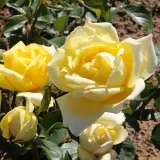
Medium-intensity, uniform yellow (RHS 14A–14B) with a warm sheen. Colour holds well in sun, fading only slightly to lemon-yellow at the end of bloom, maintaining a clean yellow display. |
| Fragrance and aroma |
Mild but noticeable fruity fragrance, refined rather than overpowering. Suits seating areas or smaller gardens where a gentle scent is preferred over very strong perfume. |
| Hip characteristics |
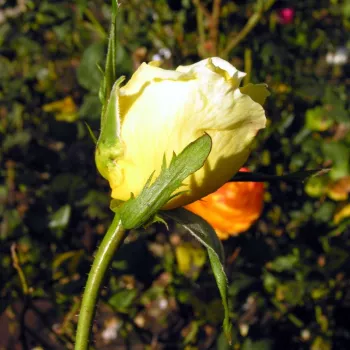
Occasional orange-red, ellipsoidal hips, around 15–21 mm in diameter. Decorative late in the season but not produced heavily or every year. |
| Resistance and winter hardiness |
Rated to approximately -18 to -21 °C (RHS H7, USDA zone 6b). Disease resistance moderate to black spot, rust and powdery mildew, benefits from standard preventative care. |
| Horticultural recommendations |
Best at 50–60 cm spacing in beds, or 100 cm as a specimen. Prefers well-drained soil, full sun, and regular feeding; moderate maintenance including pruning and occasional disease management. |
Epi d'Or offers luminous repeat-flowering blooms, a compact, easy-to-place habit and long-lived own-root reliability; a thoughtful choice if you would like a stable yellow hybrid tea in your garden.