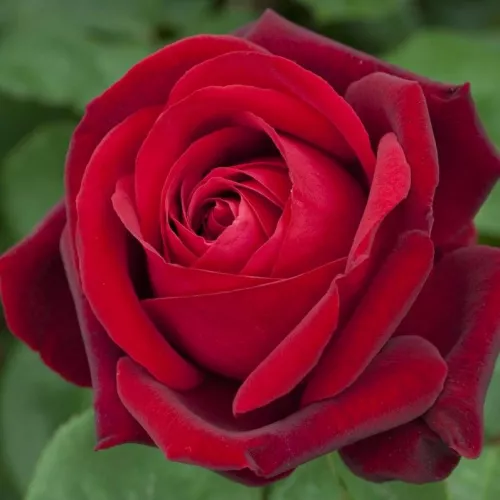
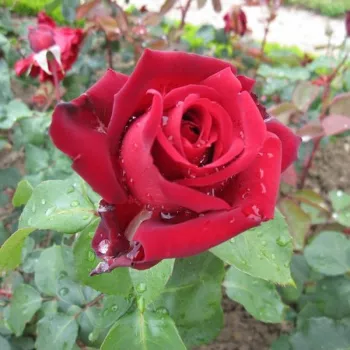
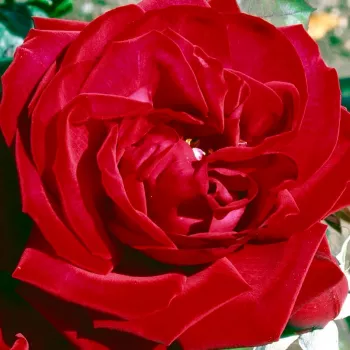
Deep, full ruby-red base colour with a delicate strawberry-red tint at the petal edges. - hybrid tea rose - strong, long-lasting scented rose - sweetly fruity, old-rose scented
– Rich, velvety ruby-red exhibition blooms.
– Strong, long-lasting sweet fruity fragrance.
– Upright, dense bush with glossy dark foliage.
– Reliable repeat flowering with abundant second flush.
– Proven award-winner in international rose trials.
– Special feature: Dedicated to Édith Piaf, uniting perfume and classic Hybrid Tea elegance.
Streamlined forms – Soil-friendly approach
pharmaROSA® ORIGINAL 2-litre own-root potted rose
21,20 £
Unfortunately, we are currently unable to ship to the United Kingdom; we only deliver to countries within the European Union. For more information, please contact us!
4(6397)
EDITH PIAF® – ruby-red tea-hybrid rose - Meilland
Fragrant late-afternoon strolls and glowing borders come naturally with this ruby-red hybrid tea, whose strong, sweetly fruity, old-rose scent and generous flower size create a real garden focus. Bred for cutting as well as display, its long, upright stems carry very double blooms that hold their colour well, even in strong sun. In typical British gardens it settles reliably with moderate, straightforward care and benefits from sensible planting in free-draining spots where heavy clay tends to stay wet. As an own-root plant it develops steadily – roots in the first year, more shoots in the second, and full ornamental value by the third – giving you a long-lived feature that repays simple pruning and regular deadheading. Ideal for compact front gardens, terraces and larger containers, it offers versatile placement options and a refined, ruby-red accent that suits both classic and contemporary homes.
Freshly opened ruby-red bloom of Edith Piaf®.
Edith Piaf® zárt bimbója sötét ruby-vörös árnyalatban.
Usage options
Target area
Reasoning
Front garden focal point
The upright, medium-height habit and extra-large, velvety ruby-red blooms create a clear visual anchor near a path or entrance without overwhelming a small plot, ideal when you want an immediate, legible focal point that stays tidy with basic care for keen beginners.
Classic rose bed for cutting
Long, straight stems with solitary, very double flowers and strong, long-lasting perfume lend themselves to regular cutting for the house, so a small bed of 3–5 bushes can supply vases from late spring through autumn while remaining orderly for fragrance-seeking home decorators.
Compact mixed border
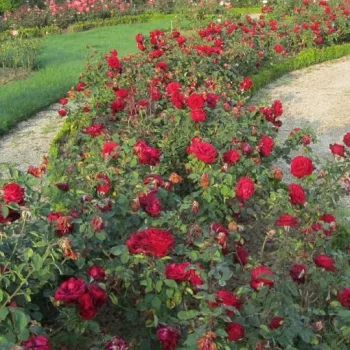
The dense dark green foliage and medium spread allow it to slip into cottage-style borders among perennials without demanding much extra space, giving repeat waves of rich colour and scent while neighbours help disguise any bare stems for design-conscious small-garden owners.
Feature container on terrace or balcony
In a large pot of at least 40–50 litres, its upright form and concentrated flowering make a striking vertical accent close to seating areas, where the perfume can be appreciated at nose height, suiting busy urban gardeners who prefer contained, easily accessed planting.
Season-long colour near seating areas
Remontant flowering with a generous second flush means that, with occasional deadheading and feeding, you can enjoy repeated displays of ruby-red blooms around patios or benches, providing reliable atmosphere from late spring well into autumn for time-pressed relaxers.
Part-shade side garden or passage
Its tolerance of partial shade lets you use it effectively where sun is limited to a few good hours, helping to brighten side returns or narrow passages with scented blooms rather than foliage-only planting, supporting homeowners making the most of awkward aspects.
Wind-sheltered coastal or exposed plots
Best placed where a fence or hedge offers some shelter, it copes well with typical British breezes and shows good flower colour retention, especially when combined with free-draining soil preparation in heavier ground for coastal and open-site family gardeners.
Long-term structural planting in small groups
As an own-root rose, it builds a stable framework over time and can regenerate well from low pruning, so groups of 3 spaced at about 50–80 cm mature into balanced, long-lived clumps that respond well to periodic renewal for planners of enduring, low-fuss borders.
Styling ideas
Cottage-curve – Plant three bushes in a gentle arc by the front path, underplant with low catmint and white campanulas to soften edges – for romantically inclined owners of compact front gardens.
Ruby-formal – Use a pair in large pots flanking the front door, with clipped box balls behind and slate chippings below for clean lines – for those favouring structured, elegant entrances.
Evening-nook – Place near a bench among lavender and silvery artemisia so the strong scent carries on warm nights – for people who unwind outdoors after work.
Cutting-corner – Dedicate a sunny bed with a simple grid of plants, backed by tall grasses, to provide a constant supply of scented stems – for home florists and bouquet enthusiasts.
Side-passage – Brighten a part-shade side return with a loose row combined with hardy geraniums and dwarf honeysuckle groundcover – for homeowners upgrading overlooked side gardens.
Technical cultivar profile
Name and registration
Hybrid tea rose, registered as MEIramboys, marketed as Edith Piaf® PERFUMELLA® MEIramboys; exhibition hybrid tea suitable for garden and cutting, with stable commercial naming.
Origin and breeding
Bred by Meilland International, breeding completed in 1999, introduced and registered in 2007 via Meilland Richardier; developed within the renowned French PERFUMELLA® fragrant rose line.
Awards and recognition
Highly decorated fragrance rose: Grand Prix International du Parfum Nantes 2005, fragrance prize Monza 2004, bronze medal Australia 2008, silver medal Alterarosa 2016, confirming garden and exhibition value.
Growth and structural characteristics
Upright hybrid tea reaching about 70–100 cm in height and 45–60 cm spread, with dense, glossy dark green foliage and moderate prickliness; forms a bushy, vertical structure suited to beds and containers.
Flower morphology
Very double, cup-shaped blooms with a pronounced high centre, typically borne singly on stems; extra-large flowers with more than 40 petals, repeating freely with a notably abundant second flush in season.
Colour data and phenology
Deep ruby-red base colour with strawberry-red tints on edges; colour holds well, lightening only moderately with a slight purplish hue as blooms age, from dark buds through opening to full flower in successive waves.
Fragrance and aroma
Strong, persistent perfume combining sweet fruity notes with classic old-rose character; scent is evident both on the plant and as a cut flower, giving high aromatic impact in small gardens and indoor arrangements.
Hip characteristics
Hip set is generally sparse because of very double flowers and regular deadheading; where present, produces small spherical orange-red hips about 10–14 mm across, of mainly ornamental interest late season.
Resistance and winter hardiness
Hardy to about -21 to -18 °C (RHS H7, USDA 6b, Swedish Zone 3); disease resistance medium to mildew, black spot and rust, benefitting from standard preventative care and good air movement in humid conditions.
Horticultural recommendations
Prefers sunny, free-draining soil; medium maintenance with regular watering in dry spells and occasional plant protection; suitable for beds, specimen planting, hedging, and large containers, including balconies and terraces.
EDITH PIAF® combines strong fragrance, rich ruby-red blooms and reliable repeat flowering on a durable own-root framework, making it a thoughtful choice for gardeners seeking long-lasting scent and colour with manageable care.
Detailed product attributes
Product Identification Data
Product Name:
EDITH PIAF® – ruby-red tea-hybrid rose - Meilland
Product Type:
pharmaROSA® ORIGINAL - 2-litre own-root potted rose
Competition and Show Awards:
Grand Prix International du Parfum – Nantes (France, 2005); Fragrance special prize – Monza Rose Competition (Italy, 2004); Bronze medal – National Rose Trial Garden of Australia (Australia, 2008); Silver medal – Alterarosa (France, 2016)
Flower Colour Description:
Deep, full ruby-red base colour with a delicate strawberry-red tint at the petal edges.
Closed Bud:
Dark ruby red with slightly blackening shadowy spots at the tip.
Newly Opened Flower:
Rich, velvety ruby red, with a paler strawberry-red shimmer along the edges of the outer petals.
Full Bloom:
Uniform ruby red, with the petal base slightly darker and a velvety texture.
Before Fading:
Slightly lightening ruby red with a restrained cherry-red fading at the edges.
Colour Fading Description:
Its colour holds well; in strong sunlight it lightens only moderately, and towards the end of opening it may take on a purplish hue.
Pollinator Attraction:
Its very double bloom form and closed centre make the stamens likely inaccessible, so it is probably of low attractiveness to pollinators.
Pollinator-Friendly Rating:
Its very double flowers conceal the stamens, making it primarily an ornamental variety.
Hip Comment:
Hip set is expected to be poor due to the double flowers and removal of spent blooms; occasionally spherical, orange-red hips 10–14 mm in diameter.
Our product is a rose grown with pharmaROSA®’s unique cultivation technology!
2-litre, own-root, potted rose.
With a shoot system appropriate to the season.
With a root system that thoroughly permeates the growing medium.
Quality compliant with the requirements of the E.N.A. (European Nurserystock Association).
Supplied in unique packaging that prevents damage.
Can be planted during frost-free periods.
True-to-variety rose bush with a unique identifier.
The pharmaROSA® own-root potted rose is a well-rooted plant that supports reliable establishment when planted and cared for properly, so it can be planted whenever the soil is not frozen.
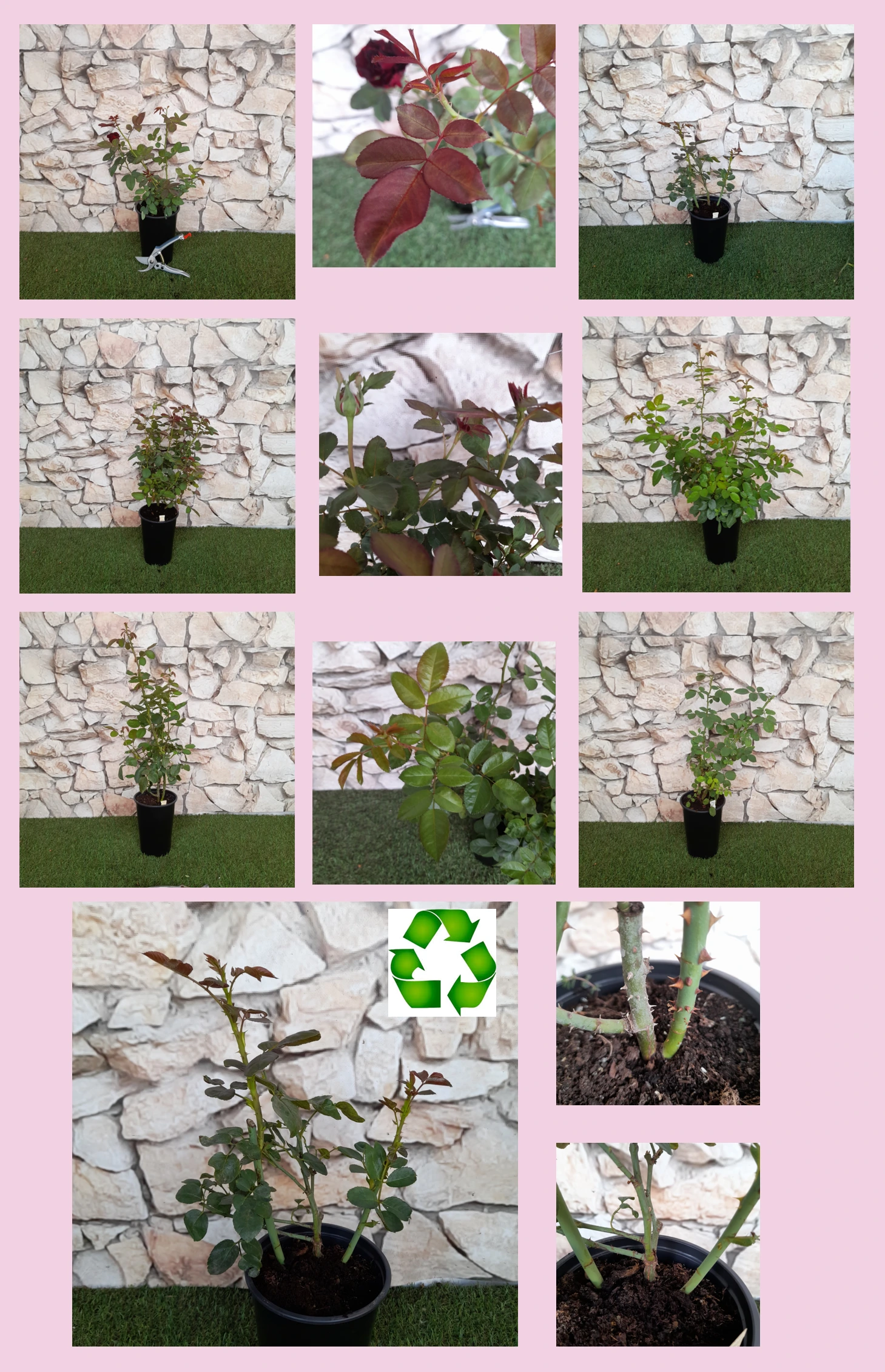
Crop overview: several varieties and growth stages in a short crop section.Shoot system: intensive growth of fresh basal shoots on a young plant.Root system: demonstration of a vigorous root system permeating the growing medium, by removing the pot.Balance: mature plant with root system and shoots in harmony with each other.
Information about the videos
The video series is not a “seasonal showcase”; it illustrates the essence of pharmaROSA® own-root cultivation in a tangible way: how the plant is built up, what the root system is like and how the shoot system regenerates. The recordings were therefore made at different times and with plants at various stages of development, so mixed foliage levels and differing stages of growth may appear in the videos. They are not a ‘sample’ of the batch dispatched, but a visual explanation of how the technology works. The current condition of the rose available to order — typical for the given period and similar to what you can expect to receive in the parcel — is shown in the upper part of the product page.
Pages for private customers Garden roses for the family garden, with minimal care → ORIGINAL® Premium garden roses – instant impact, a truly showpiece garden → EXTRA® Pages for professionals and private customers Roses for public spaces – large areas, sustainable maintenance → NATURAL® Roses for projects – hedge and row planting, fast implementation → RAPID® For professional partners only Production – propagation material for garden roses, wholesale → NEONATAL®
Company details
PharmaRosa Ltd. Company registration number: 01-09-717479 VAT number: 13075314-2-43 Plant health registration no.: HU130721 Bank account (IBAN): HU85117631891388688400000000 BIC (SWIFT): OTPVHUHB Bank name: OTP Bank Nyrt.