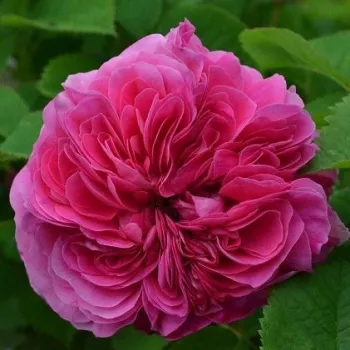
DUC DE CAMBRIDGE – purple historic Damask rose - Laffay
Historic charm meets practical garden performance in this tall, bushy Damask shrub, ideal for creating romantic structure in family plots while coping well with typical British weather patterns, including exposed, breezier spots near open ground or coasts. The scented rosette blooms appear once in early summer, but their very strong, classic Damask fragrance easily fills smaller gardens and lingers near doors, paths, and seating areas. As an own-root plant, it establishes steadily and offers reassuring longevity, rebuilding shoots from the base over time for a stable hedge or specimen. In the first year it concentrates on underground roots, the second on leafy growth, and by the third it shows its full ornamental character, giving you a mature, composed presence with relatively little ongoing effort.
Usage options
| Target area |
Reasoning |
| Fragrant focal point by a front path |
The intense Damask scent is one of this cultivar’s greatest assets, making it perfect beside frequently used paths, gateways, or front-door approaches where you pass close by on mild evenings. Its once-a-year flowering still provides a memorable seasonal highlight for scent-lovers |
| Statement shrub in a cottage-style border |
Its tall, bushy habit and historic character suit relaxed cottage schemes with perennials and herbs, giving height and a distinctive purple colour accent. Once settled, it forms a solid backbone with relatively modest care for cottage-gardeners |
| Traditional flowering hedge along boundaries |
Planted at hedge spacing, this dense, thorny rose gradually forms a visually effective, seasonally flowering barrier that also discourages unwanted access. Its vigorous, own-root structure helps it regenerate from the base after pruning for practical-homeowners |
| Specimen rose in a small lawn or courtyard |
Used singly with generous space around it, the tall, arching shrub shape and shifting purple–lilac tones create a period-feel focal point. It needs no elaborate training, only straightforward winter pruning, suiting busy-gardeners |
| Scented corner near seating or terrace |
Positioned near a bench, terrace, or summer dining area, its very strong, garden-filling perfume creates an atmospheric backdrop to evening use. Even in partial shade it flowers reliably, supporting shaded sitting areas for relaxation-seekers |
| Historic-rose themed planting with period character |
As a documented 1840 Damask by Jean Laffay, it anchors historically themed beds with genuine period material. Its once-flowering habit and traditional colour harmonise well with other heritage plants valued by history-enthusiasts |
| Loose screen for overlooking windows |
At 200–300 cm high with dense foliage, it can soften views and provide privacy from neighbouring windows or streets. Own-root growth ensures long-term structure, even if hard-pruned from time to time, supporting privacy-seekers |
| Large container on patio or in front garden |
In a well-drained container of at least 50 litres, it can be grown where soil is heavy or unsuitable, with watering and feeding kept simple. This helps overcome difficult ground conditions and still gives classic charm to urban-owners |
Styling ideas
- COTTAGE HEDGE – run a loose hedge of this rose along a front boundary, underplanting with catmint and hardy geraniums to soften the base – for lovers of informal, scented entrances
- PERIOD BORDER – combine with foxgloves, delphiniums, and old-fashioned phlox for a Victorian feel that highlights its historic origin – for gardeners curating a traditional look
- SCENTED NOOK – place one or two plants near a simple bench, with lavender and thyme edging, to create a compact retreat focused on fragrance – for those valuing evening relaxation
- STRUCTURAL ACCENT – use as a tall anchor at the back of a mixed border, balanced by ornamental grasses such as Carex ‘Blue Zinger’ – for design-conscious homeowners needing height
- COURTYARD FEATURE – grow it in a 50–70 litre terracotta pot against a warm wall, pairing with aubrieta at the base for spring colour – for small-space urban gardeners
Technical cultivar profile
| Parameter |
Data |
| Name and registration |
Duc de Cambridge is a historic Damask shrub rose, classified as an old garden rose; current trade and exhibition name Duc de Cambridge, unregistered but authenticity verified for this product. |
| Origin and breeding |
Bred by Jean Laffay in France and introduced around 1840, this cultivar represents early nineteenth-century Damask breeding; parentage and initial distribution remain unknown in current records. |
| Growth and structural characteristics |
Vigorous, bushy shrub reaching about 200–300 cm tall and 140–220 cm wide, with dense, matte olive-green foliage and strong prickliness, forming substantial, structural plants in time. |
| Flower morphology |
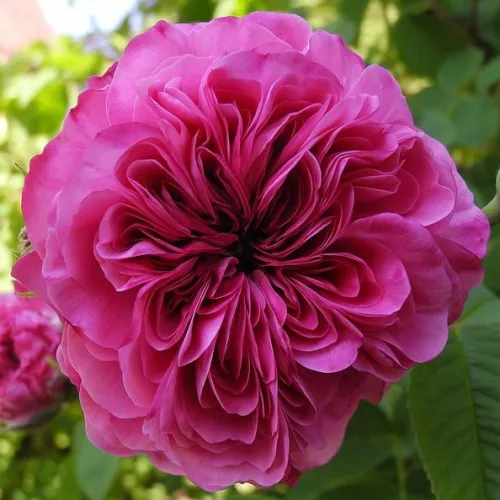
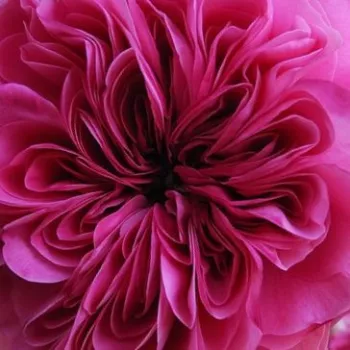
Medium-sized, very full, rosette-shaped blooms with more than 40 petals, mainly borne singly; once-flowering in early summer, with moderate self-cleaning and some hip formation after bloom. |
| Colour data and phenology |
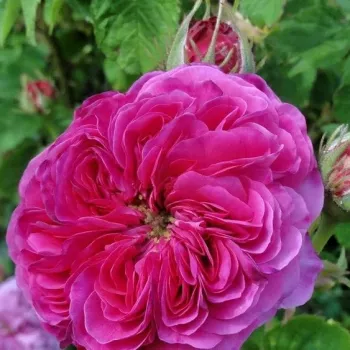
Crimson-lilac to purple-lilac tones that vary with weather, deeper in cool spells and slightly lighter in strong sun, giving a mauve, silvery effect as flowers age through the short main flush. |
| Fragrance and aroma |
Very strong, classic Damask fragrance that is rich and lingering, easily noticeable across a small garden, making it particularly suitable for scented areas and traditional rose collections. |
| Hip characteristics |
Forms pear-shaped, red–orange hips 16–24 mm across, but only sporadically due to very double flowers; when present, the hips add a modest ornamental feature later in the season. |
| Resistance and winter hardiness |
Hardy to about –29 to –32 °C (RHS H7, USDA 4b, Swedish zone 5); disease resistance is moderate, with average tolerance to black spot, powdery mildew, and rust under garden conditions. |
| Horticultural recommendations |
Best as hedge, specimen, or park rose at 105–190 cm spacing; tolerates partial shade, prefers well-drained soil, and benefits from medium-level care, including occasional plant protection. |
DUC DE CAMBRIDGE rewards you with rich Damask fragrance, tall structural growth, and adaptable planting options while its own-root form supports long-lived, easily maintained character, making it a thoughtful choice for traditional gardens.