ANDeli – Herbert C. Swim; A. E. Ellis; A. W. Ellis
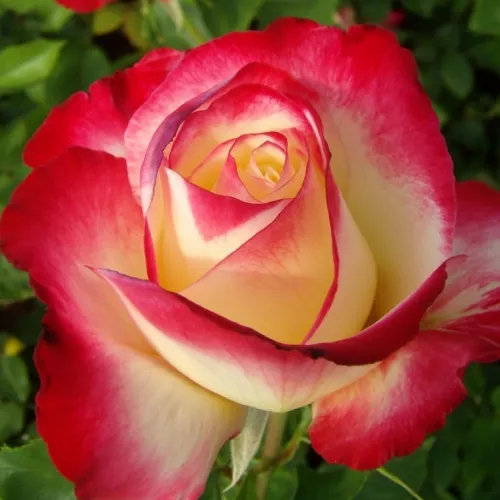
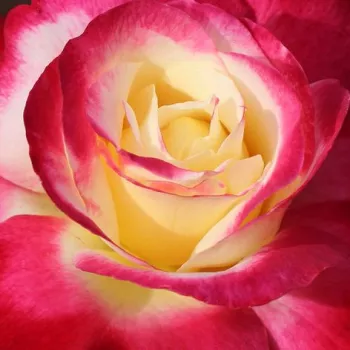
The edges of the cream-white petals are marked by an intense carmine-red band. The red shade deepens in sunlight. - hybrid tea rose - very strong, detectable from a distance rose - rich, sweet-spicy fragrance
– Striking red‑and‑white bicolour hybrid tea blooms.
– Very strong, rich sweet‑spicy fragrance.
– Excellent repeat flowering through the season.
– Robust health with high disease resistance.
– Award‑winning classic, World’s Favourite Rose.
– Special feature: Colour intensifies in strong sun while petals keep their freshness and form.
Unfortunately, we are currently unable to ship to the United Kingdom; we only deliver to countries within the European Union. For more information, please contact us!
Fragrant and visually striking, Double Delight is a classic hybrid tea that offers generously sized blooms for cutting and garden display, with reliable repeat flowering across the season. Its bushy habit suits modest front gardens and small borders, while its proven disease resistance keeps care pleasantly simple in typical British conditions, even where summer air is humid and diseases can easily spread in still, damp weather. As an own-root plant it settles in securely and builds long-term stability, rewarding steady care with a dependable, long-lived presence. Plant it in beds, borders or a large 40–50 litre container for a focal-point feature that also provides wonderfully perfumed stems indoors. Over the first three years it steadily strengthens – first rooting, then top growth, and finally full ornamental impact – giving you time to shape it to your garden. Thoughtful deadheading and light pruning help maintain a tidy outline in compact family spaces.
Freshly opened bloom of Double Delight with cream-white petals and a soft raspberry-red edge.
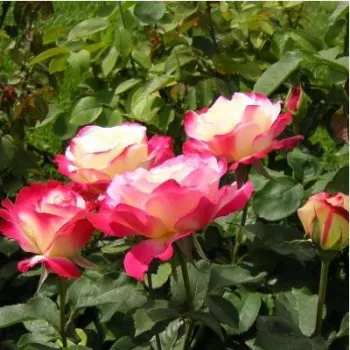
Double Delight in full bloom, showing its red-and-white petals.
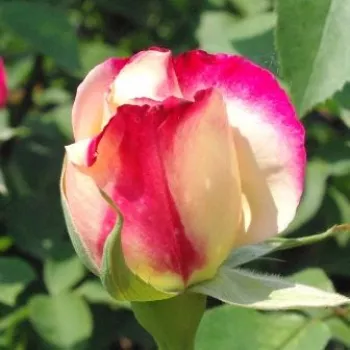
Closed bud of Double Delight, ivory with a pale rose-pink tint.
Usage options
Target area
Reasoning
Front-garden focal point by the entrance
Planted as a single specimen by a path or doorstep, Double Delight’s large, high‑centred blooms and strong perfume create an immediate sense of welcome in a small front garden. Regular deadheading keeps the plant neat and encourages repeat flowering, without the need for complex pruning, making it ideal for busy homeowners and beginners
Classic hybrid tea rose bed
In a dedicated rose bed, its bushy structure and repeat flowering give a traditional hybrid tea look with less fuss, thanks to good disease resistance that reduces spraying needs. Space plants at about 65 cm to allow air movement and easy access for deadheading, suiting those who want a structured, reliable display for families
Cutting garden for perfumed roses
The long, straight stems and large, high‑centred flowers are excellent for cutting, and the very strong, sweet‑spicy fragrance is notable even in a vase indoors. Plant a small group of three to five bushes to have a regular supply of blooms throughout summer, appealing to fragrance lovers and home arrangers as well as enthusiasts
Mixed cottage-style border
Among perennials and cottage favourites, its cream and carmine-red bicolour flowers add drama without overwhelming a small plot. The moderately dense, glossy foliage offers a solid green backdrop between flushes, while own-root growth ensures the bush matures steadily in its final position, reassuring style-focused gardeners
Feature rose in a large container
In a generous 40–50 litre pot with good drainage, Double Delight performs well as a patio centrepiece, where its fragrance can be enjoyed at close quarters. Container planting also helps manage heavier clay soils, making it easier to provide the free‑draining, enriched compost this variety appreciates for urban and suburban owners
Low-intervention family rose corner
Good resistance to powdery mildew and black spot, combined with moderate watering needs, allows for a relatively low‑intervention planting that still looks refined. Once established on its own roots, the shrub maintains shape and recovers well from minor neglect, suiting family spaces where time for detailed care is limited for households
Sunny border with partial shade periods
Double Delight tolerates some partial shade, so it suits borders that receive strong morning or afternoon sun but are shaded at other times. In such spots it still flowers reliably, and its colour holds well, with the red deepening attractively in bright light, giving flexibility in siting for smaller plots and newcomers
Weather-resilient ornamental planting
Its strong constitution and H7 hardiness cope well with typical UK winters, while sound disease resistance helps it stay tidy in humid summers when fungal problems often rise in British gardens. This resilience, combined with own-root longevity, supports long-term, low-maintenance planting choices for pragmatic, long‑view buyers
Styling ideas
Cottage Contrast – Combine Double Delight with Verbena hastata ‘Pink Spires’ and airy perennials for a loose cottage feel where its striking bicolour blooms punctuate softer textures – ideal for romantic, informally inclined gardeners
Entrance Accent – Plant a single bush in a neat bed by the front door, underplanted with low lavender or catmint, to frame the path with fragrance and colour – well suited to compact front gardens seeking easy impact
Patio Showcase – Grow it in a 40–50 litre terracotta or stone-effect container, paired with trailing thyme or silver foliage, to enjoy scent and cut flowers close to the house – perfect for balconies, terraces and small urban spaces
Classic Rose Row – Arrange several plants in a straight or gentle curved line along a lawn edge, trimmed with low box or hebe, to create a traditional hybrid tea rose display – appealing to lovers of formal, ordered planting
Fragrant Nook – Position Double Delight near a favourite bench with soft grasses and late perennials so its perfume and repeat blooms enrich a quiet seating area – designed for those who value evening relaxation in the garden
Technical cultivar profile
Parameter
Data
Name and registration
Hybrid tea rose, registered as ANDeli, marketed as Double Delight hybrid tea rose ANDeli; exhibition category exhibition hybrid tea and cut flower, ARS exhibition name Double Delight.
Origin and breeding
Bred in the United States in 1976 by Herbert C. Swim with A. E. and A. W. Ellis at Armstrong Nurseries; ‘Granada’ × ‘Garden Party’, introduced and registered in 1977.
Awards and recognition
Highly decorated variety: Baden-Baden and Rome Gold Medals (1976), Geneva Most Fragrant Rose (1976), All-America Rose Selections Winner (1977), World’s Favourite Rose (1985), James Alexander Gamble Fragrance Award (1986).
Growth and structural characteristics
Bushy hybrid tea shrub 110–150 cm high and 75–105 cm wide, with moderately dense, glossy medium-green foliage and moderate prickliness; forms a balanced, upright bush suitable for beds, borders and specimen planting.
Flower morphology
Large, double, high-centred, pointed-budded blooms with 26–39 petals, typically borne singly on stems; classic hybrid tea form suitable for exhibition and cutting, with good stem length and repeat flowering through the season.
Colour data and phenology
Cream-white petals edged with intense carmine red (ARS RB, RHS 53A, 155D); red deepens in strong sun while colour generally fades little, with successive stages showing cream, raspberry-red edging and gentle salmon-pink and yellowish tones.
Fragrance and aroma
Very strong, sweet-spicy perfume, often detectable from a distance; a key feature of the cultivar and widely recognised in fragrance awards, primarily ornamental rather than pollinator-focused due to the full double flower form.
Hip characteristics
Hip set is usually scant because of the double, many-petalled flowers; where present, hips are small, spherical, about 10–14 mm in diameter, with a red colour, adding only minor autumn interest in most seasons.
Resistance and winter hardiness
Good resistance to powdery mildew and black spot, moderate rust susceptibility; hardy to approximately –26 to –23 °C (RHS H7, USDA 5b, Swedish Zone 4), reliably overwintering in typical UK conditions with normal garden protection.
Horticultural recommendations
Best in full sun with fertile, well-drained soil; moderate heat and drought tolerance but benefits from regular watering in dry spells. Deadhead spent blooms, prune annually, and allow space per planting guidelines for air circulation and vigour.
DOUBLE DELIGHT – red-and-white hybrid tea rose - Swim & Ellis & Ellis offers award-winning fragrance, repeat flowering and resilient, own-root growth for long-term enjoyment; a refined yet practical choice for a well-used family garden.
Competition and Show Awards:
Baden-Baden – Gold Medal (1976); Rome – Gold Medal (1976); Geneva – Most Fragrant Rose Award (1976); All-America Rose Selections – Winner (1977); World’s Favourite Rose / Rose Hall of Fame (1985); James Alexander Gamble Fragrance Award (1986)
Our product is a rose grown with pharmaROSA®’s unique cultivation technology!
2-litre, own-root, potted rose.
With a shoot system appropriate to the season.
With a root system that thoroughly permeates the growing medium.
Quality compliant with the requirements of the E.N.A. (European Nurserystock Association).
Supplied in unique packaging that prevents damage.
Can be planted during frost-free periods.
True-to-variety rose bush with a unique identifier.
The pharmaROSA® own-root potted rose is a well-rooted plant that supports reliable establishment when planted and cared for properly, so it can be planted whenever the soil is not frozen.
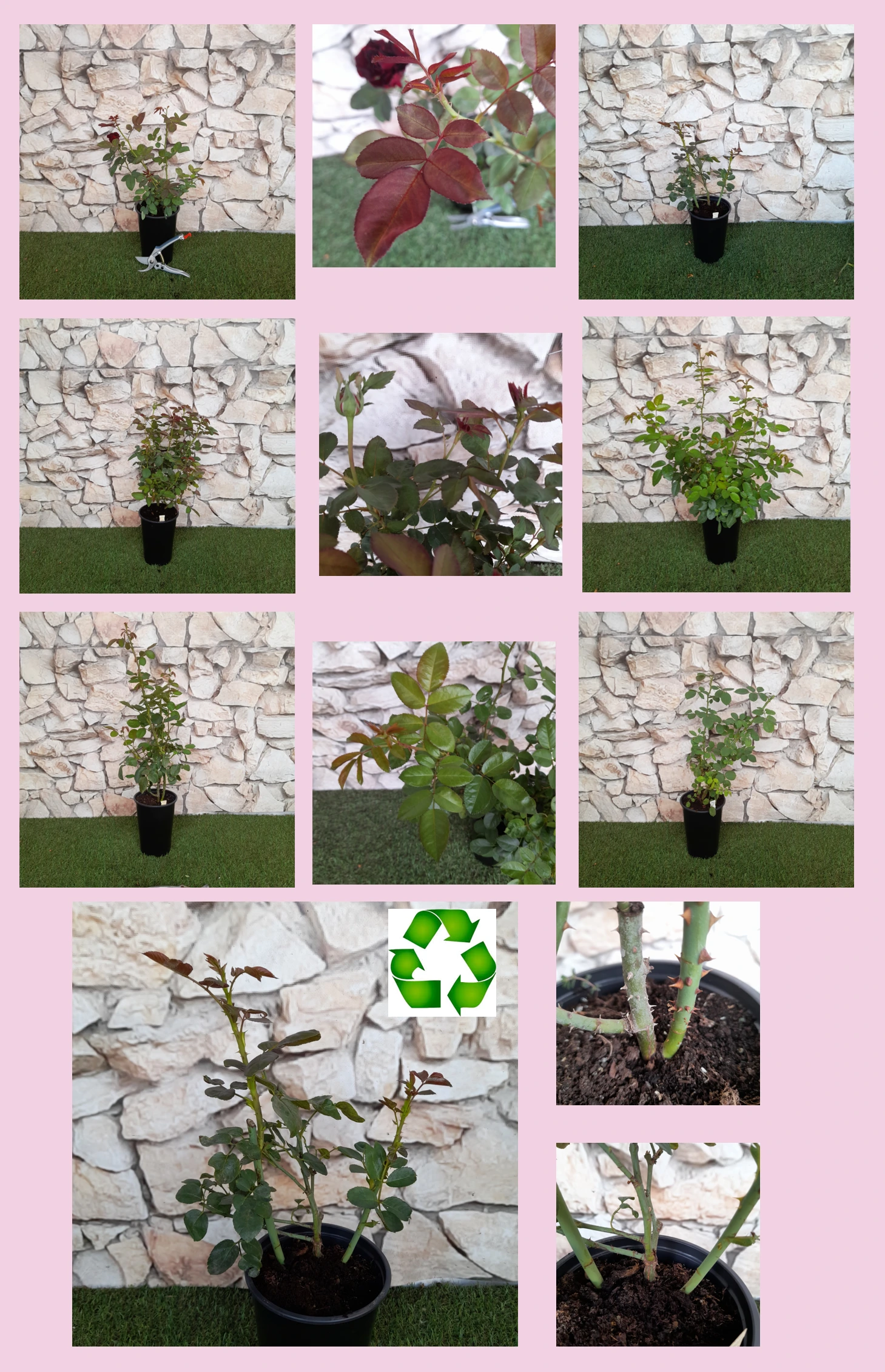
Crop overview: several varieties and growth stages in a short crop section.Shoot system: intensive growth of fresh basal shoots on a young plant.Root system: demonstration of a vigorous root system permeating the growing medium, by removing the pot.Balance: mature plant with root system and shoots in harmony with each other.
Information about the videos
The video series is not a “seasonal showcase”; it illustrates the essence of pharmaROSA® own-root cultivation in a tangible way: how the plant is built up, what the root system is like and how the shoot system regenerates. The recordings were therefore made at different times and with plants at various stages of development, so mixed foliage levels and differing stages of growth may appear in the videos. They are not a ‘sample’ of the batch dispatched, but a visual explanation of how the technology works. The current condition of the rose available to order — typical for the given period and similar to what you can expect to receive in the parcel — is shown in the upper part of the product page.
Pages for private customers Garden roses for the family garden, with minimal care → ORIGINAL® Premium garden roses – instant impact, a truly showpiece garden → EXTRA® Pages for professionals and private customers Roses for public spaces – large areas, sustainable maintenance → NATURAL® Roses for projects – hedge and row planting, fast implementation → RAPID® For professional partners only Production – propagation material for garden roses, wholesale → NEONATAL®
Company details
PharmaRosa Ltd. Company registration number: 01-09-717479 VAT number: 13075314-2-43 Plant health registration no.: HU130721 Bank account (IBAN): HU85117631891388688400000000 BIC (SWIFT): OTPVHUHB Bank name: OTP Bank Nyrt.