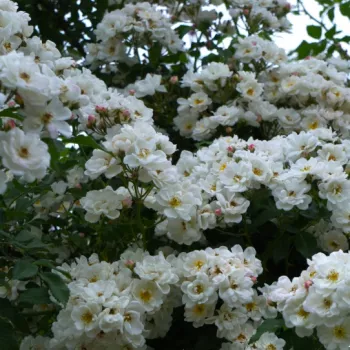
Dentelle de Bruges – white park shrub rose (Hybrid Musk)
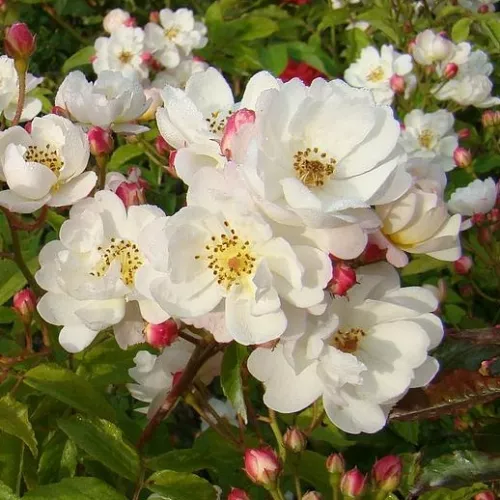
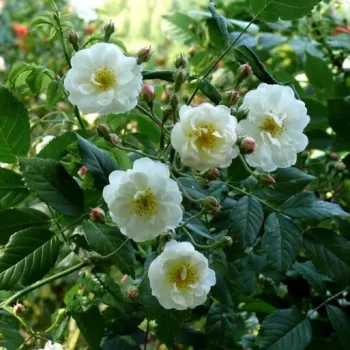
This refined park shrub rose brings a touch of classic elegance to family gardens, producing airy clusters of small, snow‑white blooms with golden stamens in a single, impressive summer display. Its semi‑double, open flowers have a strong, spicy‑honey fragrance and invite bees, giving you a naturally lively, pollinator‑friendly border. As an own‑root shrub it develops steadily into a tall, upright, bushy structure that anchors well even in exposed, breezy sites with thoughtful attention to garden drainage. Over the years it forms a long‑lived planting, with the first season focused on roots, the second on shoots, and by the third year offering its full ornamental character. After flowering, the plant is studded with small orange hips that bring extra interest into autumn, extending the value of this easy‑to‑place, low‑intervention garden rose.
Usage options
| Target area |
Reasoning |
| Front garden focal shrub |
The tall, upright, bushy habit makes this rose ideal as a single statement shrub near the front door or along a main path, giving height and presence without complex pruning demands over the years – reassuring for the beginner. |
| Cottage-style mixed border |
Loose clusters of semi-double white blooms and strong fragrance fit naturally with cottage perennials, while own-root growth creates a durable, long-lived clump that settles into its surroundings with only basic yearly care – appealing to the hobby-gardener. |
| Informal flowering hedge |
Planted at hedge spacing, the bushy structure knits together into a soft, white-flowering screen, then carries orange hips for autumn interest; pruning can remain light and occasional, suiting those wanting structure without fuss – ideal for the homeowner. |
| Wall or fence background |
Its height and upright habit allow it to act as a relaxed backdrop along a wall or fence, softening hard boundaries with a single summer flush of scented white flowers, while own-root resilience supports long-term planting plans – helpful for the planner. |
| Pollinator-friendly wildlife corner |
Semi-double, open flowers with accessible golden stamens and strong fragrance are attractive to bees, and the later orange hips offer seasonal structure, making this rose a good choice where aesthetics and garden ecology meet – perfect for the nature-lover. |
| Part-shaded side garden |
Its tolerance of partial shade lets you brighten side paths or north-east aspects with light, airy white blooms, reducing the pressure to reserve only prime sunny spots for roses and simplifying layout decisions – reassuring for the urban-gardener. |
| Large container near seating area |
In a 40–50 litre container, its fragrance and white blooms can be enjoyed up close on terraces or patios; the own-root plant structure adapts gradually to confined soil, provided watering and feeding are reasonably regular – suited to the balcony-owner. |
| Loose, low-maintenance park-style planting |
With medium disease resistance and a once-a-year flowering habit followed by long-lasting hips, this variety suits wider, less intensively managed beds where robust structure and seasonal highlights matter more than constant deadheading – attractive to the time-poor. |
Styling ideas
- White-lace hedge – Plant a loose line 130 cm apart, underplant with low evergreen groundcover to catch fallen petals, creating a soft white summer curtain and simple boundary – for relaxed front-garden owners.
- Cottage duet – Combine with blue globe thistle and white blazing star for a textured blue-and-white border that highlights the airy clusters and hips – for lovers of traditional cottage mixes.
- Entrance accent – Use a single shrub by the gate or path with clipped Lonicera nitida forms, pairing formal shapes with the rose’s natural habit and scent – for those seeking a welcoming front approach.
- Wildlife corner – Group 3 shrubs with long-grass edges and insect-friendly perennials, allowing hips to remain for birds and winter structure – for gardeners prioritising pollinators and seasonal habitat.
- Patio perfume – Grow one plant in a 40–50 litre pot near seating to enjoy the spicy-honey scent on summer evenings, with minimal shaping and simple seasonal feeding – for busy urban gardeners.
Technical cultivar profile
| Property |
Data |
| Name and registration |
Dentelle de Bruges (LENmule), shrub Hybrid Musk park rose; ARS exhibition name Dentelle de Bruges; collection: Park – shrub rose; meaning references Bruges lace-making tradition. |
| Origin and breeding |
Bred by Louis Lens, Lens Roses (Belgium), from ‘Seagull’ × ‘Mühle Hermsdorf’; bred 1988, introduced and registered 1990, initially distributed by Lens Roses as a park and shrub garden rose. |
| Growth and structural characteristics |
Upright, bushy shrub 170–230 cm high and 120–180 cm wide, moderately thorny, with moderately dense, slightly glossy mid‑green foliage; suited to use as specimen, hedge, wall or fence background. |
| Flower morphology |
Semi-double, cup-shaped blooms with 13–25 petals, small size (0.5–1.5 in), freely produced in large clusters; flowers once in summer, not remontant, and shows weak self-cleaning due to generous hip set. |
| Colour data and phenology |
Buds deep crimson-red; opening pale cream, quickly turning pure snow-white, sometimes with greenish tinge before fading; golden-yellow stamens stand out strongly, creating a translucent, lace-like white effect. |
| Fragrance and aroma |
Strong, full fragrance with a complex spicy-honey character; open, semi-double blooms with accessible stamens provide both scent and visual cues, contributing to moderate pollinator attraction during peak flowering. |
| Hip characteristics |
After flowering, produces moderately abundant, small spherical orange hips, approximately 6–10 mm in diameter, which may persist into autumn, extending ornamental interest and adding a light wildlife food source. |
| Resistance and winter hardiness |
Medium disease resistance; powdery mildew, black spot and rust manageable with occasional protection; hardy to about −18 to −15 °C, RHS H6, Swedish zone 2, USDA zone 7a, suitable for most settled UK gardens. |
| Horticultural recommendations |
Best in sun to partial shade in fertile, well-drained soil; spacing 130–220 cm depending on use; minimal shaping and periodic renewal pruning recommended; hips form if spent blooms are not removed after flowering. |
Dentelle de Bruges offers fragrant white summer clusters, autumn hips and a durable own-root shrub form that matures reliably over time, making it a thoughtful choice if you are planning a long-lived, characterful rose planting.