CORRIDA™ – red tea-hybrid rose - Sauvageot
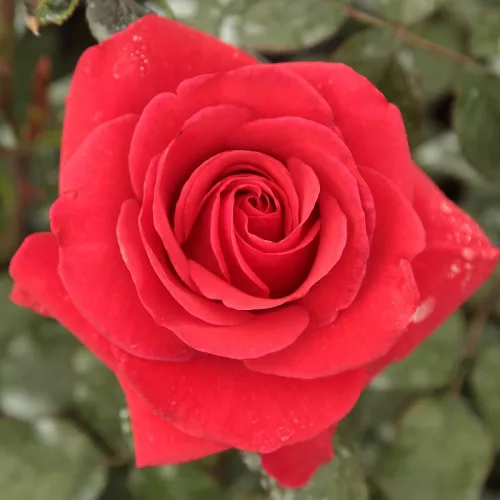
Velvety deep-red blooms, an upright, orderly bush and dependable repeat flowering make CORRIDA™ a confident choice when you want classic hybrid tea elegance without fuss; its disease resistance, low-maintenance upkeep and tolerance of partial shade suit typical British family plots where you may also need to think about heavier soils and good drainage in wetter spells, while the own-root habit supports longevity and reliable regrowth after pruning so the plant can mature steadily from root-building in the first year, to stronger shoots in the second and full ornamental presence by the third, giving you stable colour, neat structure and lasting value in beds, borders or larger containers.
Usage options
| Target area |
Reasoning |
| Front garden focal point near the entrance |
The upright, compact habit and dense dark foliage create a tidy, structured plant that frames a path or doorway without overwhelming smaller spaces; the velvety red blooms read clearly from a distance and stay neat with simple deadheading – ideal for the busy beginner |
| Small mixed border in a family garden |
Good resistance to black spot, mildew and rust means less spraying and less time troubleshooting problems, so it slips easily into mixed borders with perennials and shrubs while reliably repeating through summer – reassuring for the low-maintenance gardener |
| Compact rose bed with 3–5 plants |
Regular flower size, uniform colour and similar plant height make small groups look composed and deliberate, whether viewed from the house or pavement, avoiding the patchy look that can bother perfectionists – well suited to the design-conscious homeowner |
| Cutting area for indoor arrangements |
Large, double, exhibition-style flowers on strong, upright stems provide classic hybrid tea stems for vases, allowing you to bring the rich red colour indoors repeatedly across the season with straightforward care – appealing for the home flower arranger |
| Around-the-house ornamental strip or narrow bed |
The upright habit with a 40–60 cm spread slots neatly into slim borders along drives, fences or patios; partial shade tolerance means it will still perform where light varies through the day – practical for the urban front-garden owner |
| Feature rose in a large container |
In a 40–50 litre pot or larger, its compact footprint and vertical growth create a smart, contained pillar of colour on patios or balconies, and the own-root form recovers well if pruning is occasionally delayed – convenient for the space-limited gardener |
| Structured cottage-style planting with perennials |
Reliable repeat flowering and stable colour, combined with dense, glossy foliage, provide a calm red anchor among looser plants such as low yarrow or dwarf lavender, helping cottage-style mixes remain coherent over years – ideal for the cottage-garden enthusiast |
| Long-term, low-intervention rose area |
The own-root plant gradually forms a balanced bush that responds well to periodic harder pruning, maintaining vigour and ornamental value over many seasons, even in gardens where attention comes in short bursts – reassuring for the time-pressed homeowner |
Styling ideas
- Classic entrance pair – Flank a front path with two CORRIDA™ in large terracotta pots, underplanted with low yarrow for a restrained red-and-cream palette – for those favouring formal, welcoming approaches
- Cottage ribbon – Thread a short row through a cottage border, alternating with dwarf lavender to echo the velvety red blooms against cool blue and grey foliage – for lovers of relaxed but orderly planting
- Patio showpiece – Plant a single specimen in a 50-litre container with gravel mulch and small evergreen companions to highlight the glossy foliage and cut-flower stems – for balcony and terrace gardeners
- Family-friendly border – Combine in a small bed with hardy perennials like purple-leaved beardtongue to give structure and colour with minimal spraying or fuss – for busy families wanting reliable impact
- Cutting corner – Dedicate a sunny spot to three plants in a triangle, spaced for air and access, creating a steady supply of long, straight stems for vases – for home florists who enjoy arranging their own blooms
Technical cultivar profile
| Parameter |
Data |
| Name and registration |
Hybrid tea rose marketed as CORRIDA™ – red tea-hybrid rose - Sauvageot; American Rose Society exhibition name ‘Corrida’; commercial group hybrid tea rose, cut and garden use. |
| Origin and breeding |
Bred by Bernard Sauvageot, NIRP International, France, around 1995; introduced commercially in 2005 by NIRP International, with parentage not publicly documented. |
| Growth and structural characteristics |
Upright hybrid tea with dense, glossy dark green foliage and moderate prickles; height typically 75–100 cm with a 40–60 cm spread, forming a compact, well-filled bush. |
| Flower morphology |
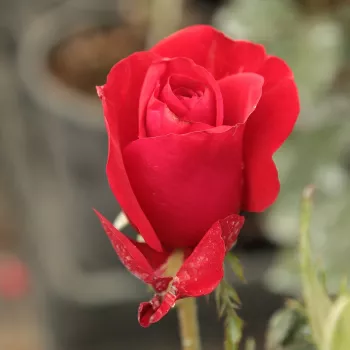
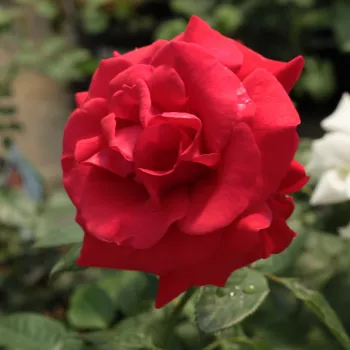
Large, double, cup-shaped blooms with 26–39 petals and a slightly raised centre; predominantly borne singly on stems, remontant with a notably generous second flush in season. |
| Colour data and phenology |
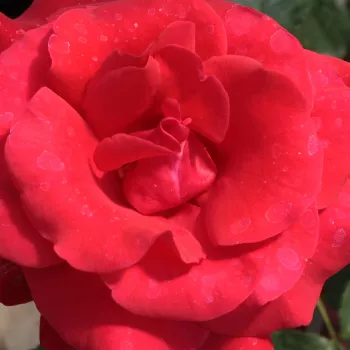
Velvety, uniform deep red blooms (RHS 53A outer, 46B inner) without blackish tones; colour remains strong, fading slowly to medium red with a raspberry edge just before petals drop. |
| Fragrance and aroma |
Fragrance is very weak, generally perceived as barely scented, so it is chosen primarily for visual effect, colour stability and form rather than for a strong perfume in the garden. |
| Hip characteristics |
Hip set is usually sparse due to double flowers; when present, produces small, egg-shaped red hips (RHS 46A) about 9–13 mm in diameter, with limited ornamental significance. |
| Resistance and winter hardiness |
Rated resistant to powdery mildew, black spot and rust; hardy approximately to −21 to −18 °C (USDA zone 6b, RHS H7, Swedish zone 3) under normal garden conditions. |
| Horticultural recommendations |
Suited to beds, specimens and cutting; prefers sun but tolerates partial shade; spacing 30–55 cm depending on use; generally low maintenance, with only routine pruning and deadheading needed. |
Choose CORRIDA™ for velvety red blooms, strong disease resistance and a compact, own-root shrub that matures steadily into a long-lived feature, an excellent option if you want dependable colour with straightforward care.