COCTAIL® – red-yellow park rose - Meilland
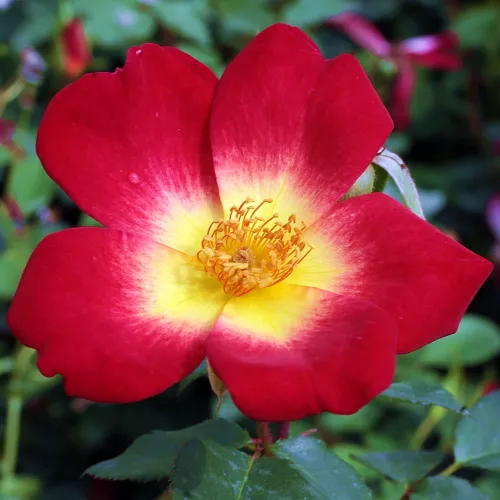
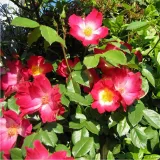
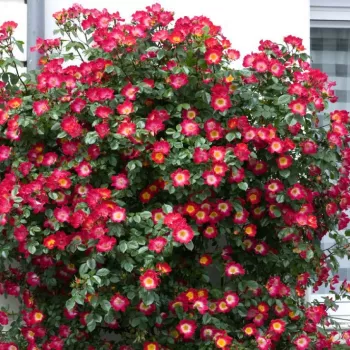
Colour and contrast define COCTAIL®, a classic French-bred climber that brings vivid scarlet red petals with a golden-yellow eye to front gardens, fences and cottage-style spaces. Its upright, bushy habit is naturally tidy, forming dense, glossy dark green foliage that clothes walls, arches and obelisks with very little shaping. Clusters of single flowers appear in generous waves from early summer, then repeat more lightly, providing long seasonal interest and an excellent landing platform for bees thanks to the open, pollen-rich centres. Well-suited to typical British conditions, it copes reliably with blustery, rainy spells and benefits from improved drainage where heavy clay soils tend to hold water. Once planted as an own-root shrub, COCTAIL® settles in and develops into a long-lived, reliable feature that regenerates well from the base, supporting a strong framework of flowering shoots. Give it the first year to root, the second to build shoots and the third to show its full ornamental value for easy-care garden impact. In time, self-cleaning blooms, good heat tolerance and steady health combine into an enduring, low-effort performer that suits busy gardeners who still want a standout, rose-covered facade.
Usage options
| Target area | Reasoning |
|---|
| Front garden focal climber on wall or fence |
COCTAIL® is ideal where you want instant visual drama from the pavement: the scarlet-and-yellow flowers read clearly from a distance and repeat in waves through the season, so the frontage never looks bare between flushes. The moderate height makes it easy to keep within typical boundary-line limits while still covering panels or brickwork. Once established on its own roots, the plant forms a durable, regenerating base that grows more impressive each year, rewarding those seeking striking kerb appeal with minimal fuss, especially beginners. |
| Cottage-style pergola or archway |
The upright, freely branching habit lends itself to training over an arch or along a light pergola, creating a tunnel of colour without becoming over-heavy. Single, bee-friendly blooms appear in clusters along the canes, softening hard structures and mixing well with classic perennials. Own-root growth means that if a cane is damaged by wind or pruning, new shoots arise from the base to rebuild the framework over time, supporting long-term use on garden features for cottage-lovers. |
| Small group planting in mixed border |
Planted in groups of 1–3 at the back or middle of a border, COCTAIL® contributes height and a strong colour accent without overshadowing nearby shrubs and perennials. The dense, glossy foliage makes a handsome backdrop even between flushes, while good self-cleaning keeps the display neat without constant deadheading. Own-root plants adapt steadily to different border soils, building a stable stand that integrates well into mixed plantings for time-poor owners. |
| Low-maintenance specimen by the front door |
As a single specimen trained on an obelisk or trellis, this rose brings a welcoming, almost lantern-like splash of red and yellow beside the entrance. The flushes are generous, and because most spent petals drop on their own, tidy paths and steps are easy to maintain. Its moderate maintenance needs suit those who prefer occasional, simple pruning over detailed shaping, while own-root resilience supports long service life in a prominent position, appealing to urban-owners. |
| Boundary screen or informal flowering hedge |
Along a sunny boundary, the plant’s 2–3 m height and 1,2–1,8 m spread can be used to create a light, flowering screen on wires or posts. Repeated clusters of flowers offer colour from early summer to autumn, and the dark, glossy foliage fills in gaps to ensure privacy. The rose accepts straightforward annual pruning, so you can keep it within the desired outline rather than tackling complex training systems, which suits busy-families. |
| Roses in heavier soils with improved drainage |
Where gardens sit on typical heavy clay, COCTAIL® responds well to planting into improved soil in a slightly raised bed, where drainage prevents waterlogging of its deepening root system. Once given this start, own-root plants anchor firmly and support a robust top growth that copes well with seasonal rain and wind, making it a dependable choice in less-than-ideal conditions for practical-gardeners. |
| Pollinator-friendly rose area near seating |
The open, single flowers and prominent stamens attract bees and other pollinators, so a small group near a bench or patio gently animates the space without strong scent. Repeating flushes extend this activity across much of the summer, while the moderate height keeps the display at eye level. The combination of continual colour, wildlife value and easy overall care makes it particularly rewarding for wildlife-lovers. |
| Large container planting on terrace or balcony |
In a minimum 40–50 litre container with quality compost and support, COCTAIL® offers a long-lived vertical accent for paved terraces or balconies. The dense leaves and regular flower clusters disguise supports effectively, while good self-cleaning keeps nearby surfaces smarter between maintenance rounds. Own-root growth ensures that, with occasional repotting and feed, the plant remains a reliable structural and flowering element for many years for container-gardeners. |
Styling ideas
- COTTAGE GATEWAY – Train COCTAIL® over a simple metal arch at the front path and underplant with lavender and catmint to echo the warm flower tones – ideal for cottage-lovers.
- WALL WASH – Use two or three plants along a sunny brick wall and mix with white clematis for a soft, painterly effect – suited to design-conscious homeowners.
- PAVED COURTYARD – Grow in a large terracotta container with airy gaura and dwarf Michaelmas daisies for a long-season, low-maintenance courtyard focal point – perfect for time-poor owners.
- FAMILY BACKDROP – Create a relaxed, flowering screen behind a seating area, combining COCTAIL® with variegated weigela for contrasting foliage – good for busy-families.
- URBAN ACCENT – Place a single container-grown plant on a balcony or roof terrace, teamed with ornamental grasses to highlight its colour contrast – appealing to urban-owners.
Technical cultivar profile
| Parameter | Data |
|---|
| Name and registration |
COCTAIL® (MEImick), also exhibited as Cocktail; shrub / park rose used as an ornamental climber on supports, verified cultivar identity and premium silver garden-quality rating. |
| Origin and breeding |
Bred by Francis Meilland, Meilland International, France, from (Independence × Orange Triumph) × Phyllis Bide; introduced 1957 as a colourful, robust garden and landscape rose. |
| Awards and recognition |
Holder of major international awards, including Rome Certificate 1956, Paris-Bagatelle 1st prize 1957, Orléans Gold Medal 1960 and WFRS Hall of Fame “World’s Favourite Rose” 2015. |
| Growth and structural characteristics |
Upright, vigorous shrub-climber reaching 2,0–3,0 m high with 1,2–1,8 m spread, densely thorned shoots and abundant, glossy dark green foliage suitable for training on various supports. |
| Flower morphology |
Single to semi-double blooms with 5–12 petals, small flat flowers in clusters, remontant with a strong first flush followed by lighter repeat flowering across the season. |
| Colour data and phenology |
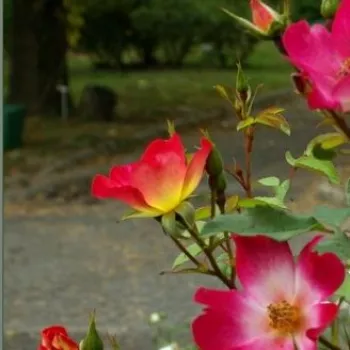
Striking bicolour effect: vivid scarlet RB outer petals (RHS 46A) with a bright yellow eye (RHS 13C); tones soften to salmon and creamy lemon as blooms age in strong sunlight. |
| Fragrance and aroma |
Fragrance is very light and unobtrusive, with a fresh, lively character that does not dominate nearby seating areas; prioritises visual impact and pollinator access over strong scent. |
| Hip characteristics |
Sets small, spherical red hips 7–13 mm across in moderate numbers; decorative late-season interest and potential food source for garden birds without overwhelming the plant. |
| Resistance and winter hardiness |
Hardy to approximately –26 to –23 °C (RHS H7, USDA 5b, Sweden Zon 4), with moderate resistance to black spot, mildew and rust; tolerates summer heat but appreciates watering in drought. |
| Horticultural recommendations |
Best in sun or light partial shade in fertile, well-drained soil; space 1,25–2,10 m depending on use, provide support for climbing, and prune annually to renew flowering wood. |
COCTAIL® offers vivid colour contrast, self-cleaning flowers and dependable own-root longevity, making it an easy, long-lived choice for front gardens and small structures that you can select with confidence.