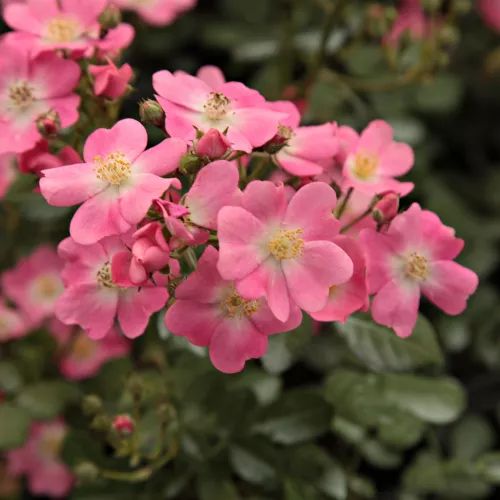
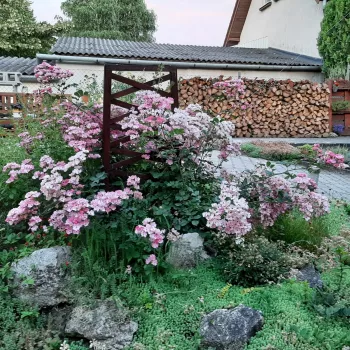
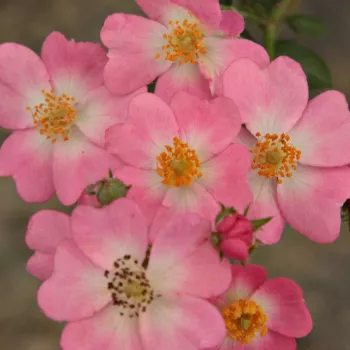
Uniform soft pastel pink shade, with a delicate whitish opalescence on the outer margin of the petals. - groundcover rose - unscented rose - no noticeable aroma
– Soft pastel pink flowers in generous clusters
– Compact, arching habit for neat groundcover
– Excellent resistance to major rose diseases
– Long flowering season with abundant rebloom
– Particularly attractive to bees and pollinators
– Special feature: Decorative red hips extend interest into autumn.
Unfortunately, we are currently unable to ship to the United Kingdom; we only deliver to countries within the European Union. For more information, please contact us!
5(7390)
BUDAI LINA EMLÉKE – pale pink groundcover rose – Győry
This low, bushy groundcover rose was created to make maintenance easy in everyday family gardens, delivering a carpet of soft pastel pink blooms from early summer and then a notably abundant second flowering. Its compact 30–60 cm height and 60–120 cm spread help you keep front borders looking orderly without constant pruning, while dense, glossy mid-green foliage ensures good ground coverage that visually knits beds together. Highly resistant to common fungal diseases, it suits British gardens where frequent rain and wind can challenge roses, especially in areas where better soil drainage is important for long-term health. The single, open flowers are particularly welcoming for visiting bees, bringing discreet wildlife interest to cottage-style plantings. As an own-root plant it settles in steadily over several seasons – roots in the first year, stronger top growth in the second, and full ornamental impact by about the third.
Budai Lina emléke in freshly opened bloom.
Budai Lina emléke in different opening phases, from pale pink bud to fading bloom.
Budai Lina emléke forms a dense, glossy mid-green foliage mass.
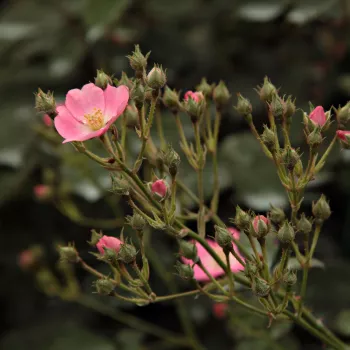
A Budai Lina emléke egyszerű, nyitott virágának belső szerkezete és jól látható porzói.
Usage options
Target area
Reasoning
Front garden groundcover
The naturally low, spreading habit forms a tidy green and pale pink carpet that softens drive edges and paths without blocking windows or sightlines. Plant on a simple grid to create a coherent, well-kept approach that stays manageable for the beginner.
Small mixed cottage border
Its modest height and bushy, arching growth slip easily into cottage-style plantings, filling gaps between perennials while the soft colour blends with traditional blues and whites. This helps you achieve a romantic look without complex layering for the homeowner.
Low-maintenance family bed
The combination of low maintenance needs and reliable repeat flowering suits busy households who want colour rather than chores. Once established, a simple annual prune and occasional feed are typically enough to keep it performing for the urban-gardener.
Informal path edging
The dense foliage and controlled spread create a soft, arching edge along garden paths, reducing the need for seasonal bedding while still providing a clear, attractive line. This makes it a good choice where you want gentle structure as a novice.
Coastal or exposed sites
Its sturdy shrub structure and dense foliage help it hold its shape where wind and rain are regular features, especially when planted in slightly raised beds that improve excess water run-off. This offers extra reassurance for the coastal gardener.
Pollinator-friendly corner
The single, open flowers with clearly exposed stamens are easy for bees to access, providing a nectar source through the main season and especially during the strong second flush. This makes it a simple way to support garden biodiversity for the wildlife-lover.
Low informal hedge strip
Planted in a row at the recommended distance, the arching shoots and glossy leaves knit together into a continuous, low line that subtly separates play areas, lawns or driveways without feeling heavy or formal, ideal for the family-focused buyer.
Roses for long-term planting schemes
The own-root format builds a durable, regenerating shrub that copes well with regular pruning and recovers strongly from weather or accidental damage, maintaining its shape and flowering performance over many years, suiting the long-view planner.
Styling ideas
Cottage-rimmed path – Line both sides of a narrow path with this rose, then weave in catmint and low campanulas behind for a soft, English-cottage edge – ideal for style-conscious beginners wanting gentle structure.
Pastel front-bed carpet – Use small drifts in front gardens, underplanting taller shrubs, to create a pastel pink and green groundcover that keeps the space neat without fussy clipping – for busy family homes.
Wildlife pocket border – Combine with bee-friendly perennials like sedum and verbena so the simple, open blooms support pollinators while foliage hides bare soil – suited to nature-minded householders.
Soft parking-screen strip – Plant a single row between drive and front lawn so the dense shrubs form a low, green-pink partition that looks cared-for yet unobtrusive – useful for compact urban plots.
Easy long-bed rhythm – Repeat groups along a longer border to tie together mixed shrubs and perennials, using its consistent height and colour as a visual thread – for gardeners planning long-term structure.
Technical cultivar profile
Parameter
Data
Name and registration
Budai Lina emléke is a groundcover shrub rose marketed as BUDAI LINA EMLÉKE – pale pink groundcover rose – Győry; commemoratively named in honour of Budai Lina for garden and landscape use.
Origin and breeding
Bred by Győry Szilveszter with parentage not recorded; introduced commercially by PharmaRosa® Ltd. from Hungary around 2000, where it has been used as a practical groundcover shrub.
Growth and structural characteristics
Forms a low, bushy, arching shrub typically 30–60 cm high and 60–120 cm wide, with dense, glossy mid-green foliage and moderate thorns, well-suited to edging, groundcover and small-scale hedging.
Flower morphology
Single to lightly petalled blooms with 5–12 petals, small diameter and flat, open form; carried in clusters with repeat, remontant flowering that includes a notably abundant second flush later in the season.
Colour data and phenology
Soft pastel pale pink with RHS 62C outer and 65D inner tones; blooms open pure light pink then fade towards near white with a pearly margin, giving a delicate, changing appearance over the flowering period.
Fragrance and aroma
Essentially unscented, with no noticeable perfume recorded; visual effect and repeat flowering are the primary ornamental features rather than fragrance, making it suitable where strong scent is not required.
Hip characteristics
Produces moderately developed spherical red hips about 5–10 mm across; these can add a modest decorative accent in late season and may offer incidental wildlife interest if left unpruned into autumn.
Resistance and winter hardiness
Rated H7 with approximate hardiness between -21 and -18 °C, suitable for USDA zone 6b and similar climates; shows high resistance to powdery mildew, black spot and rust in typical garden conditions.
Horticultural recommendations
Best in full sun with reasonably drained soil; spacing varies from about 75–150 cm depending on hedging, groundcover or specimen use, with planting densities near 1.4–1.6 plants per square metre in mass schemes.
BUDAI LINA EMLÉKE offers soft pastel colour, low-maintenance groundcover and reliable repeat flowering on a durable own-root shrub, making it a thoughtful choice when planning a long-lived, family-friendly garden.
Detailed product attributes
Product Identification Data
Product Name:
BUDAI LINA EMLÉKE – pale pink groundcover rose - Győry
Product Type:
pharmaROSA® ORIGINAL - 2-litre own-root potted rose
Pollinator Attraction:
Its simple, open flower form with easily accessible stamens is likely to attract bees, as flower form (simple/semi-double/double) and stamen accessibility affect pollinator attraction.
Pollinator-Friendly Rating:
Particularly pollinator-friendly due to its simple, open flowers; it attracts bees well.
Our product is a rose grown with pharmaROSA®’s unique cultivation technology!
2-litre, own-root, potted rose.
With a shoot system appropriate to the season.
With a root system that thoroughly permeates the growing medium.
Quality compliant with the requirements of the E.N.A. (European Nurserystock Association).
Supplied in unique packaging that prevents damage.
Can be planted during frost-free periods.
True-to-variety rose bush with a unique identifier.
The pharmaROSA® own-root potted rose is a well-rooted plant that supports reliable establishment when planted and cared for properly, so it can be planted whenever the soil is not frozen.
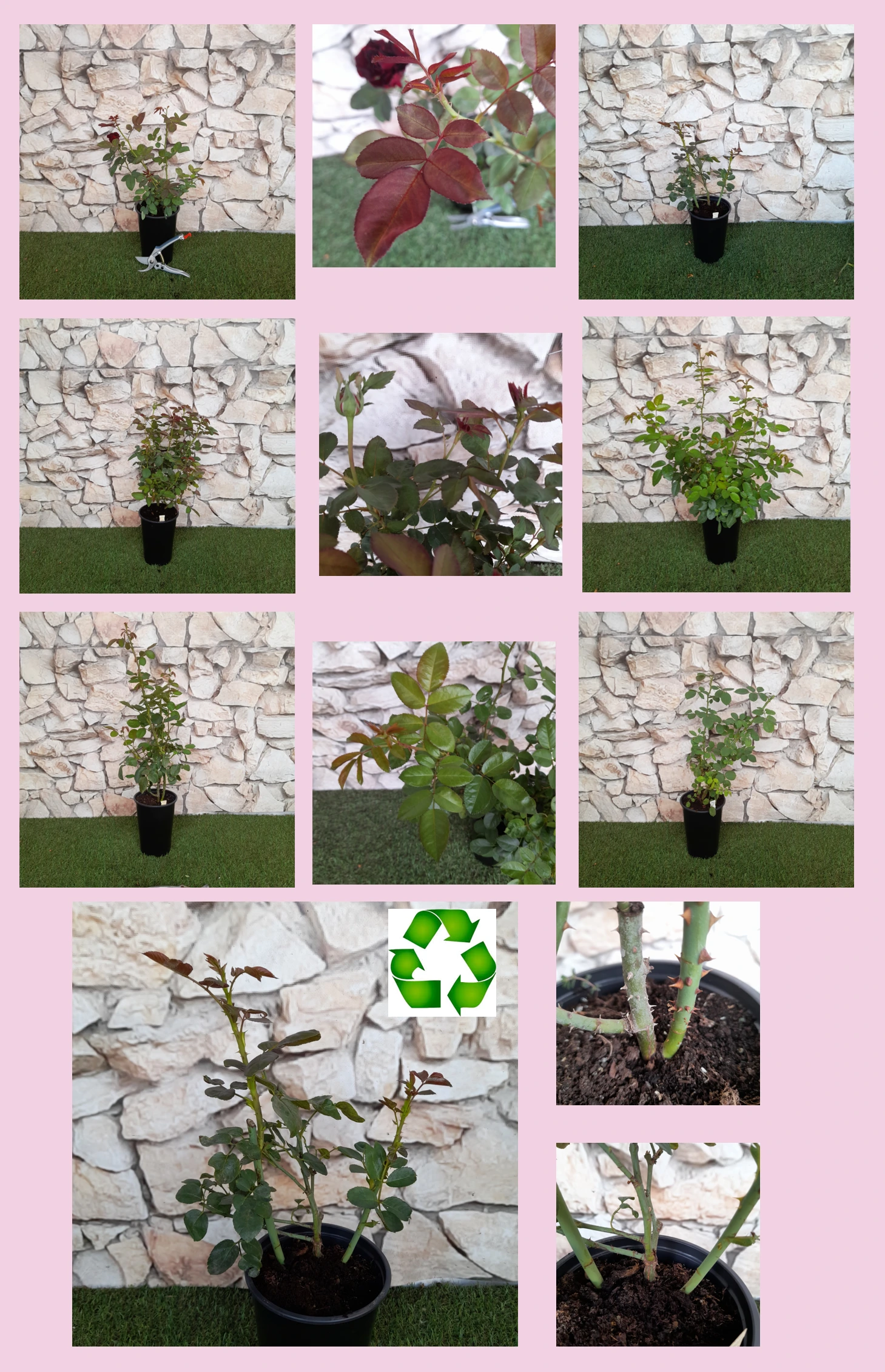
Crop overview: several varieties and growth stages in a short crop section.Shoot system: intensive growth of fresh basal shoots on a young plant.Root system: demonstration of a vigorous root system permeating the growing medium, by removing the pot.Balance: mature plant with root system and shoots in harmony with each other.
Information about the videos
The video series is not a “seasonal showcase”; it illustrates the essence of pharmaROSA® own-root cultivation in a tangible way: how the plant is built up, what the root system is like and how the shoot system regenerates. The recordings were therefore made at different times and with plants at various stages of development, so mixed foliage levels and differing stages of growth may appear in the videos. They are not a ‘sample’ of the batch dispatched, but a visual explanation of how the technology works. The current condition of the rose available to order — typical for the given period and similar to what you can expect to receive in the parcel — is shown in the upper part of the product page.
Pages for private customers Garden roses for the family garden, with minimal care → ORIGINAL® Premium garden roses – instant impact, a truly showpiece garden → EXTRA® Pages for professionals and private customers Roses for public spaces – large areas, sustainable maintenance → NATURAL® Roses for projects – hedge and row planting, fast implementation → RAPID® For professional partners only Production – propagation material for garden roses, wholesale → NEONATAL®
Company details
PharmaRosa Ltd. Company registration number: 01-09-717479 VAT number: 13075314-2-43 Plant health registration no.: HU130721 Bank account (IBAN): HU85117631891388688400000000 BIC (SWIFT): OTPVHUHB Bank name: OTP Bank Nyrt.