Delicate, translucent surface with a pale pink hue and a uniform tone. - floribunda bedding rose - strong, long-lasting scented rose - raspberry, fruity
– Compact, bushy habit for neat bedding displays.
– Richly double, cup-shaped blooms all season.
– Elegant pink flowers fading softly to cream tones.
– Strong, long-lasting raspberry-fruity fragrance.
– Good heat tolerance, suitable for warmer sites.
– Special feature: Award-winning floribunda, honoured at Baden-Baden and Le Roeulx.
Organised composition – Transparent processes
pharmaROSA® ORIGINAL 2-litre own-root potted rose
19,30 £
Unfortunately, we are currently unable to ship to the United Kingdom; we only deliver to countries within the European Union. For more information, please contact us!
3(4350)
ROUSEFRËNN – pink bedding floribunda rose – Żyła
The compact ROUSEFRËNN floribunda builds a neat, low structure that suits front gardens and edging, creating a refined, orderly border without complex pruning. Its double, cup-shaped blooms offer generous, repeat flowering through the season, while the strong, fruity-raspberry fragrance brings classic rose character close to paths and entrances. Dense, mid-green, slightly glossy foliage sets off the softly pink, cream-fading flowers, giving a well-groomed look even in small spaces exposed to breezy, damp British weather. As an own-root rose it develops steadily into a durable, balanced bush, following the natural rhythm of year one for roots, year two for shoots and year three for full effect.
ROUSEFRËNN in the late flowering phase, as the pink tones fade to cream-ivory.
Rousefrënn at full bloom, with soft pink flowers fading to ivory.
ROUSEFRËNN sűrű, közézöld lombfelülete
Usage options
Target area
Reasoning
Front garden edging along paths or drives
The compact 40–60 cm habit creates a low, tidy line that frames paths and driveways without obscuring views from windows or cars. Regular repeat blooming keeps the edge colourful from early summer onwards with minimal shaping for beginners.
Small, formal beds near the house
Dense, mid-green foliage and controlled spread of 50–70 cm allow you to plant in simple geometric beds that remain organised rather than sprawling, echoing neat town front gardens and making upkeep realistic for busy-owners.
Cottage-style mixed borders
The soft baby-pink flowers that fade to cream-ivory blend naturally with phlox, verbena and other cottage perennials, giving a gentle, layered look while the bushy structure fills gaps and reduces the need for complex border planning for aesthetes.
Repeated group planting in beds and parks
Square or hexagonal planting at 4.9–5.7 plants/m² produces an even, rhythmic mass of flower and foliage, ideal where you want a cohesive block of colour that stays manageable over years, even as the own-root plants mature for planners.
Containers on patios, terraces and small courtyards
The compact frame and remontant flowering make it suitable for large containers of at least 40–50 litres, giving long-season scent and colour close to seating areas without dominating tight spaces, ideal when ground beds are limited for urbanites.
Part-shade side gardens and narrow strips
Its tolerance of partial shade lets it flower reliably beside fences or between houses where sun is limited, bringing fragrance and softer colour into awkward, overlooked strips that are hard to design coherently for homeowners.
Heat-exposed, well-drained beds
Good heat tolerance allows planting in sunnier, more sheltered spots that dry quickly, provided irrigation is available in prolonged drought, making it suitable for modern, open plots that experience stronger sun and occasional dry spells for pragmatists.
Long-term, low-fuss family plantings
As an own-root rose it develops a durable framework that can recover well from weather damage or occasional pruning mistakes, supporting long-lived, low-fuss beds in typical family gardens even where winds and damp weather are frequent for families.
Styling ideas
Front-border ribbon – Plant a single, gently curving line along your front path, underplant with low silver foliage like Stachys to highlight the pink-cream blooms – ideal for style-conscious beginners.
Pastel cottage patch – Combine with Phlox paniculata and soft blue nepeta in a small square bed for a relaxed, informal mix that still reads as tidy – for lovers of classic cottage gardens.
Symmetrical entrance pair – Place two 40–50 litre containers either side of the front door, underplanted with white lobelia to emphasise the fragrance as you pass – for urban terrace and townhouse owners.
Low rose hedge – Use closer spacing of about 35 cm to form a low, flowering hedge that subtly separates lawn from drive while remaining easy to trim – for families wanting structure without hard fencing.
Park-style island – Create a small, circular island bed of repeated groups, edging with dwarf box or hebe to give a formal feel scaled to a home garden – for homeowners who enjoy ordered, classical layouts.
Technical cultivar profile
Parameter
Data
Name and registration
Floribunda bedding rose marketed as ROUSEFRËNN – Żyła; bed rose group, ornamental bed and park rose for group planting, current trade name used in consumer garden retail.
Origin and breeding
Bred in Poland in 2014 by Stanisław Żyła, with parentage not recorded; introduced after 2018 by Lens Roses in Belgium, with registration year documented as 2018 for this cultivar.
Awards and recognition
Recognised in European rose trials: Special Prize at Baden-Baden International Rose Competition 2014 and Merit Award at Le Roeulx Rose Competition 2016 for garden performance.
Growth and structural characteristics
Compact, bushy habit 40–60 cm high and 50–70 cm wide, moderately thorny stems, dense mid-green foliage with slight gloss, forming low, cohesive mounds suitable for edging and bedding.
Flower morphology
Double, cup-shaped clusters with 26–39 petals, large-flowered for a bedding rose, producing repeated flushes through the season with plentiful second flowering on well-established plants.
Colour data and phenology
Pale baby-pink buds with raspberry blush open to soft pink centres (RHS 60C/61B), then fade markedly to cream-ivory, giving a delicate, translucent look but relatively poor colour retention in strong sun.
Fragrance and aroma
Strong, long-lasting scent with a distinct raspberry, fruity character; better appreciated at close range in front gardens, near doors, seating areas and paths where air movement carries the perfume.
Hip characteristics
Occasionally forms small, spherical red hips 5–8 mm in diameter; hips are sparse and mainly ornamental, not a dominant feature of the plant’s overall garden effect in most seasons.
Resistance and winter hardiness
Rated RHS H6 and USDA zone 7b, hardy to about −15 to −12 °C; moderate resistance to black spot, powdery mildew and rust, with good heat tolerance if watered in extended dry periods.
Horticultural recommendations
Suited to beds, edging and containers; plant 35–75 cm apart depending on effect, in well-drained soil with regular feeding and occasional disease checks to support sustained flowering.
ROUSEFRËNN offers compact structure, repeat flowering and rich fragrance on a durable own-root framework, making it a thoughtful choice when you want a long-lived, low-fuss rose that simply settles into your garden.
Detailed product attributes
Product Identification Data
Product Name:
ROUSEFRËNN – pink bedding floribunda rose - Żyła
Product Type:
pharmaROSA® ORIGINAL - 2-litre own-root potted rose
Closed Bud:
Pale powder pink with a slight raspberry blush at the tips.
Newly Opened Flower:
The inner petals are a soft baby-pink with a subtle peachy sheen in the centre, while the outer petal whorl lightens to cream-white.
Full Bloom:
Baby-pink in the centre, gradually fading towards the edges to an almost ivory tone.
Before Fading:
The pink fades markedly and mellows to a cream-ivory shade.
Colour Fading Description:
As the bloom opens, the baby‑pink tone gradually fades to a cream–ivory shade and becomes significantly faded by full opening.
Pollinator Attraction:
Because it bears double flowers with 26–39 petals, which conceal the stamens and reduce nectar and pollen accessibility, it is of low attractiveness to pollinating insects.
Pollinator-Friendly Rating:
Its double flowers, with 26–39 petals, attract pollinators only to a limited extent, so it is at best partially pollinator-friendly and primarily an ornamental variety.
Our product is a rose grown with pharmaROSA®’s unique cultivation technology!
2-litre, own-root, potted rose.
With a shoot system appropriate to the season.
With a root system that thoroughly permeates the growing medium.
Quality compliant with the requirements of the E.N.A. (European Nurserystock Association).
Supplied in unique packaging that prevents damage.
Can be planted during frost-free periods.
True-to-variety rose bush with a unique identifier.
The pharmaROSA® own-root potted rose is a well-rooted plant that supports reliable establishment when planted and cared for properly, so it can be planted whenever the soil is not frozen.
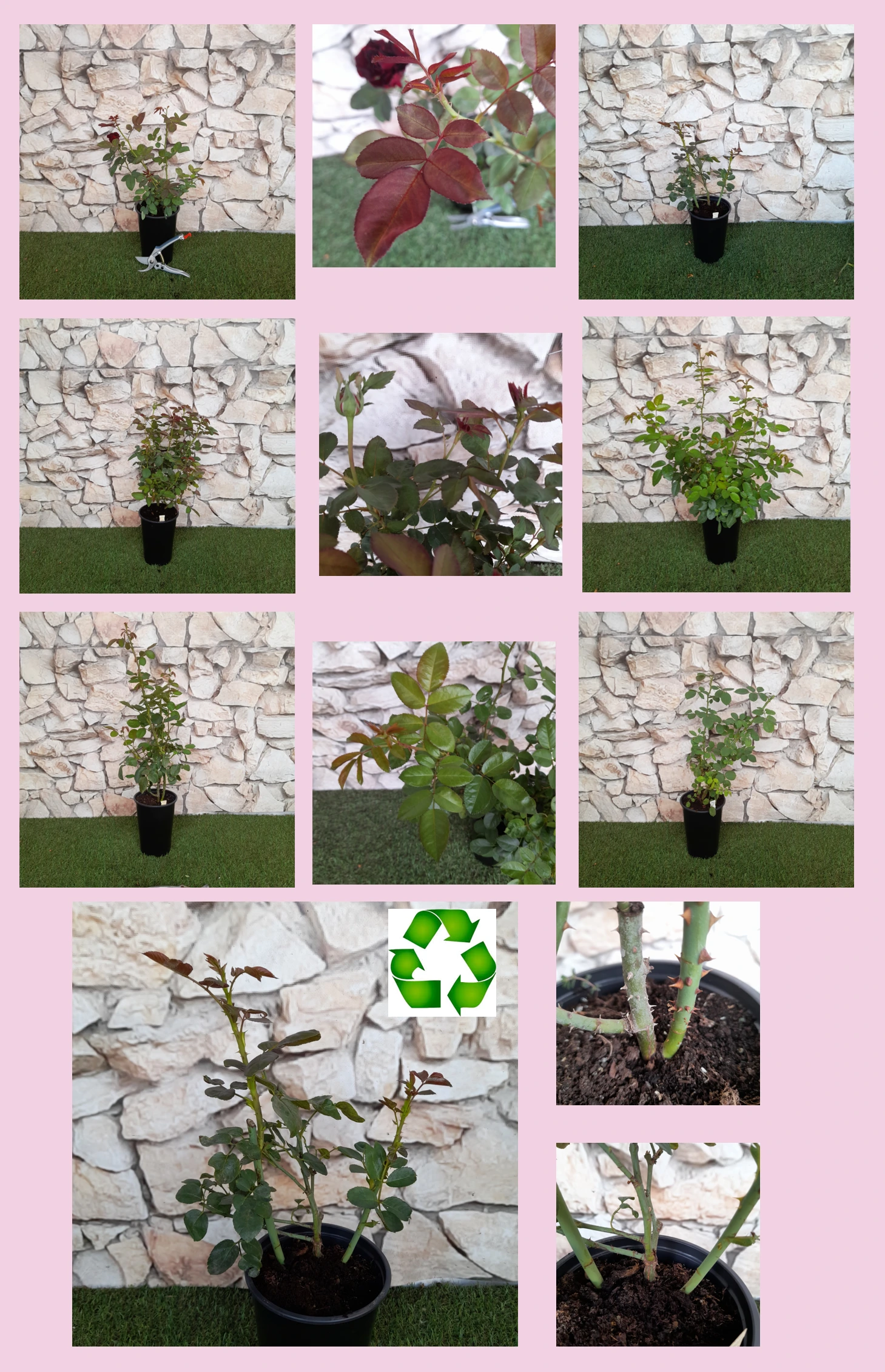
Crop overview: several varieties and growth stages in a short crop section.Shoot system: intensive growth of fresh basal shoots on a young plant.Root system: demonstration of a vigorous root system permeating the growing medium, by removing the pot.Balance: mature plant with root system and shoots in harmony with each other.
Information about the videos
The video series is not a “seasonal showcase”; it illustrates the essence of pharmaROSA® own-root cultivation in a tangible way: how the plant is built up, what the root system is like and how the shoot system regenerates. The recordings were therefore made at different times and with plants at various stages of development, so mixed foliage levels and differing stages of growth may appear in the videos. They are not a ‘sample’ of the batch dispatched, but a visual explanation of how the technology works. The current condition of the rose available to order — typical for the given period and similar to what you can expect to receive in the parcel — is shown in the upper part of the product page.
Pages for private customers Garden roses for the family garden, with minimal care → ORIGINAL® Premium garden roses – instant impact, a truly showpiece garden → EXTRA® Pages for professionals and private customers Roses for public spaces – large areas, sustainable maintenance → NATURAL® Roses for projects – hedge and row planting, fast implementation → RAPID® For professional partners only Production – propagation material for garden roses, wholesale → NEONATAL®
Company details
PharmaRosa Ltd. Company registration number: 01-09-717479 VAT number: 13075314-2-43 Plant health registration no.: HU130721 Bank account (IBAN): HU85117631891388688400000000 BIC (SWIFT): OTPVHUHB Bank name: OTP Bank Nyrt.