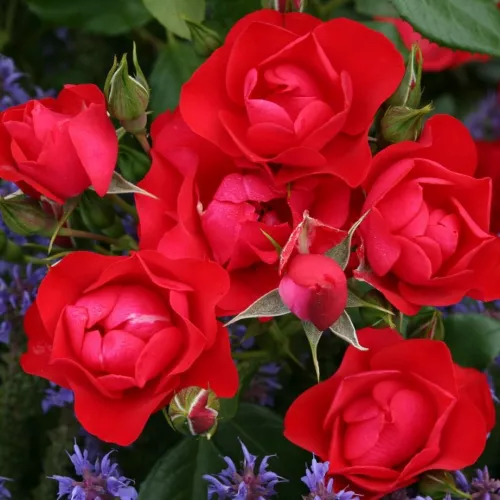
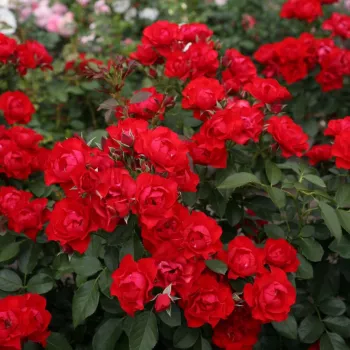
Bright, saturated red shade with no fading. - flower-bed floribunda rose - unscented rose - no noticeable fragrance
– Vivid, saturated red blooms with no fading
– Bushy, upright habit for structured flowerbeds
– Good heat and short-drought tolerance
– Reliable hardiness to around –25 °C
– Award-winning ADR and multiple gold medals
– Special feature: Excellent self-cleaning clusters for long, tidy displays.
Climate-conscious choice – Season-spanning
pharmaROSA® ORIGINAL 2-litre own-root potted rose
18,70 £
Unfortunately, we are currently unable to ship to the United Kingdom; we only deliver to countries within the European Union. For more information, please contact us!
3(4449)
Black Forest Rose® – red floribunda bedding rose
Reliable clusters of vivid red blooms make Black Forest Rose® an easy choice for neat, front‑of‑house beds and borders, where you want colour without demanding upkeep. This compact, bushy floribunda forms a dense, glossy green shrub that keeps its shape well, anchoring small gardens even where strong winds and rain frequently test planting schemes. Self‑cleaning flowers mean most spent blooms drop off naturally, helping the plant stay tidy with only light deadheading. As an own‑root rose, it settles in and matures steadily, giving you a robust structure that bounces back from pruning and winter weather, supporting a genuinely long garden lifespan. The medium‑sized, semi‑double blooms open their stamens to visiting bees, so your flowerbed also feels more alive. The intense red colour hardly fades, ensuring a consistent, impactful display from the first flush through a generous second wave of flowering. In its first year it focuses on roots, the second on stronger shoots, and by the third year it delivers full ornamental value with minimal intervention.
Cup-shaped, semi-double red blooms of Black Forest Rose®.
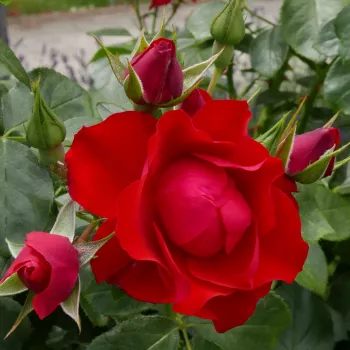
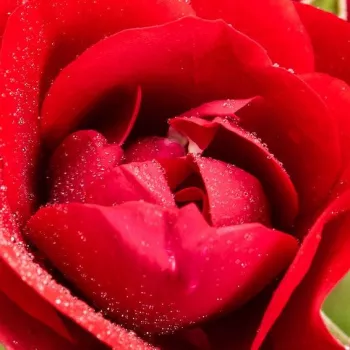
Freshly opened vivid red bloom of Black Forest Rose®.
Usage options
Target area
Reasoning
Front garden bedding near the entrance
The compact, bushy habit and medium height make this rose ideal for low beds flanking a path or doorway, where it provides strong colour without overwhelming the space. Its reliable, long flowering season creates a welcoming look for busy homeowners.
Small family borders around the house
Good self-cleaning and moderate maintenance needs keep borders looking neat between occasional tidy‑ups, even when time is short. The shrub’s natural shape stays orderly, so you can keep borders attractive with flexible, light pruning suited to beginners.
Informal cottage-style mixed plantings
The semi-double blooms offer accessible pollen, supporting bees among perennials such as asters and clematis. This adds movement and life to a classic cottage mix, where you can rely on repeat flowering without complex care, ideal for nature-lovers.
Colour-strong focal groupings (3–5 plants)
Planted in small groups, the even, medium-toned red and excellent colour retention give a bold, unified block of colour that reads clearly from the pavement. The generous second flush extends this effect through summer, appealing to visually focused gardeners.
Low informal hedging along paths or drives
Regular spacing creates a continuous line of bushy, upright plants that frame paths without growing too tall. Own-root development means the hedge thickens reliably over time and recovers well from periodic trimming, suiting long-term‑thinking planners.
Family play-space edges and lawn borders
The dense, glossy foliage and sturdy structure stand up well at the edge of lawns where balls and feet may brush past. Colour stays strong with little fading, so borders remain attractive between weekend gardening sessions, ideal for active families.
Containers and large patio planters
This rose performs well in generous containers of at least 40–50 litres, where its compact frame and self-cleaning habit simplify terrace care. Steady own-root growth helps it adapt to pot conditions, giving dependable structure for time-pressed city-dwellers.
Exposed or wind-affected garden spots
The bushy, well-branched form anchors beds and borders where wind and rain would flatten floppier perennials, helping maintain a tidy outline through unsettled British weather. This resilience reassures less experienced but quality-conscious buyers.
Styling ideas
Cottage-curve border – weave Black Forest Rose® through a curved front border with hardy geraniums and dwarf asters for relaxed colour that still looks orderly – suited to informal-style enthusiasts.
Red-and-green focus – plant a tight group of three roses against dark evergreen shrubs to emphasise the saturated red flowers and glossy foliage – ideal for design-conscious small-garden owners.
Pathway edging – line a garden path with evenly spaced plants, underplanted with creeping thyme to soften the edge while the roses provide long-season structure – perfect for low-maintenance front gardens.
Patio feature pot – use a single plant in a 50-litre container with trailing thyme and seasonal bulbs for year-round interest and easy pruning access – convenient for terrace and balcony gardeners.
Family lawn frame – set a row along the edge of a lawn, alternating with compact perennials, to create a tough, colourful boundary that copes with everyday play – great for busy family households.
Technical cultivar profile
Property
Data
Name and registration
Floribunda bed rose from the RigoRosen® collection; registered as KORschwill and marketed as Black Forest Rose® / Black Forest Rose, exhibition floribunda / bush rose for garden and show use.
Origin and breeding
Bred by Tim-Hermann Kordes at W. Kordes’ Söhne from unnamed seedlings; introduced and registered in 2010 by W. Kordes’ Söhne, continuing the firm’s modern landscape floribunda line.
Awards and recognition
ADR rose (Germany, 2010); 1st prize Baden bei Wien Rose Competition 2010; Gold medals Kortrijk/Courtrai 2011 and 2012; RNRS Trial Ground Certificate UK 2011; honoured at La Tacita, Italy.
Growth and structural characteristics
Bushy, upright floribunda reaching about 65–95 cm high and 55–85 cm wide; moderately thorny stems with dense, glossy dark green foliage that forms a cohesive, ground-covering shrub in beds.
Flower morphology
Medium-sized, semi-double, cup-shaped blooms with around 13–25 petals, borne in clusters. Remontant habit with a plentiful second flush, and good self-cleaning as many spent blooms fall naturally.
Colour data and phenology
Bright, saturated medium red, ARS MR, RHS 46A–46B; colour retention is excellent with minimal fading, moving slightly towards maroon as blooms age. Closed buds are deep scarlet-red, opening to uniform red.
Fragrance and aroma
No noticeable fragrance; classed as unscented. Semi-double form leaves stamens exposed, giving partial pollinator friendliness as bees and other insects can access nectar and pollen with ease.
Hip characteristics
Occasional small spherical hips, about 6–10 mm across, in orange-red RHS 40A tones; overall production is low due to good self-cleaning, so hips are a minor visual element on established plants.
Resistance and winter hardiness
Hardy to about −26 to −23 °C (RHS H7, Swedish zone 4, USDA 5b). Good heat tolerance and coping with short dry spells; black spot and rust resistant, powdery mildew moderate, requiring occasional monitoring.
Horticultural recommendations
Best in full sun with well-drained soil; spacing 50–100 cm depending on use. Suitable for beds, hedging, ground cover and urban plantings; plant 2.8–3.2 plants/m² for dense mass effects in public or private spaces.
Black Forest Rose® offers long-season red colour, tidy self-cleaning clusters and a compact, durable own-root shrub that matures steadily over the years, making it a reassuring choice for easy-going family gardens.
Detailed product attributes
Product Identification Data
Product Name:
BLACK FOREST ROSE® – red bedding floribunda rose - Kordes
Product Type:
pharmaROSA® ORIGINAL - 2-litre own-root potted rose
Competition and Show Awards:
Baden bei Wien Rose Competition – 1st prize (2010); Kortrijk/Courtrai (Belgium) – Gold medal (2011); Kortrijk/Courtrai (Belgium) – Gold medal (2012); RNRS Trial Ground Certificate (United Kingdom) (2011); La Tacita International Rose Competition (Italy) –
Before Fading:
Darker red tone with a burgundy tinge.
Colour Fading Description:
The colour changes very little: during opening it settles to a medium red, becoming slightly maroon before the bloom fades; fading is not typical.
Pollinator Attraction:
Its open, semi‑double blooms with exposed stamens attract pollinating insects because the semi‑double form and accessible stamens make nectar and pollen easy to reach.
Pollinator-Friendly Rating:
Due to its semi-double flowers, it is considered partially pollinator-friendly.
Hip Comment:
Occasionally produced, 6–10 mm diameter, spherical orange-red (RHS 40A) hips; their quantity is expected to be low due to good self-cleaning.
Our product is a rose grown with pharmaROSA®’s unique cultivation technology!
2-litre, own-root, potted rose.
With a shoot system appropriate to the season.
With a root system that thoroughly permeates the growing medium.
Quality compliant with the requirements of the E.N.A. (European Nurserystock Association).
Supplied in unique packaging that prevents damage.
Can be planted during frost-free periods.
True-to-variety rose bush with a unique identifier.
The pharmaROSA® own-root potted rose is a well-rooted plant that supports reliable establishment when planted and cared for properly, so it can be planted whenever the soil is not frozen.
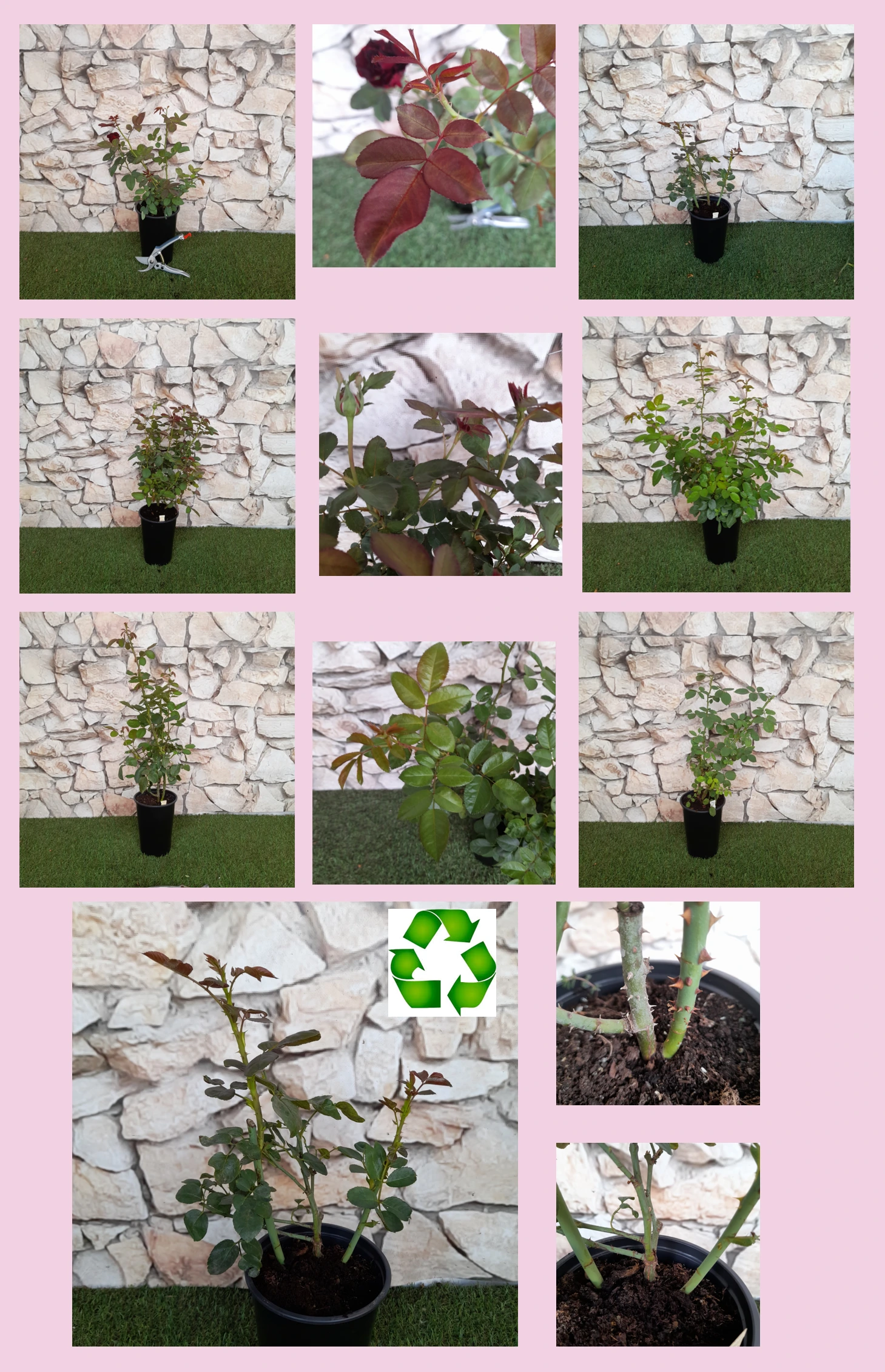
Crop overview: several varieties and growth stages in a short crop section.Shoot system: intensive growth of fresh basal shoots on a young plant.Root system: demonstration of a vigorous root system permeating the growing medium, by removing the pot.Balance: mature plant with root system and shoots in harmony with each other.
Information about the videos
The video series is not a “seasonal showcase”; it illustrates the essence of pharmaROSA® own-root cultivation in a tangible way: how the plant is built up, what the root system is like and how the shoot system regenerates. The recordings were therefore made at different times and with plants at various stages of development, so mixed foliage levels and differing stages of growth may appear in the videos. They are not a ‘sample’ of the batch dispatched, but a visual explanation of how the technology works. The current condition of the rose available to order — typical for the given period and similar to what you can expect to receive in the parcel — is shown in the upper part of the product page.
Pages for private customers Garden roses for the family garden, with minimal care → ORIGINAL® Premium garden roses – instant impact, a truly showpiece garden → EXTRA® Pages for professionals and private customers Roses for public spaces – large areas, sustainable maintenance → NATURAL® Roses for projects – hedge and row planting, fast implementation → RAPID® For professional partners only Production – propagation material for garden roses, wholesale → NEONATAL®
Company details
PharmaRosa Ltd. Company registration number: 01-09-717479 VAT number: 13075314-2-43 Plant health registration no.: HU130721 Bank account (IBAN): HU85117631891388688400000000 BIC (SWIFT): OTPVHUHB Bank name: OTP Bank Nyrt.