BAD BIRNBACH ® – pink bedding floribunda rose - Kordes
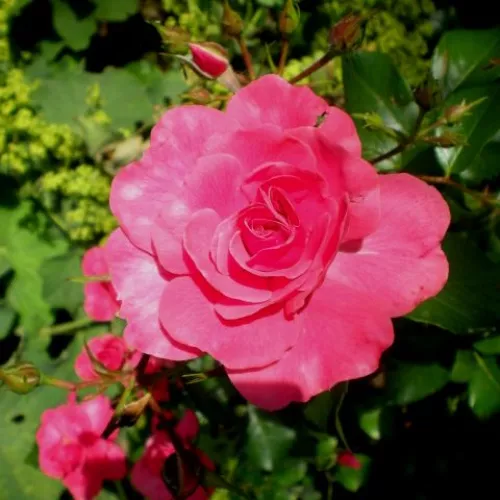
Reliable and gently coloured, Bad Birnbach brings relaxed cottage charm to small British gardens without demanding complex maintenance. Its compact, bushy habit works beautifully in front gardens, edging paths and softening boundaries, creating a low, flowering border that fits neatly into typical family plots. The semi-double blooms appear in generous clusters, repeating steadily through the season so beds never look bare, while the accessible centres offer welcome forage to visiting pollinators. As an own-root rose it develops a naturally balanced framework, maturing year by year into a long-lived, easily managed groundcover that copes well with blustery, rain-laden weather near exposed coasts. With time, the plant’s roots establish, then top growth fills out, and by the third season you can expect its full ornamental impact.
Usage options
| Target area |
Reasoning |
| Front garden beds by the house |
The compact, bushy shape and 40–60 cm height make Bad Birnbach ideal for neat, low front-garden beds that stay within typical boundary heights. Regular clusters of salmon-pink flowers keep entrances looking cared-for with only modest pruning and feeding, giving dependable colour for busy beginners. |
| Low-maintenance groundcover and edging |
Planted at the recommended close spacing, its dense foliage and branching habit knit together into a flowering carpet that suppresses weeds along paths and borders. Own-root growth helps it regenerate from the base after trimming, so the line stays even and attractive over many seasons for time-pressed owners. |
| Small mixed cottage-style borders |
The warm salmon-pink tones blend well with perennials such as daisies and campanulas, giving a soft cottage look without needing elaborate design. Its medium height sits comfortably mid-front of a border and repeat flowering ensures gaps are quickly refilled, suiting style-focused gardeners. |
| Urban and family gardens with partial shade |
This variety tolerates partial shade, so it continues to flower reliably on east- or west-facing plots between houses. The dense, glossy foliage maintains structure even where sunlight hours are limited, helping small city gardens feel lush and finished for courtyard homeowners. |
| Containers and large patio planters |
Its moderate size and rounded habit work well in large containers of at least 40–50 litres, where roots have space to form a stable, own-root plant. Repeating clusters brighten terraces and paved front gardens without needing intricate pruning, an advantage for balcony and patio users. |
| Exposed or coastal-influenced sites |
Bad Birnbach’s sturdy, bushy structure and healthy foliage help it cope with unsettled, wind-driven rain, keeping beds presentable in typical British weather. With correct planting and drainage, the plant anchors and thickens over time, making it suitable for coastal-climate gardeners. |
| Long-term, durable planting schemes |
As an own-root floribunda, this rose develops from a young, well-rooted plant into a durable shrub that can be rejuvenated by pruning without losing its character. Over the years the framework becomes more robust while flowering remains generous, rewarding long-view planners. |
| Wildlife-aware yet orderly plantings |
Semi-double flowers with accessible stamens offer a modest resource for visiting pollinators whilst still giving the tidy, floribunda bedding effect many front gardens need. Occasional hips add seasonal interest without overwhelming the planting, appealing to wildlife-conscious families. |
Styling ideas
- Cottage-Edge Row – line a front path with Bad Birnbach and interplant low daisies for a soft, pastel edging that stays compact and orderly – ideal for small-family front gardens
- Pastel Patch – create a 3–5 plant group in a sunny bed, underplant with airy Verbena bonariensis for height and gentle movement – suited to relaxed cottage-style enthusiasts
- Patio Focus – place one plant in a 50-litre terracotta pot, surround the rim with seasonal bedding for an easy focal point – perfect for balcony and terrace owners
- Neighbour-Friendly Strip – use as a low hedge along driveways, mixing with soft grasses to keep boundaries attractive yet easy to trim – practical for busy homeowners
- Lawn-Island Drift – cluster several plants in a small island bed, backed by bellflowers for contrast and long viewing from windows – good for beginners planning their first feature bed
Technical cultivar profile
| Characteristic |
Data |
| Name and registration |
Floribunda bed rose, registered as KORpancom, marketed as Bad Birnbach ® Kordes’ Klima-Rosen®, exhibition category bedding rose and small groups, ARS name Bad Birnbach. |
| Origin and breeding |
Bred by Reimer Kordes (Germany) in 1983 from ‘Weisse Immensee’ × ‘Bella Rosa’; introduced by W. Kordes’ Söhne in 1999, with German variety protection from 1998. |
| Awards and recognition |
Holder of the ADR award (2000), silver medal in Madrid (1999) and Australian Certificate of Merit (2001), confirming garden performance and decorative value in varied climates. |
| Growth and structural characteristics |
Compact, bushy shrub 40–60 cm high and wide with dense, dark green, glossy foliage and moderate prickles, forming a low, rounded cushion suitable for bedding and edging. |
| Flower morphology |
Semi-double, flat, cluster-flowering blooms of medium size with approximately 13–25 petals, repeating well through the season, with a notably abundant second flush in summer. |
| Colour data and phenology |
Warm salmon-pink flowers (RHS 38C outer, 38D inner) from deeper buds, opening to pastel pink, then gently fading at the edges; colour may lighten in heat and intensify in cooler spells. |
| Fragrance and aroma |
Fragrance is very weak and barely noticeable, making it suitable where strong scent is not desired; visual impact and repeat flowering are the main ornamental features of this variety. |
| Hip characteristics |
Produces a moderate crop of small, spherical red hips 6–10 mm in diameter, adding a light touch of autumn interest without significantly affecting the plant’s neat appearance. |
| Resistance and winter hardiness |
Hardy to approximately -26 to -23 °C (RHS H7, USDA 5b, Swedish Zone 4) with moderate resistance to black spot, powdery mildew and rust under typical garden conditions. |
| Horticultural recommendations |
Best in beds, edging, groundcover and large containers with medium care, regular watering and occasional plant protection; recommended spacing 40–75 cm depending on use and layout. |
Bad Birnbach ® offers compact repeat flowering, adaptable partial-shade performance and long-lived, regenerating own-root growth, making it a thoughtful choice for those planning an easy, dependable rose planting.