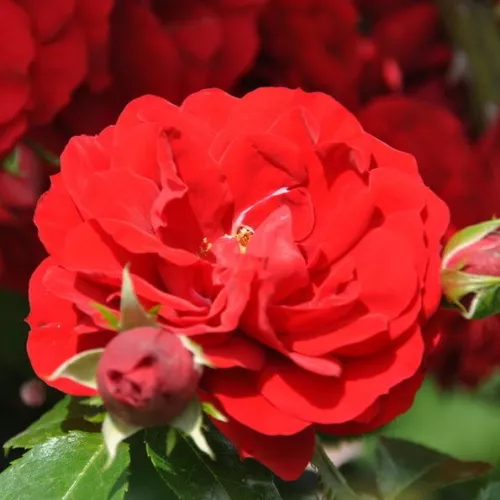
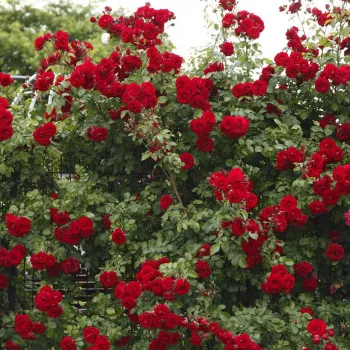
Lustrous deep‑red petals without loss of colour. Their rich tone does not fade even in strong sunlight. - climber, climbing rose - mild, restrained-scented rose - fresh, rose‑scented
– Lustrous deep-red blooms hold colour in sun.
– Abundant remontant flowering in large clusters.
– Vigorous climber for walls and arches.
– Mild, fresh rose fragrance adds charm.
– Good heat and drought tolerance in summer.
– Special feature: Multi-award-winning climber with gold medals from top European rose trials.
Open to feedback – Thinking about the garden’s future
pharmaROSA® ORIGINAL 2-litre own-root potted rose
19,30 £
Unfortunately, we are currently unable to ship to the United Kingdom; we only deliver to countries within the European Union. For more information, please contact us!
4.5(6619)
AMADEUS® – red climbing rose – Kordes
This vigorous own‑root climber has been selected for colour, impact and long‑term structure in real British family gardens, where wind, rain and heavy soil demand reliable performance and good anchoring against the elements. Large, cup‑shaped clusters of scarlet‑red blooms keep their brightness in strong sun, giving arches, walls and pergolas a classic cottage‑garden look right through summer and again in a generous second flush. As the own‑root plant matures, its dense, glossy dark‑green foliage and well‑branched framework create a lasting feature that can be pruned either hard or lightly, depending on how formal or relaxed you want the display. With sensible feeding, watering and simple training, it settles in steadily – roots in the first year, then strong new shoots in the second, building to full ornamental value by the third – rewarding your initial patience with a tall, richly flowering companion for decades of garden enjoyment.
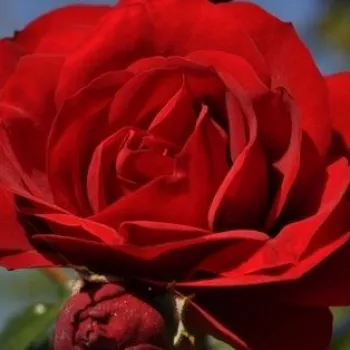
Freshly opened, cup-shaped blooms of Amadeus®
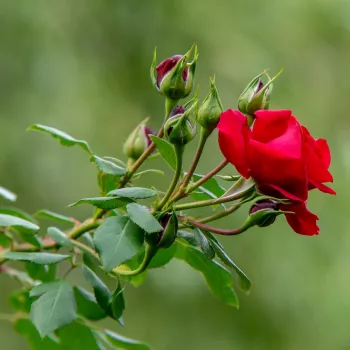
Amadeus® climbing rose in full bloom
Usage options
Target area
Reasoning
Front‑of‑house rose arch or gateway
The strong climbing habit and dense branching make this rose ideal for training over a rose arch or entrance structure, creating a tall, welcoming tunnel of red blooms that reads beautifully from the street for classic kerbside appeal – rewarding for the visually minded beginner.
South‑ or west‑facing house wall
With a height of 2.4–3.8 m, this variety clothes a wall quickly, using its glossy foliage and large clusters of flowers to soften brick or render without overwhelming smaller plots, especially where a warm wall helps ripen growth – well suited to the time‑pressed homeowner.
Pergola or seating‑area frame
Its vigorous, trainable canes and repeat flowering allow you to weave stems along beams and uprights, giving a shaded seating area framed with red blooms that hold their colour even in high summer, extending evening enjoyment for the comfort‑seeking gardener.
Small group planting on a boundary
Planted at hedging distance, a short run of plants creates a flowering screen where the combination of dense leafage and repeat clusters delivers both privacy and long‑season interest, maturing steadily over successive years for the planning‑oriented buyer.
Urban courtyard or side‑return trellis
The rose tolerates partial shade and copes with radiated heat from paving and brick, so it can brighten narrow side paths or courtyard trellises with vertical colour where horizontal space is scarce, a practical solution for the busy town‑dweller.
Cottage‑style mixed border backdrop
Trained on discrete supports at the back of a border, the rich red flowers and dark, healthy foliage form a strong vertical accent behind perennials and shrubs, echoing traditional cottage gardens while remaining manageable for the style‑conscious novice.
Informal country‑style boundary or screen
With good winter hardiness and reliable cane growth, this climber is well suited to exposed or semi‑rural sites, where once anchored it copes reliably with wind and rain in heavier soils, offering long‑term structure for the future‑focused owner.
Larger container with obelisk or column
In a 40–50 litre or larger pot, provided watering and feeding are consistent, this rose can be grown up an obelisk to provide height and drama on patios or by doors, extending its use where in‑ground planting is limited, appealing to the space‑conscious gardener.
Styling ideas
Cottage Arch – Train over a simple metal or wooden arch and underplant with Geranium macrorrhizum to soften the base and suppress weeds – ideal for lovers of relaxed, romantic entrances.
Formal Facade – Tie stems to a fan pattern on a sunny wall, spacing canes neatly and underplanting with low Euonymus japonicus ‘Microphyllus’ for a crisp evergreen line – for those favouring ordered structure.
Pergola Retreat – Cover a small pergola, pairing its red flowers with white or pale pink climbers for contrast and using fragrant herbs in pots beneath – suited to evening sit‑out spaces.
Country Screen – Run along a post‑and‑wire boundary with Potentilla and cottage perennials in front for a soft, layered hedge that works from house and lane side – good for village and edge‑of‑town gardens.
Patio Column – Grow in a large 50‑litre container with a sturdy obelisk, combining with seasonal bedding at the base for colour right to the doorstep – perfect for compact urban patios.
Technical cultivar profile
Parameter
Data
Name and registration
Large‑flowered climbing rose from the Klettermaxe collection; registered as KORlabriax, traded as Amadeus® / Klettermaxe®, with Amadeus™ as the approved ARS exhibition name.
Origin and breeding
Bred by W. Kordes III in Germany (2003) and introduced by W. Kordes’ Söhne in 2007; parentage is unrecorded, typical of modern exhibition‑quality red climbers.
Awards and recognition
Highly decorated in European rose trials, with gold medals at The Hague and Geneva (2004), Lyon (2005) and a Certificate of Merit from Bagatelle, Paris, confirming ornamental performance.
Growth and structural characteristics
Strong climbing habit, about 2.4–3.8 m high and 0.9–1.6 m spread; moderately thorny canes with dense, glossy dark‑green foliage, forming a well‑leafed framework when trained on support.
Flower morphology
Semi‑double, cup‑shaped blooms with 13–25 petals, produced in clusters; large flower size (around 7–10 cm), with remontant, abundant repeat flush following the main summer display.
Colour data and phenology
Rich, lustrous deep red (RHS 53A/46A) from velvety ruby buds to full bloom; colour darkens slightly as flowers age yet resists fading or bluing even in strong sunlight and prolonged warmth.
Fragrance and aroma
Mild, fresh rose scent, noticeable at close range without dominating sitting areas; semi‑double form allows moderate bee access, adding some pollinator interest alongside ornamental value.
Hip characteristics
Forms moderate numbers of small, spherical hips about 9–15 mm across, coloured orange‑red (RHS 40A), which can add late‑season texture if not all spent blooms are removed.
Resistance and winter hardiness
Very hardy to around –26 to –23 °C (RHS H7, USDA 5b); tolerates heat if watered, but is disease‑sensitive, especially to powdery mildew, so benefits from preventative care and monitoring.
Horticultural recommendations
Best on well‑drained soil with sun or light shade; ideal for walls, arches and pergolas in home gardens, with regular feeding, watering and appropriate plant protection to maintain vigour and foliage quality.
AMADEUS® offers vivid red colour, strong vertical impact and dependable long-term structure on its own roots, making it a thoughtful choice for gardeners planning a lasting, characterful feature.
Detailed product attributes
Product Identification Data
Product Name:
AMADEUS® – red climbing rose - Kordes
Product Type:
pharmaROSA® ORIGINAL - 2-litre own-root potted rose
Competition and Show Awards:
Gold medal – Hague International Rose Trials (2004); Gold medal – Geneva International Rose Trials (2004); Gold medal – Lyon International Rose Trials (2005); Bagatelle (Paris) – Certificate of Merit (2004)
Our product is a rose grown with pharmaROSA®’s unique cultivation technology!
2-litre, own-root, potted rose.
With a shoot system appropriate to the season.
With a root system that thoroughly permeates the growing medium.
Quality compliant with the requirements of the E.N.A. (European Nurserystock Association).
Supplied in unique packaging that prevents damage.
Can be planted during frost-free periods.
True-to-variety rose bush with a unique identifier.
The pharmaROSA® own-root potted rose is a well-rooted plant that supports reliable establishment when planted and cared for properly, so it can be planted whenever the soil is not frozen.
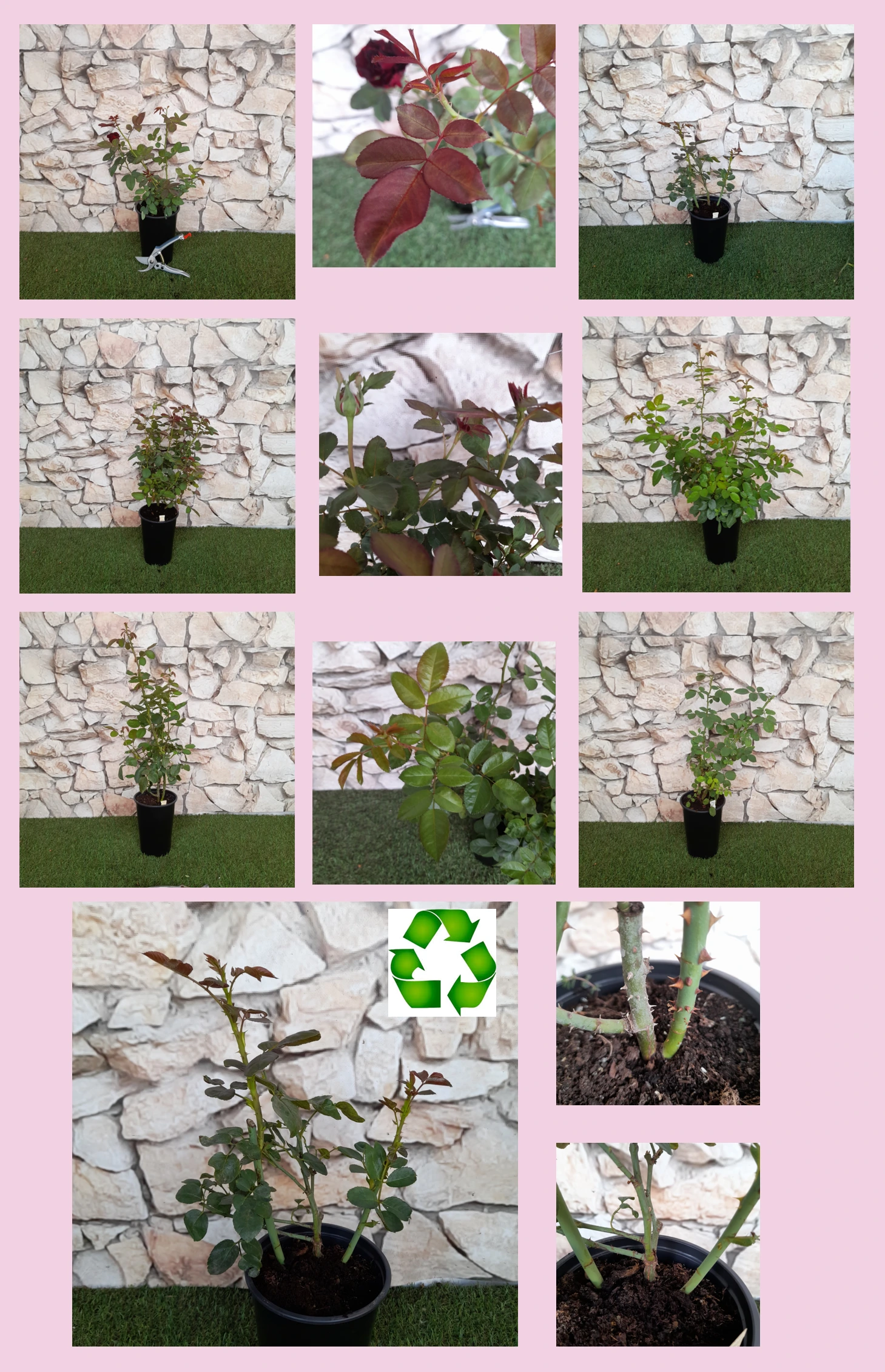
Crop overview: several varieties and growth stages in a short crop section.Shoot system: intensive growth of fresh basal shoots on a young plant.Root system: demonstration of a vigorous root system permeating the growing medium, by removing the pot.Balance: mature plant with root system and shoots in harmony with each other.
Information about the videos
The video series is not a “seasonal showcase”; it illustrates the essence of pharmaROSA® own-root cultivation in a tangible way: how the plant is built up, what the root system is like and how the shoot system regenerates. The recordings were therefore made at different times and with plants at various stages of development, so mixed foliage levels and differing stages of growth may appear in the videos. They are not a ‘sample’ of the batch dispatched, but a visual explanation of how the technology works. The current condition of the rose available to order — typical for the given period and similar to what you can expect to receive in the parcel — is shown in the upper part of the product page.
Pages for private customers Garden roses for the family garden, with minimal care → ORIGINAL® Premium garden roses – instant impact, a truly showpiece garden → EXTRA® Pages for professionals and private customers Roses for public spaces – large areas, sustainable maintenance → NATURAL® Roses for projects – hedge and row planting, fast implementation → RAPID® For professional partners only Production – propagation material for garden roses, wholesale → NEONATAL®
Company details
PharmaRosa Ltd. Company registration number: 01-09-717479 VAT number: 13075314-2-43 Plant health registration no.: HU130721 Bank account (IBAN): HU85117631891388688400000000 BIC (SWIFT): OTPVHUHB Bank name: OTP Bank Nyrt.